[Intelligent lightning protection platform] Why do alarm classification and work order closed loop determine whether the system is truly useful?
Abstract: After many intelligent lightning protection systems go online, the platform page looks very rich, including equipment online status, SPD alarms, lightning strike records, grounding data, and various reports. But what really determines whether the system is valuable is not the amount of data, but whether the platform can determine which alarms are more important, which points need priority processing, whether there is someone to review after the alarm, and whether the processing results are recorded. The core capability of the intelligent lightning protection platform is to turn data into risk judgments, and then turn risk judgments into operation and maintenance actions.
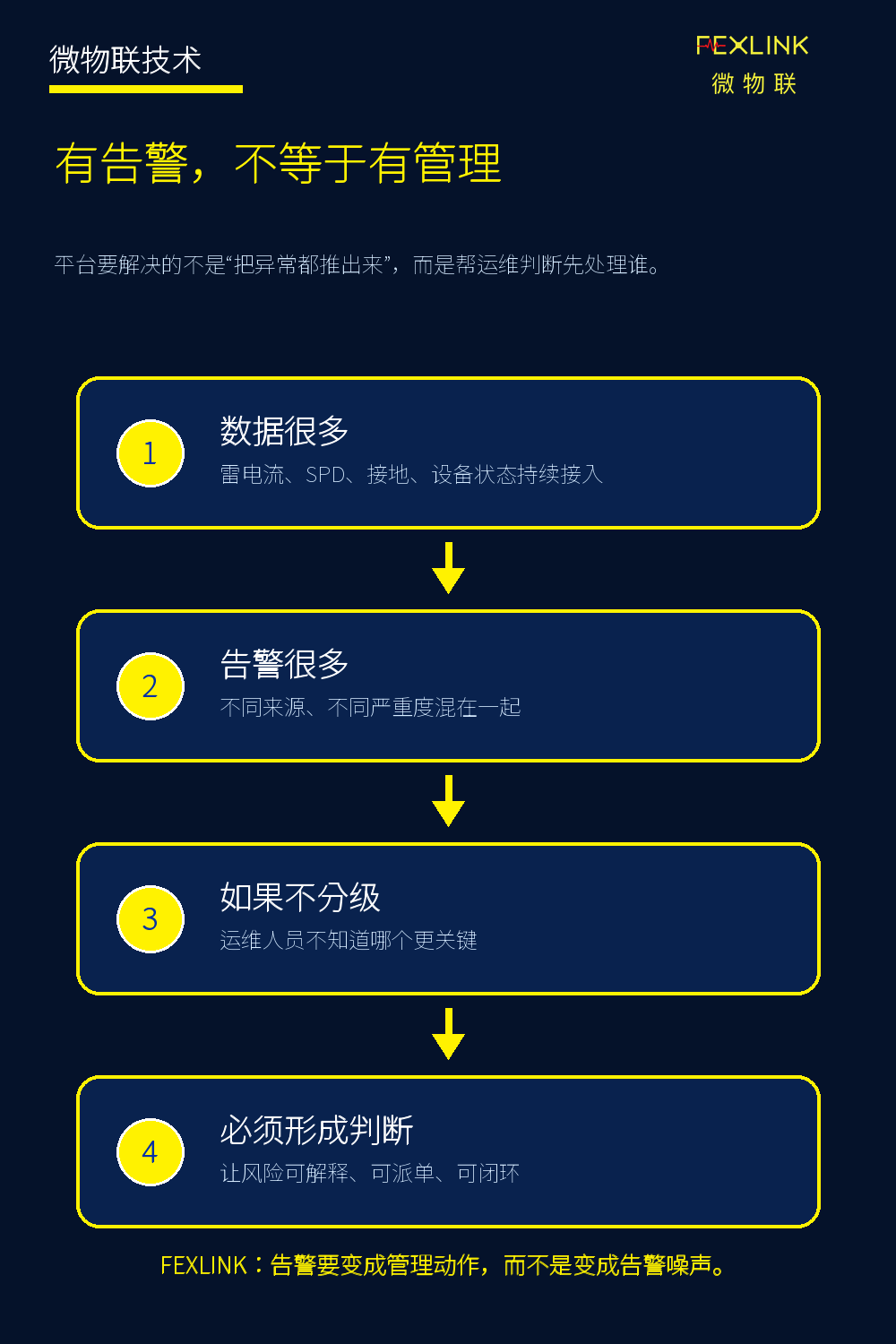
After many projects build intelligent lightning protection systems, a large number of statuses and alarms will appear on the platform: a certain SPD remote signaling anomaly, a certain grounding point trend increases, a surge event occurs at a certain site, a certain terminal goes offline, and a certain device generates a communication alarm.
On the surface, the system is "smart" because it sees a lot of data. But when we actually go to the operation and maintenance site, the question often becomes: With so many alarms, which one is the most serious? Which one needs to be dealt with immediately? Which one can be observed? Which one might be a false positive? Which one is related to the lightning strike incident? Has there been any recovery after the treatment?
If the platform cannot answer these questions, any number of alerts will turn into noise. Having data does not mean that there is judgment; having alarms does not mean that there is management; having a platform does not mean that there is a closed loop.
1. Why does “having alarms” not mean “having management”?
The most feared situation of the intelligent lightning protection platform is not that there are no alarms, but that there are too many alarms with unclear levels and unknown reasons. If terminals are temporarily offline, SPD remote signaling anomalies, grounding value fluctuations, lightning strike event records, communication timeouts, and equipment status abnormalities are all prompted in the same way, the platform will soon change from "helping to judge" to "creating pressure."
There was no explanation for the alarm, and it was difficult to take action on site. A simple "abnormality" can only remind engineers that there is a problem, but it cannot tell engineers what type of data the abnormality comes from, whether the risk is ongoing, whether it is related to lightning strikes, and whether observation, review, or dispatch is required.
If alarms have no priority, operation and maintenance resources cannot be allocated reasonably. It is impossible to process all points at the same time along a highway, photovoltaic power station, wind farm, communication base station group or petrochemical tank farm. The platform must answer: which one to process first, why to process it first, and how to confirm recovery after processing.
2. How should intelligent lightning protection alarms be classified?
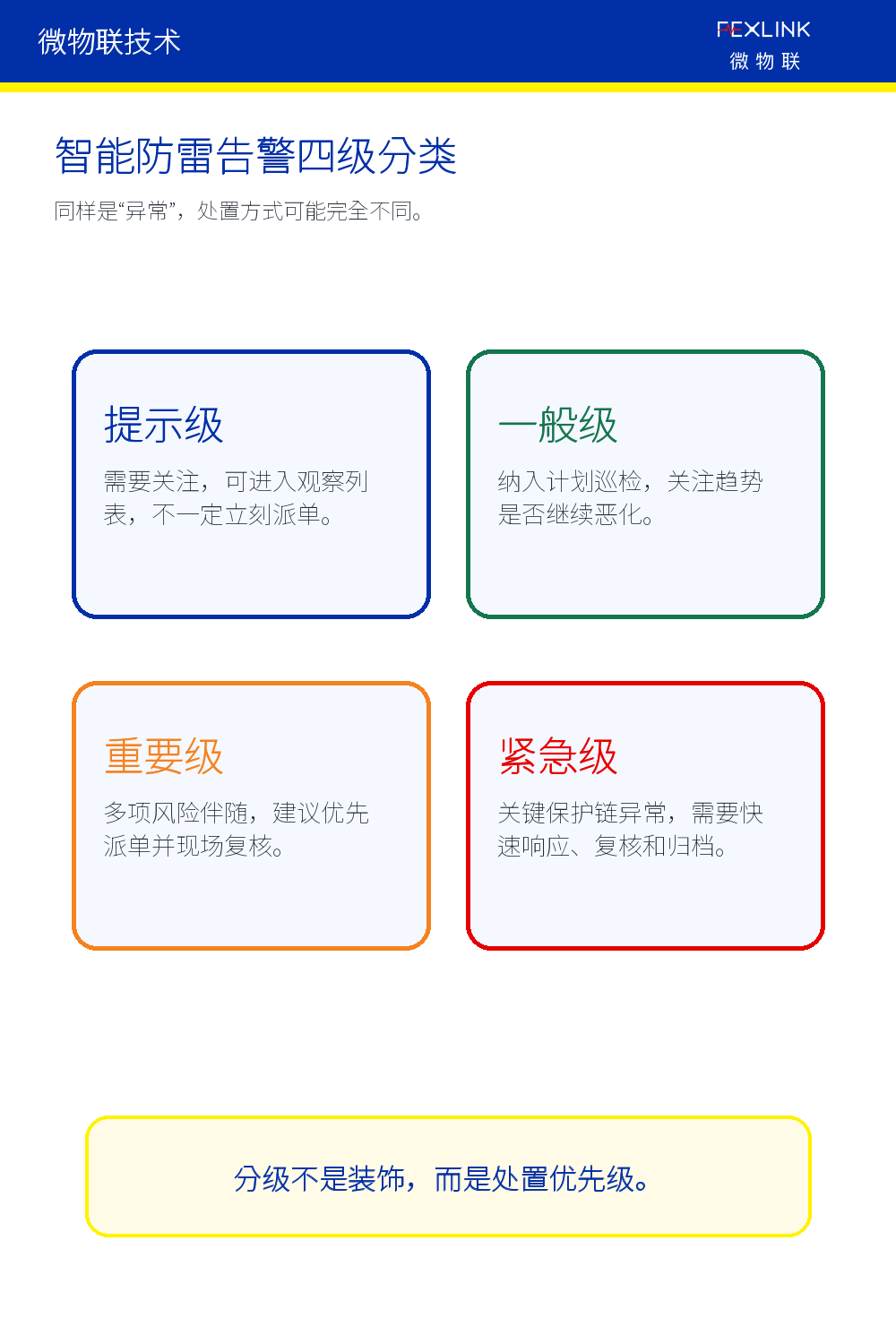
Intelligent lightning protection alarms can be divided into four levels according to operational impact and handling urgency: prompt level, general level, important level and emergency level. The significance of grading is not to make the interface more complex, but to make operation and maintenance actions clearer.
The prompt level is usually used when the terminal recovers after being offline for a short period of time, the grounding value fluctuates slightly, and a single low-intensity surge event occurs. This type of alarm requires attention, but it does not necessarily require immediate dispatch of orders. It is more suitable to enter the watch list.
The general level is suitable for problems such as abnormal continuous trends, increased frequency of ordinary surges, and decreased equipment online rates, which need to be included in planned inspections. The important level usually means that there is a correlation between lightning strike events, SPD status changes, sudden grounding changes, or equipment alarms. It is not appropriate to just observe, but to form a work order. The emergency level corresponds to SPD tripping after a strong lightning strike, grounding anomaly superimposed on equipment failure, protection chain anomalies in key scenarios, etc., which requires rapid response, review and archiving.
3. Alarm classification cannot rely solely on one threshold
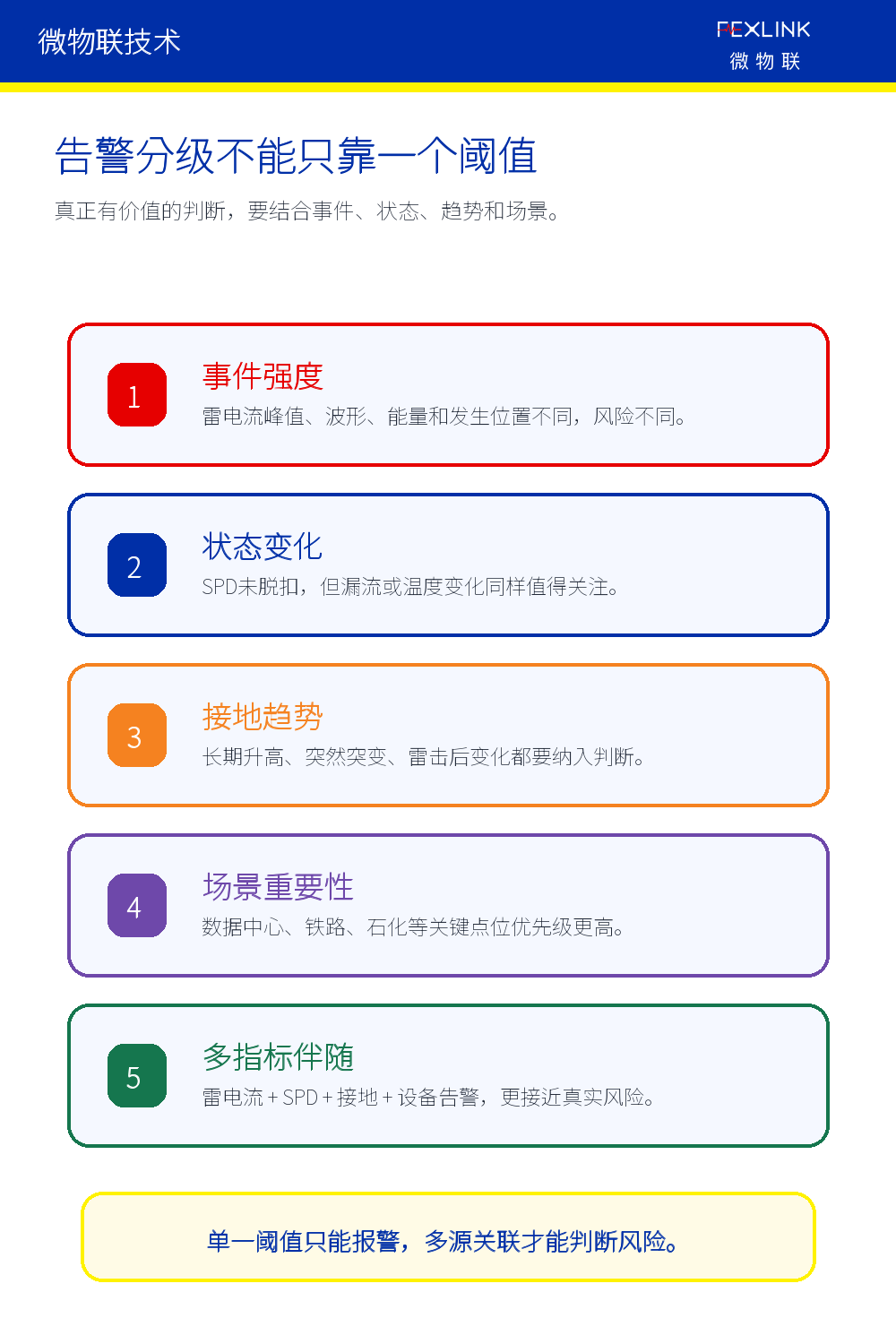
It is easy for traditional platforms to make alarms as "if the threshold is exceeded, it will alarm, and if it is below the threshold, it will be normal." But intelligent lightning protection cannot be so simple. Lightning strikes, surges, SPD degradation, grounding status changes and equipment abnormalities are themselves the result of multiple factors.
For the same lightning strike event, the risks of low-intensity surges and high-intensity lightning current events are completely different. The same SPD does not trip, but if the leakage current increases after a lightning strike, the temperature is abnormal, or the life trend decreases, the risk level will be different.
The same is true for changes in grounding values. If the change occurs after a thunderstorm, appears at a key point, and is accompanied by equipment alarms, the processing priority should also be increased. The most valuable alarms are not single-point anomalies, but combined anomalies: lightning current events, SPD status changes, grounding mutations, and equipment alarms appear on the same timeline at the same time.
4. From alarm to work order, how should we close the loop?
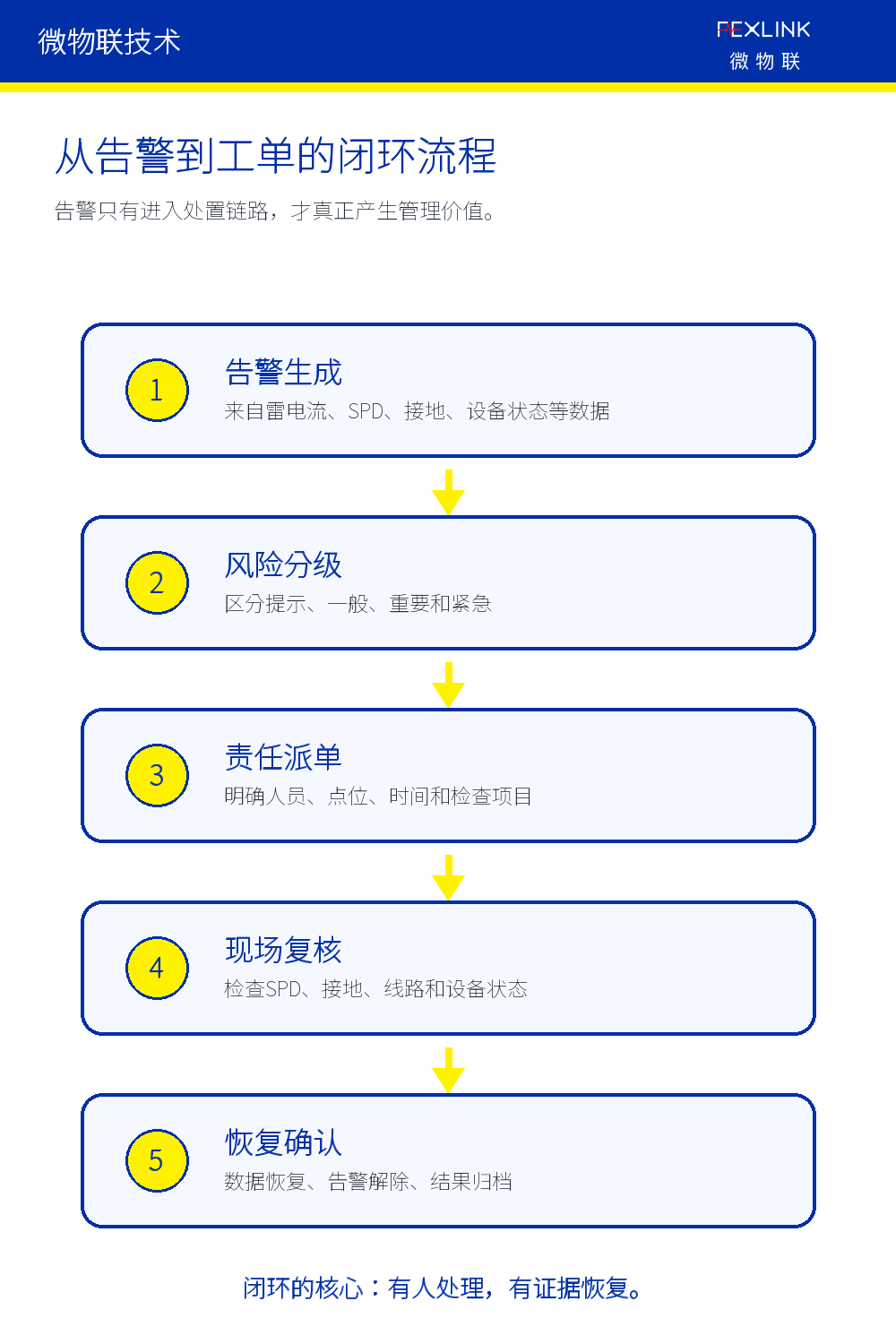
A complete intelligent lightning protection closed loop should include alarm generation, risk classification, responsibility dispatch, on-site review, disposal records, recovery confirmation, event archiving and trend analysis. This process does not seem complicated, but it determines whether the platform is a "display system" or an "operation and maintenance system."
Dispatching an order is not simply sending a message, but rather explaining who will handle it, when it will be handled, which point to go to, which equipment to check, whether spare parts need to be brought, and whether shutdown or power outage is required. The on-site review should not only look at the alarm point itself, but also check the SPD status, backup protection, ground connection, communication lines, water in the box, loose terminals, ablation marks and equipment operating status.
After the disposal is completed, the platform should also confirm whether the alarm has been lifted, whether the data has returned to normal, and whether replacement, retesting, photography and notes are complete. Only by forming records can there be a basis for subsequent review, audit, insurance, rectification and life assessment.
5. What results should the intelligent lightning protection platform output?
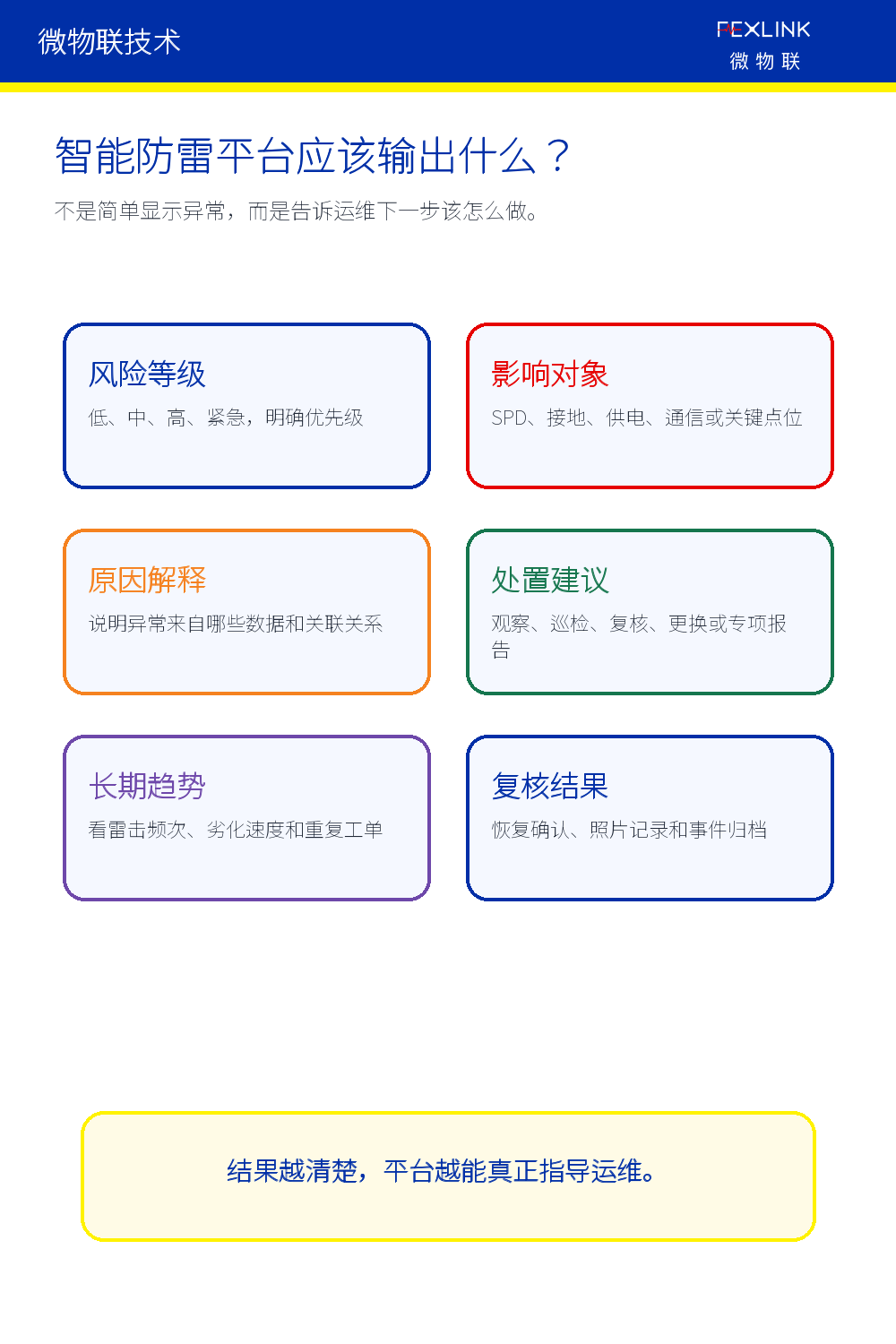
The platform cannot just output "normal" or "abnormal". A truly valuable platform should output risk levels, affected objects, explanations of causes, disposal suggestions, long-term trends and review results.
For example, the platform should not only prompt "SPD abnormality", but should further explain: the site experienced a high-intensity lightning current event during thunderstorms, and then the SPD leakage current increased, the grounding state suddenly changed, and the communication alarm time with the equipment was close. It is recommended to give priority to on-site review. This explanation is closer to the judgment really needed on the engineering site than a single alarm.
In the long run, the platform should also tell managers which sites have frequent lightning strikes, which SPDs deteriorate quickly, which grounding points are unstable for a long time, which work orders appear repeatedly, and which areas require systematic rectification.
6. How does multi-source data form risk judgments?
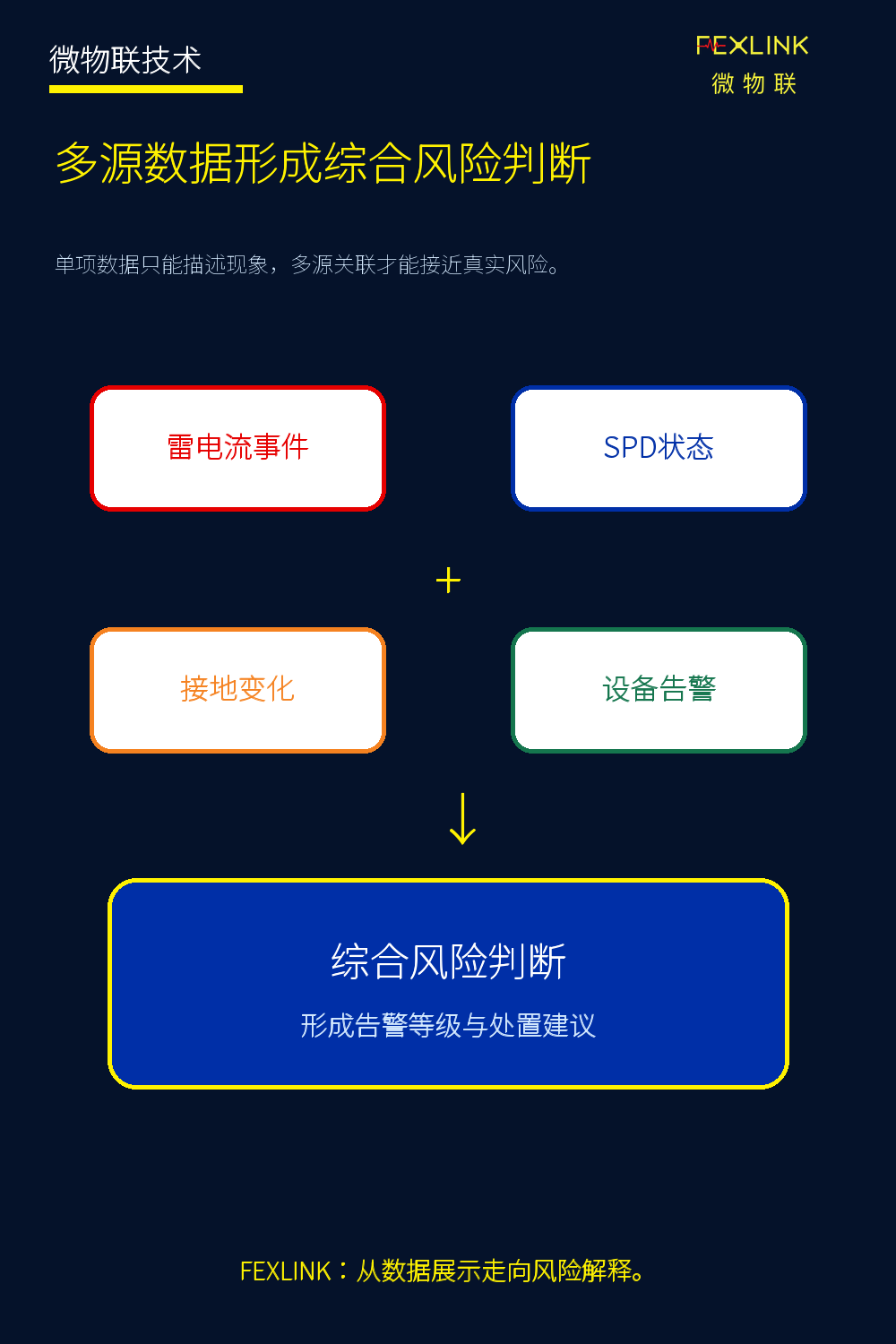
The key to an intelligent lightning protection platform is not to display each type of data in isolation, but to identify the relationship between data. The lightning current event indicates "what impact occurred", the SPD status indicates "whether the protective device has changed", the grounding status indicates "whether the discharge path is reliable", and the equipment alarm indicates "whether the business equipment is affected".
If these data change at the same time near the same timeline, the platform should not treat them as four independent alarms, but should identify them as a risk chain. This kind of judgment is what distinguishes the intelligent lightning protection platform from ordinary monitoring platforms.
7. How does FEXLINK understand the intelligent lightning protection platform?
MicroIoT believes that the intelligent lightning protection platform is not a software interface that “connects equipment to display status”, but a system that converts on-site lightning protection data into risk judgment and operation and maintenance actions.
It needs to complete three transformations: from data display to risk explanation, from alarm push to hierarchical processing, and from single maintenance to long-term risk files. The FEXLINK digital lightning protection system focuses not only on individual data such as lightning current, SPD, and grounding, but also on the relationship between these data.
Only by putting event data, status data, trend data and work order data together can the platform truly answer: Where are the risks? Why is it risky? Do you want to deal with it? Who will handle it? Will it be restored after processing?
Conclusion: The platform is not for displaying data, but for reducing risks
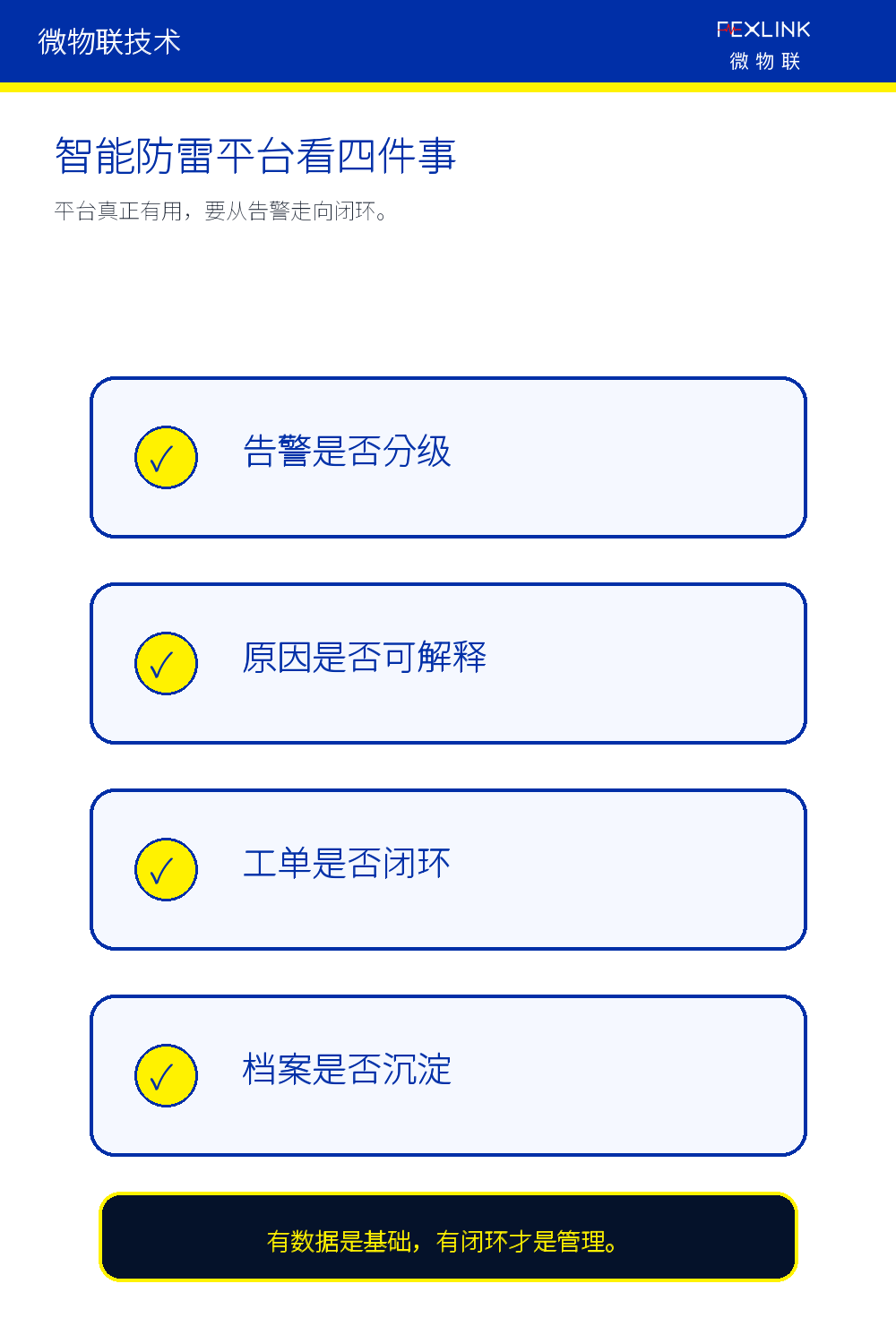
The real value of the intelligent lightning protection platform is not that the more alarms the better, nor that the more complex the page the better. A truly valuable platform should allow important risks to be seen first, allow exception causes to be explained, operation and maintenance actions to be closed loop, and historical events to be deposited into long-term risk files.
The lightning protection system is ultimately not to "display data", but to guide maintenance, reduce risks, and support management. Only when alarms can be classified, causes can be explained, work orders can be closed-looped, and events can be archived, can the intelligent lightning protection platform truly move from "device online" to "risk online".
FEXLINK technology will continue to share content related to intelligent lightning protection, early warning of electrical safety, digital power distribution, energy supervision and industrial Internet of Things.
FEXLINK/FEXLINK uses data to reconstruct energy efficiency and electrical safety.
Where there is electricity, there is FEXLINK.