Abstract: Arc faults do not necessarily appear as large currents, nor do they necessarily trigger traditional protection immediately. Series arcs, poor contact arcs and insulation damage arcs often have the characteristics of intermittent, waveform distortion, high-frequency components and continuous repetition, so multi-dimensional feature recognition and scene filtering are required.
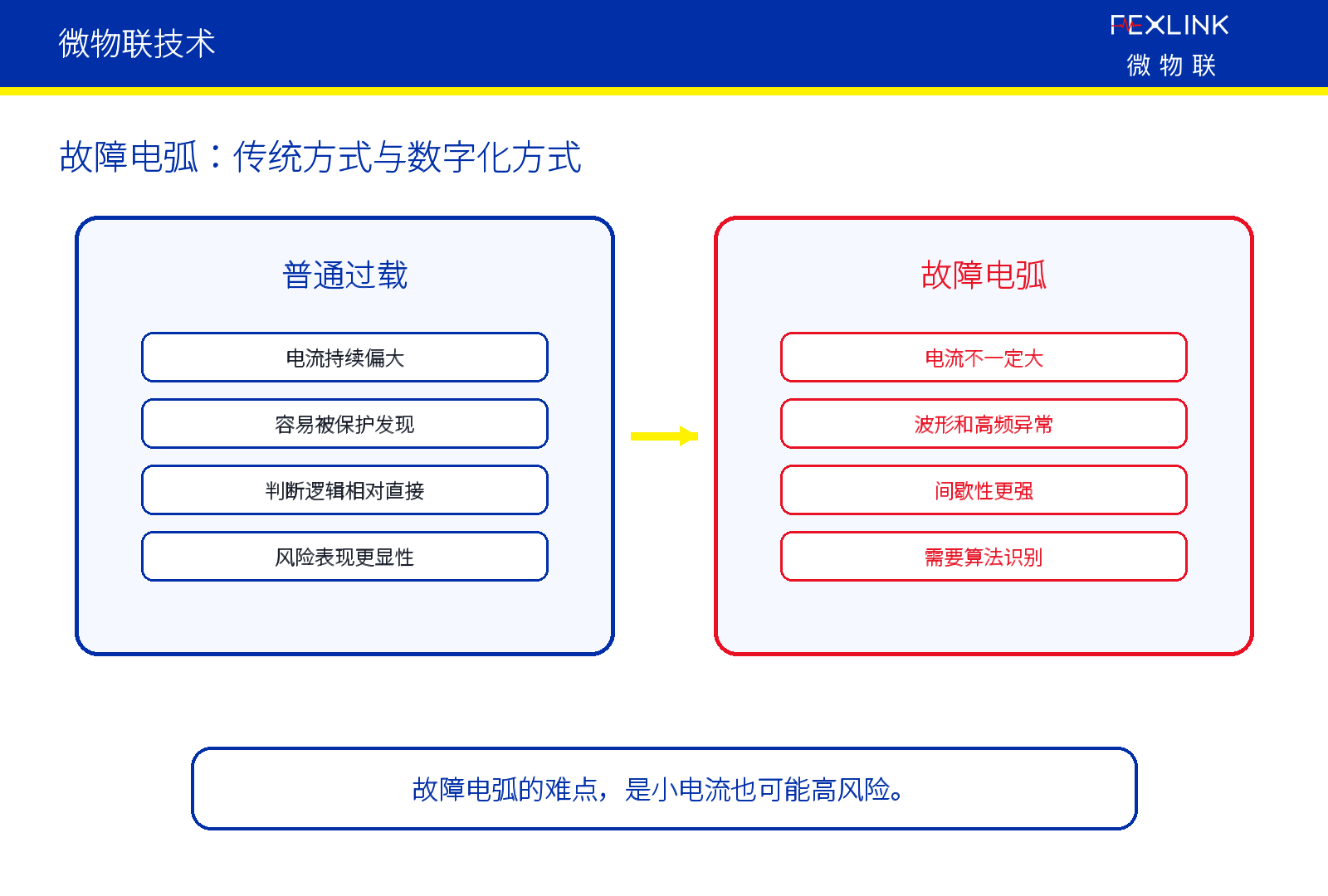
Overload is usually relatively easy to understand: the current exceeds the allowable range, the protective device operates, and the lines and equipment are protected. But arc faults are more subtle, because arcs don't always bring noticeable high currents.
As in many fire hazards, the danger of arc risk lies not in the size of the current, but in the high localized temperatures and energy concentration that occur repeatedly and do not necessarily trigger traditional overload protection.

1. What is arc fault?
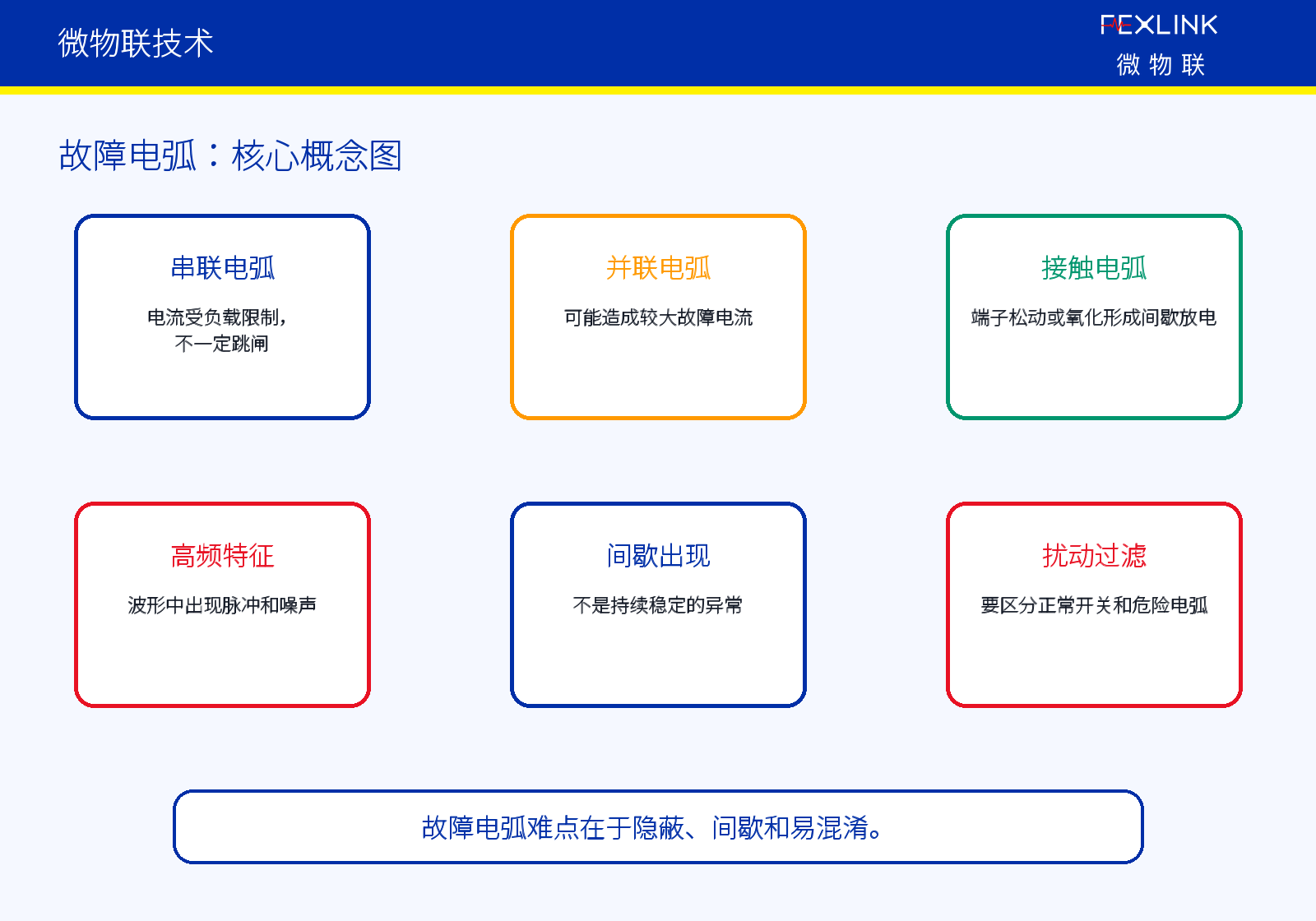
Arc faults usually include arcs caused by series arcs, parallel arcs, poor contact arcs and insulation damage. Series arcs may occur in loose terminals, broken wires, poor contact in plugs and sockets, etc. Parallel arcs may result from damaged insulation and abnormal discharges between conductors.
These arcs may produce high temperatures, sparks and local carbonization, gradually increasing the risk. Their common feature is that they are not necessarily stable, persistent or obvious in the early stages.
2. Why traditional protection may not detect
Traditional circuit breakers are better at handling short circuits and overloads. If the arc fault current does not exceed the operating threshold, the protective device may not operate. Especially for series arcs, the current is limited by the load and is not necessarily much larger than the normal operating current.
Therefore, it cannot be simply assumed that "without tripping, there is no arc risk." Arc hazards may exist in the form of intermittent pulses or abnormal waveforms for a long time before the protective device operates.
3. What are the early characteristics of arc?
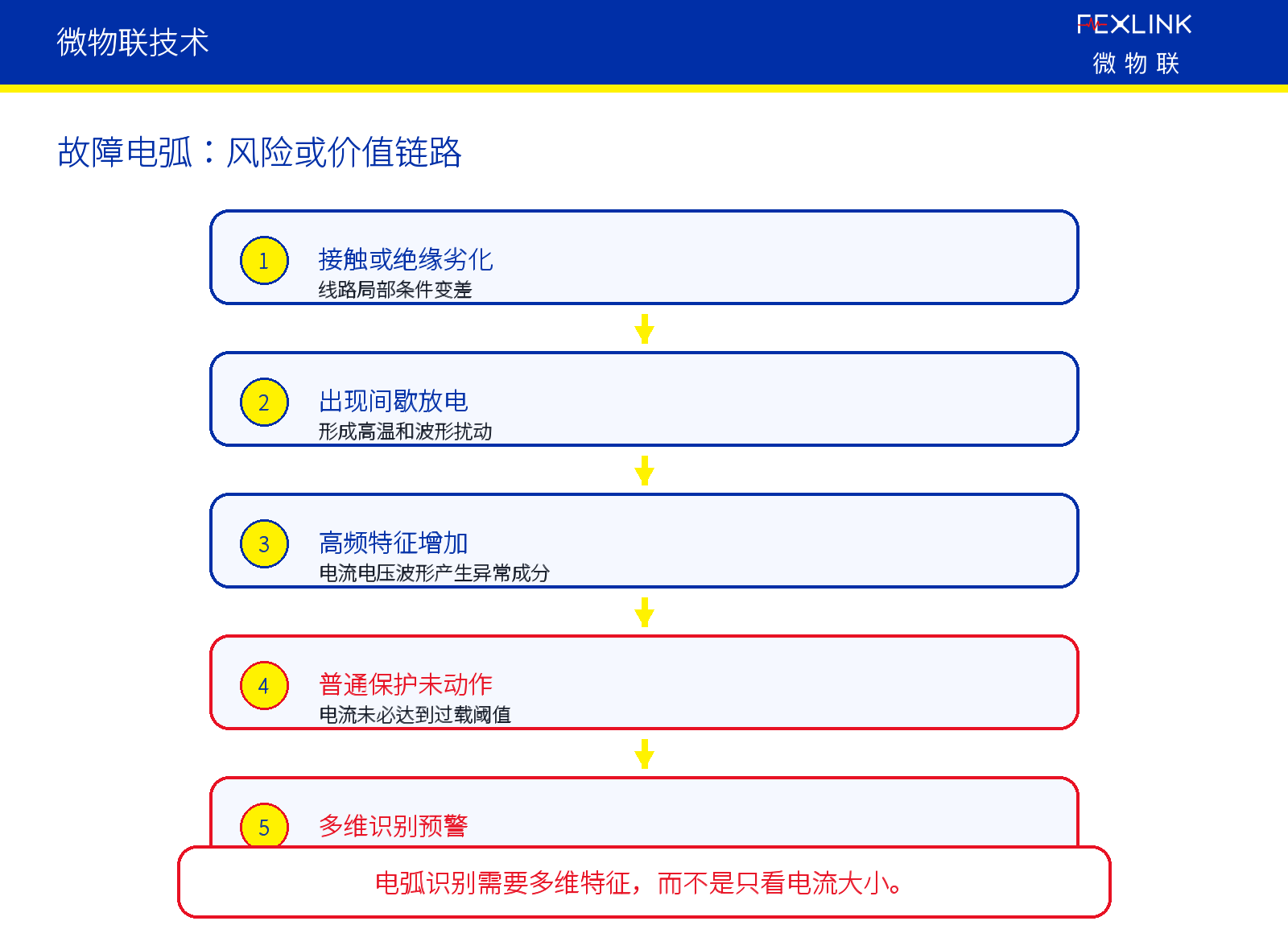
Early arc characteristics are usually reflected in waveform details, such as current discontinuity, half-cycle anomalies, high-frequency pulses, harmonic changes, increased noise density, and abnormal recurrence. A single anomaly is not necessarily dangerous, but if it continues to grow over the timeline, it is cause for concern.
At the same time, normal loads will also cause disturbances. Switching actions, motor starting, power adapters, and frequency conversion equipment may all cause similar noise. Therefore, arc detection must simultaneously identify dangerous features and filter normal disturbances.
4. Why arc detection requires multi-dimensional features
Just looking at a high-frequency signal can easily lead to false alarms. Effective identification requires a combination of current, voltage, harmonics, frequency band characteristics, time density, load scenarios and duration. For different scenarios, the normal disturbance models are also different.
This is also the difficulty of arc fault early warning: the system must not only know that "there is an abnormality", but also determine whether the abnormality is a dangerous arc, whether it continues to grow, and whether alarms and handling are needed.

5. How does FEXLINK understand arc fault early warning?
FEXLINK believes that fault arc identification is not a single threshold problem, but a dynamic diagnosis problem at the waveform level, multi-frequency bands, and multi-time scales. FEXLINK related algorithms should combine low-frequency features, high-frequency features, half-cycle waveforms and scene filtering.
From the perspective of equipment capabilities, there are already high-precision electrical parameters and harmonic data that can be used as a basis to further upgrade to waveform-level arc identification.
Conclusion: The hidden danger of arc is that "the current may not be large, but the risk may be high"
Arc faults are more difficult to detect than ordinary overloads because they are often hidden in waveform details and intermittent anomalies. A truly effective arc warning requires multi-dimensional data, timeline judgment and normal disturbance filtering.
FEXLINK technology will continue to share content related to intelligent lightning protection, early warning of electrical safety, digital power distribution, energy supervision and industrial Internet of Things.
FEXLINK/FEXLINK uses data to reconstruct energy efficiency and electrical safety.
Where there is electricity, there is FEXLINK.