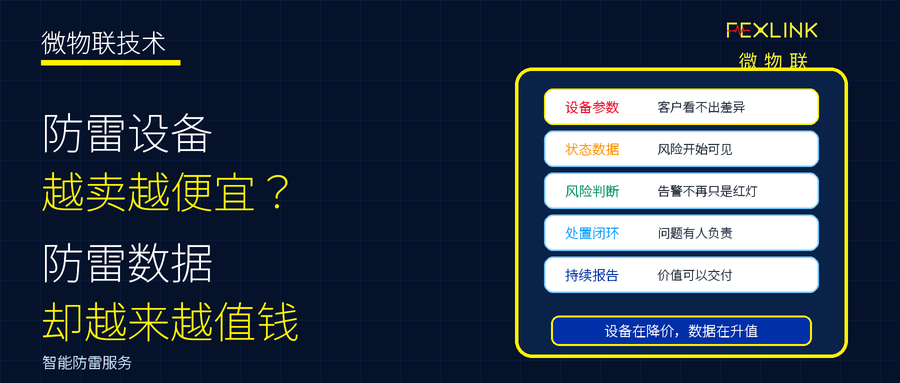
Public account cover picture: Lightning protection equipment is getting cheaper and cheaper, but lightning protection data is becoming more and more valuable
Abstract: Many lightning protection manufacturers, power distribution manufacturers and engineering companies are experiencing the same reality: it is becoming increasingly difficult to sell differences in SPDs, lightning protection boxes and lightning protection modules, and customers begin to compare prices as soon as they discuss purchasing. But on the other hand, Party A's requirements for downtime losses, equipment damage, responsibility traceability, operation and maintenance efficiency, and safety management are increasing. The problem is not that lightning protection has no value, but that in the past, the industry was too accustomed to selling equipment, selling parameters, and selling acceptance results, but did not clearly explain the risk management value behind lightning protection. The real direction of intelligent lightning protection is not to simply sell expensive equipment, but to turn lightning strikes, surges, SPD status, grounding changes, alarm handling and periodic reports into deliverable data services.
This article wants to discuss a more realistic question: Why are many customers unwilling to pay for a more expensive lightning protection device, but may be willing to pay for controllable risks, traceable liability, and worry-free operation and maintenance?
The lightning protection industry is not without value, but a lot of value has been hidden for a long time in "no accidents", "no equipment damage" and "no downtime". The less accidents there are, the easier it is for customers to think that lightning protection is just a cost; once an accident occurs, customers hope someone can tell them clearly: Was it a lightning strike? Is the equipment protected? Is maintenance performed in a timely manner? Where does the responsibility lie?
Therefore, the core judgment of Article 49 is: Lightning protection companies must break out of low-price competition. They cannot just talk about how good the equipment is, but they must clearly explain how the data generated by the equipment can help customers manage risks. The expression of lightning protection value must be upgraded from “selling equipment parameters” to “selling risk results”.
1. Why is it increasingly difficult to simply sell lightning protection equipment?
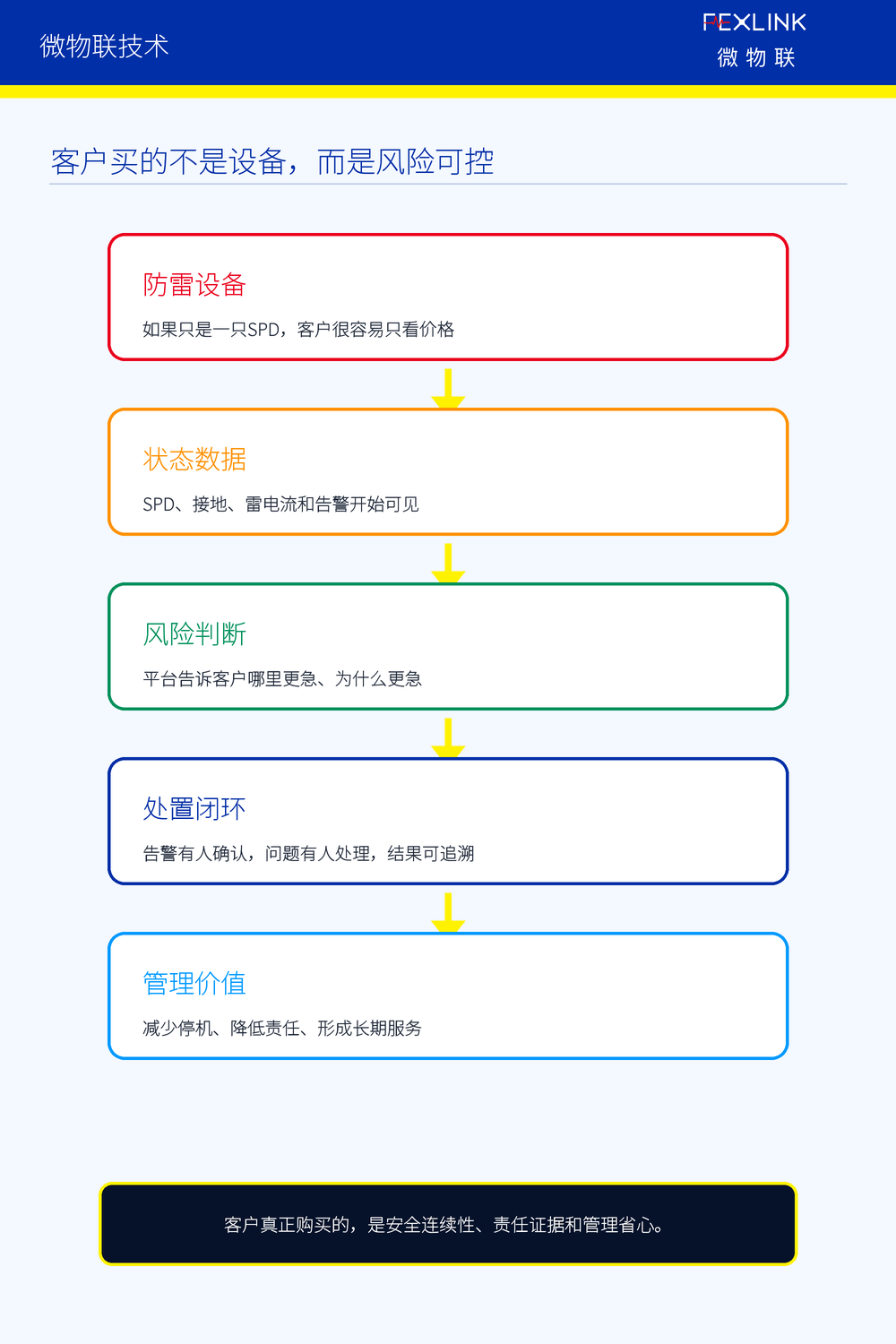
First, product homogeneity is becoming more and more obvious. SPD, lightning protection boxes, lightning protection modules, and lightning protection engineering materials all look more and more alike in the eyes of many customers. If customers cannot understand parameter differences, material differences, process differences and system differences, they will use the simplest way to make judgments: choose who is cheaper; choose who can pass the acceptance inspection; choose who responds quickly.
Second, the value of lightning protection is often expressed as “no loss occurred”. Lightning protection systems do not directly increase production capacity like production equipment, nor do they directly improve experience like lighting and air conditioning. The value of a lightning protection system is often reflected in: no damage by lightning strikes, no downtime, no communication interruptions, no liability disputes, and no major safety accidents. The problem is that "didn't happen" is difficult for customers to actively perceive.
Third, acceptance logic suppresses value perceptions. In many projects, lightning protection is included in the compliance acceptance item. What customers care about is whether it can pass the test, whether the report can be issued, and whether the information is complete. When lightning protection is only understood as the acceptance cost, it is naturally difficult to sell high value.
Fourth, low-price competition will make the industry more and more passive. When lightning protection equipment is simplified into a parameter table and several quotations, it is difficult for companies to explain the professional differences clearly. In the end, what customers compare is not the risk management capabilities, but the price of a single device.
2. What are customers really willing to pay for?
It’s not that customers are unwilling to invest, but they need to know what results they can get from their investment. For data centers, communication base stations, photovoltaic power plants, wind farms, factory production lines, highway electromechanical systems, and petroleum and petrochemical scenarios, a shutdown, a communication interruption, and a key equipment damage are often much higher than the cost of a lightning protection monitoring system.
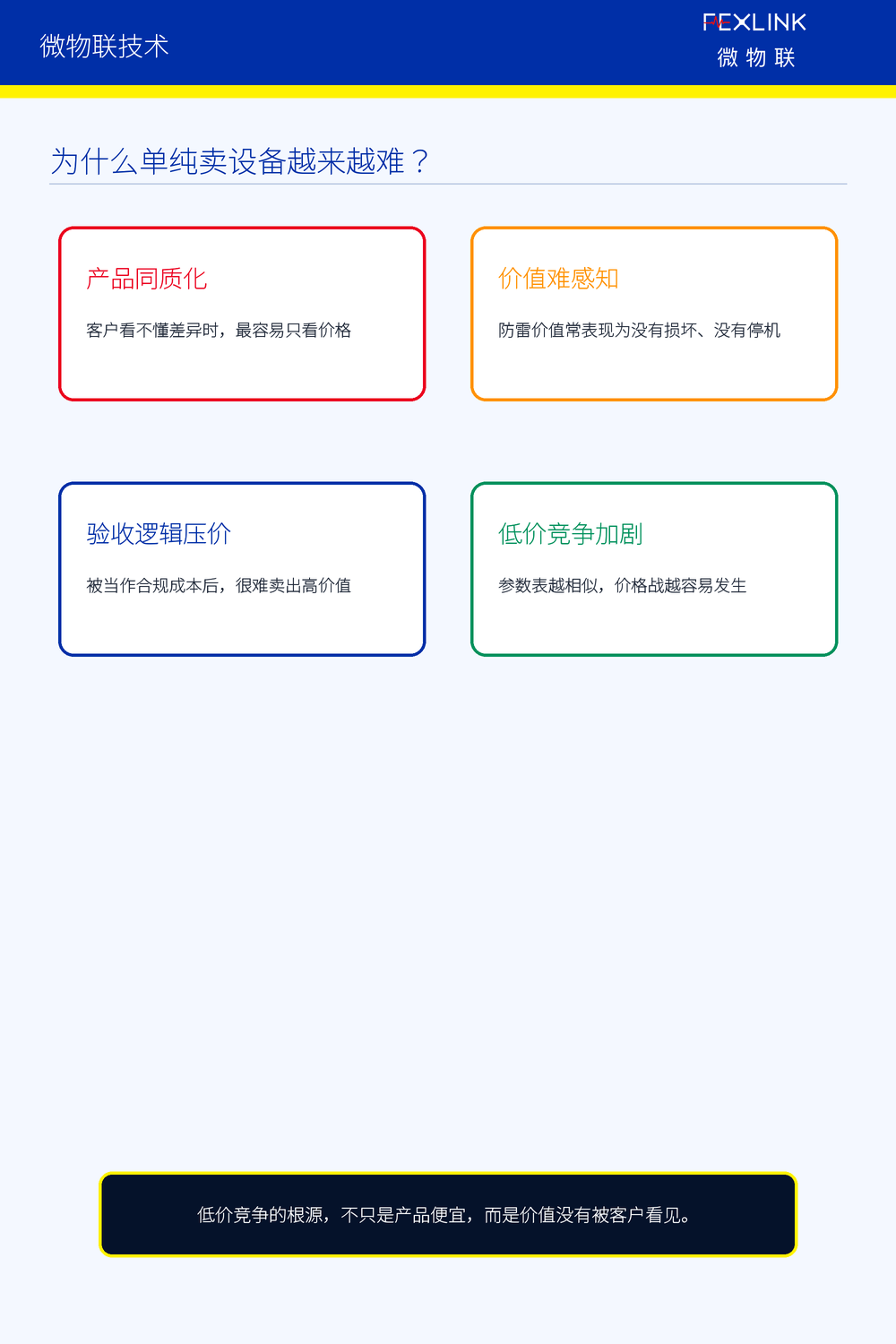
Customers are willing to pay for reduced downtime. What intelligent lightning protection means is not "I will sell you one more device", but "I will help you reduce the uncertainty of sudden shutdowns and equipment damage during thunderstorms." When customers can connect lightning protection with business continuity, lightning protection is no longer just an acceptance item.
Customers are willing to pay for visibility of risk. What managers are really afraid of is not the risk, but not knowing where the risk is, not knowing when the risk will become greater, not knowing what will be related to the problem, and not knowing which point to deal with first. Intelligent lightning protection uses data to turn SPD status, grounding status, lightning current events and alarm handling into visible objects.
Customers are willing to pay for liability traceability. After a problem occurs, what Party A and managers are most concerned about is: Was it a lightning strike? Has the SPD taken any action? Is there anything wrong with the grounding? Is maintenance handled in a timely manner? If there is no data, you can only rely on guessing; if there is data, you can form event time, lightning current records, SPD status, grounding changes, equipment alarms, work order handling and review conclusions.
Customers are also willing to pay for operation and maintenance efficiency. Traditional inspections often face problems such as too many locations, few manpower, not knowing where to check first, and repeated problems that are difficult to count. The intelligent lightning protection platform can screen key review points after a thunderstorm, give priority to high-risk alarms, automatically accumulate event files, and form periodic reports.
3. How should lightning protection companies re-express their value?
It’s not that lightning protection companies can’t talk about technical parameters, but they can’t just stop at parameters. For technicians, the maximum discharge current, protection level, response time, leakage current, temperature rise, sampling rate, and communication stability are all important. But for managers, these parameters must translate into more intuitive questions: What equipment is protected? What systems will be affected after the failure? Can abnormalities be discovered in advance? Can it be reviewed after a lightning strike? Can you explain clearly what went wrong?
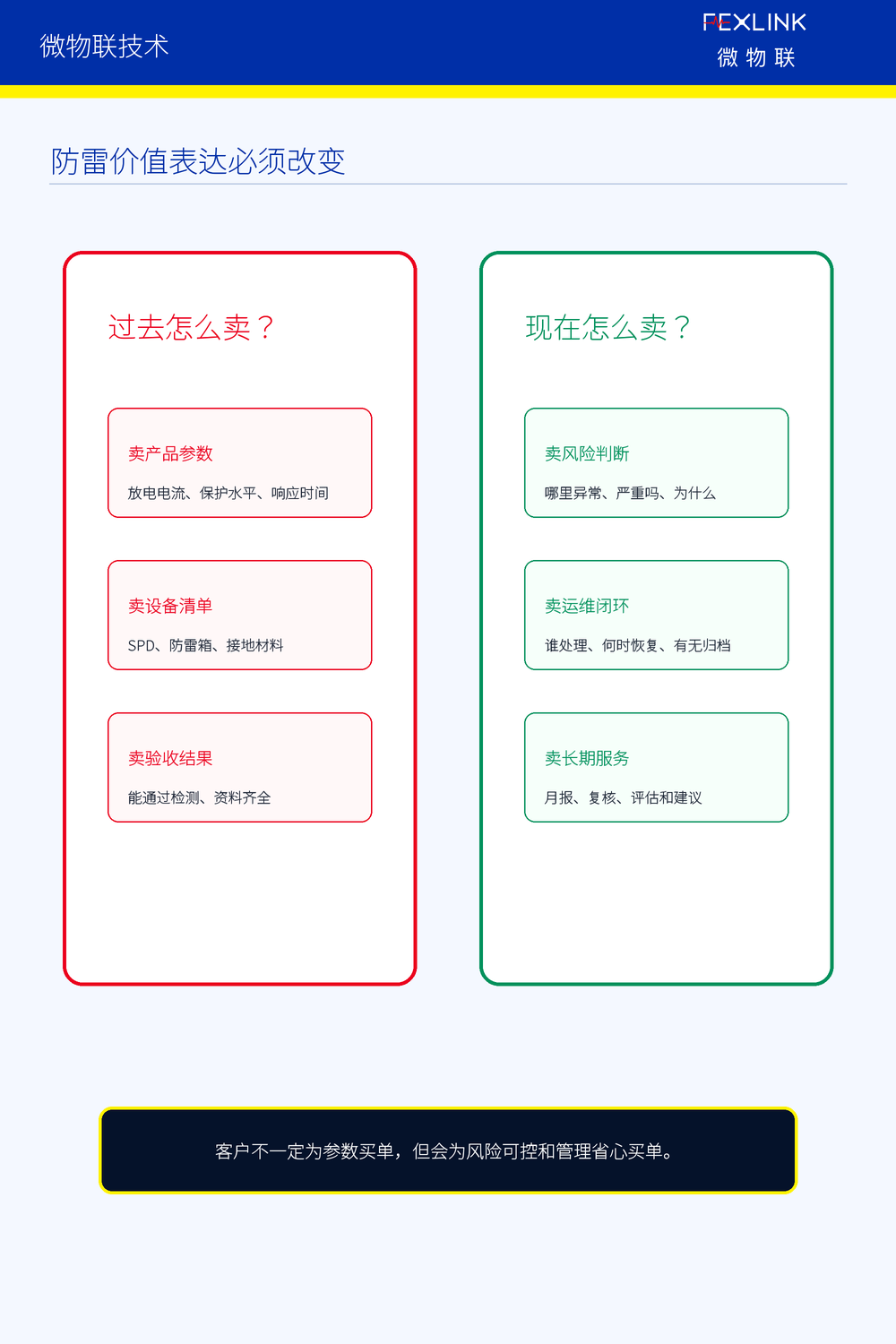
In the past, value expressions often involved selling product parameters, equipment lists, and acceptance results. The current expression of value needs to shift to selling risk judgment, selling operations and maintaining closed loops, and selling long-term services. Customers do not necessarily need to know every underlying sampling point, but customers need to know where the abnormality is, is it serious, why is it abnormal, should it be processed immediately, who handled it, and whether it will be restored after processing.
Therefore, lightning protection manufacturers, power distribution manufacturers and engineering companies should talk less about "my equipment is smart" and more about "how this system can make customers more worry-free". For example, you know where to check after a thunderstorm, you know which points have increased risks every month, you know which areas need rectification every year, you know whether equipment is damaged and whether it is related to lightning strikes, and management can see the safety status report.
4. The value of intelligent lightning protection should be packaged as services
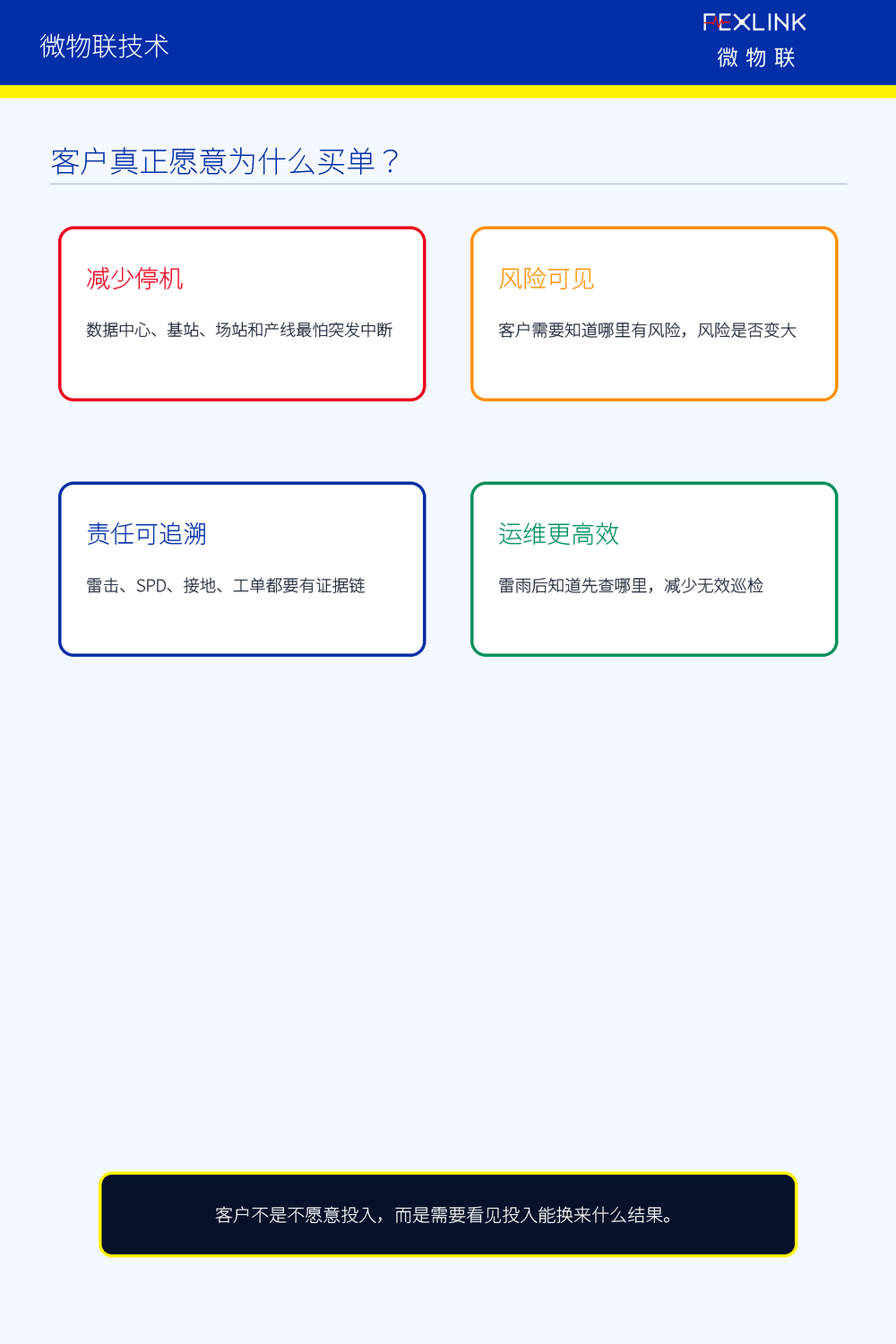
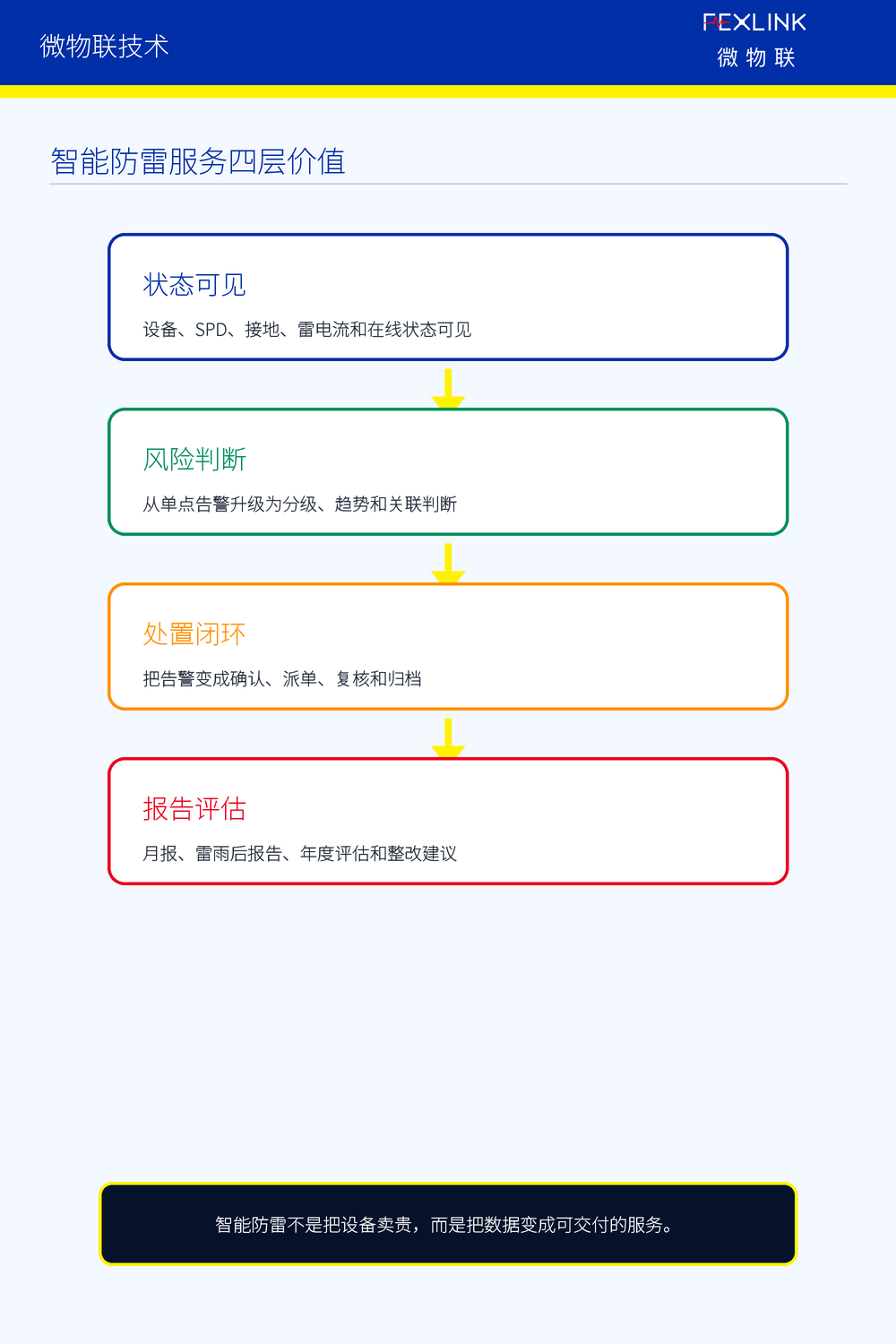
The first layer is the state-visible service. Customers first need to see the SPD status, grounding status, lightning current events, equipment online status and cabinet environment. It answers: Is the lightning protection system normal now?
The second layer is risk judgment services. The platform cannot just display red lights, but must also perform alarm classification, trend identification, multi-source correlation, changes after lightning strikes, and identification of repeated anomalies. It answers: Where is the greatest priority?
The third layer is the disposal of closed-loop services. After the alarm, you must proceed to confirmation, order dispatch, on-site review, recovery confirmation and incident archiving. It answers: Has the problem been addressed?
The fourth level is report evaluation services. Intelligent lightning protection cannot stay on the page, but must output monthly reports, special reports after thunderstorms, quarterly trend reports, annual risk assessments and rectification suggestions. It answers: How is the lightning protection system performing at this stage, and how should it be changed next?
5. Different audiences should hear different expressions
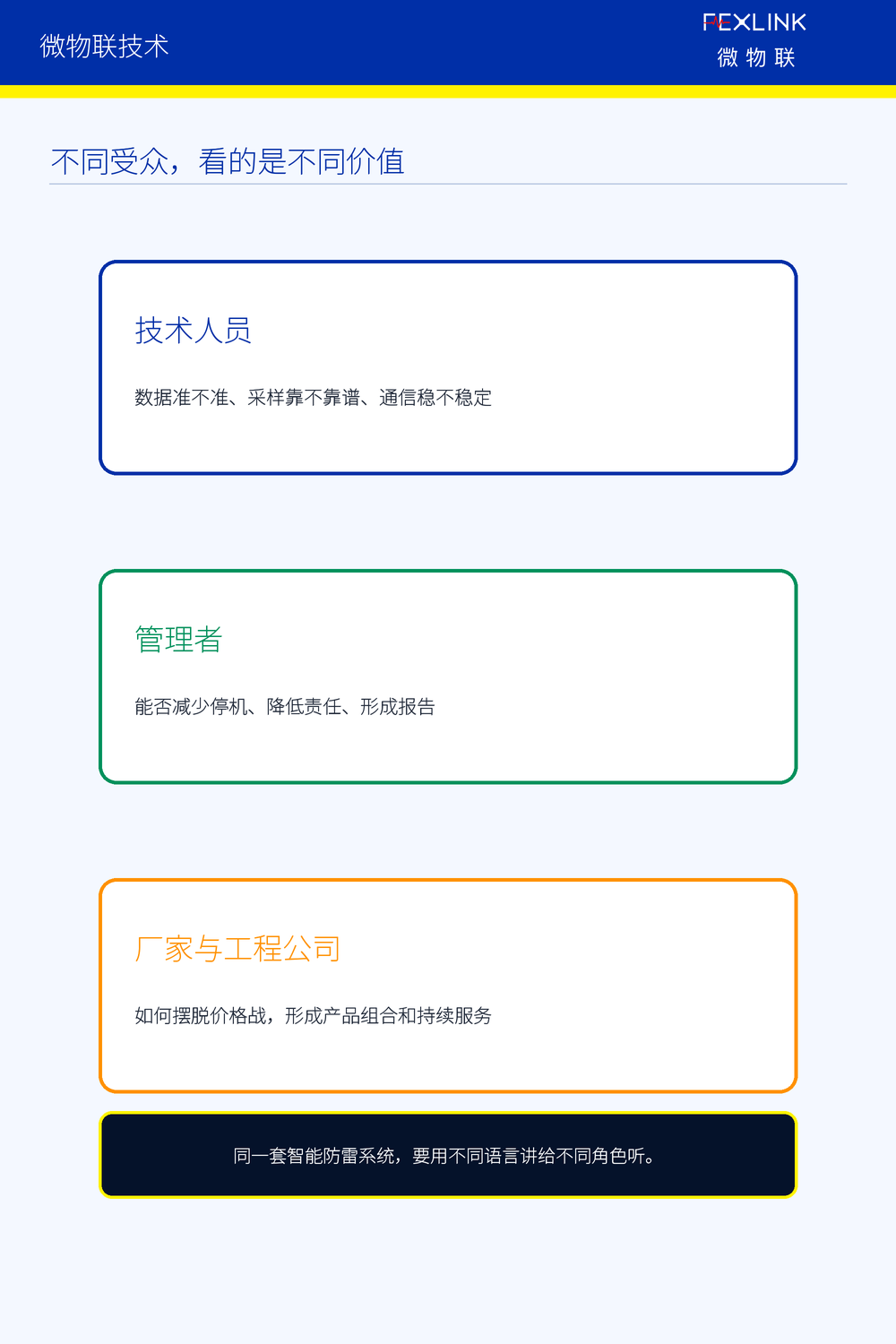
For technicians, it is necessary to talk about whether the data is reliable, whether the sampling is accurate, whether the alarm logic is reasonable, whether SPD, grounding and lightning current can be related, whether the communication is stable, and whether the site is easy to install and maintain. What the technicians are concerned about is: is this set of things reliable?
For managers and decision makers, it is necessary to talk about what losses can be reduced, what management can be improved, whether reports can be formed, whether accident liability can be reduced, whether compliance and safety management can be supported, and whether a long-term operation and maintenance system can be formed. What managers care about is: is the investment worth it?
For manufacturers, power distribution companies and engineering companies, we need to talk about how to get rid of price wars, how to form product portfolios, how to design service packages, how to keep customers purchasing, and how to turn projects into long-term relationships. What manufacturers and engineering companies care about is: how to do business.
The same intelligent lightning protection system cannot just say the same thing to different people. Technical language must support credibility, management language must support decision-making value, and business language must support continuous service.
6. How does FEXLINK understand the customer value of intelligent lightning protection?
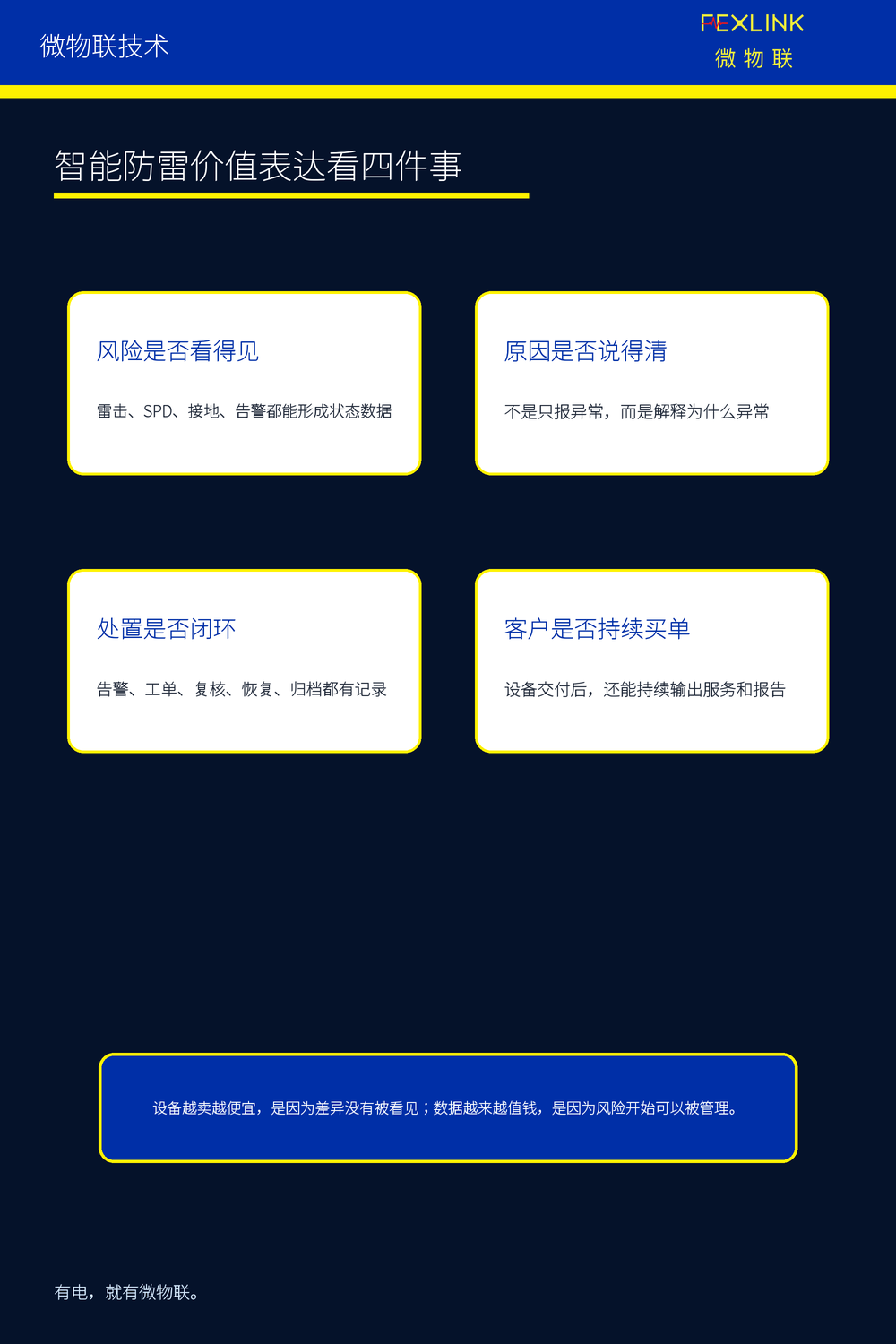
FEXLINK believes that the essence of intelligent lightning protection is not to network lightning protection equipment, but to turn the lightning protection system into a safety perception system that continuously produces risk data. The real value is not that the customer buys an extra piece of equipment, but that the customer gains visibility of risks, investigation of causes, management of disposal, traceability of responsibilities, and sustainable services.
FEXLINK focuses on: whether the lightning strike event is visible, whether the SPD status can be judged, whether the grounding status can be continuously monitored, whether the risk can be graded, whether the disposal can be closed loop, and whether the report can serve customer management.
When lightning protection is only expressed as equipment, parameters and acceptance items, it is naturally easy for customers to lower the price. When lightning protection is expressed as reduced downtime, controllable risks, traceable responsibilities, and more efficient operation and maintenance, it is easier for customers to understand why it is worth investing.
Conclusion: Equipment becomes cheaper as it sells, because the value is not seen
It’s not that the lightning protection industry has no value, but that many of its values have not been seen by customers in the past. Devices are becoming more and more bulky because customers cannot see the difference; data is becoming more and more valuable because data can turn invisible risks into manageable objects.
What intelligent lightning protection needs to solve is not only the issue of technology upgrading, but also the issue of value expression. Companies that will be more competitive in the future will not just sell SPDs, lightning protection boxes and engineering materials, but will be able to organize equipment status, lightning events, grounding trends, alarm work orders and periodic reports into risk management services that customers can understand, use and are willing to continue to purchase.
Lightning protection equipment may become cheaper and cheaper, but truly high-quality, interpretable, traceable, and closed-loop lightning protection data will become increasingly valuable.
FEXLINK technology will continue to share content related to intelligent lightning protection, early warning of electrical safety, digital power distribution, energy supervision and industrial Internet of Things.
FEXLINK/FEXLINK uses data to reconstruct energy efficiency and electrical safety.
Where there is electricity, there is FEXLINK.