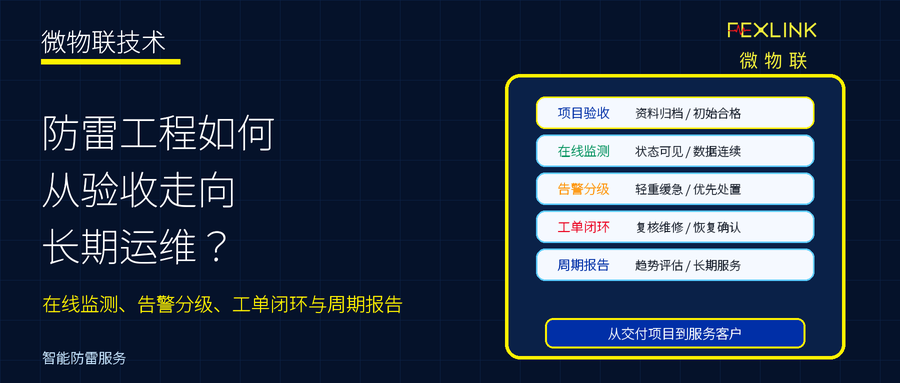
Cover image of the public account: How does a lightning protection project move from acceptance to long-term operation and maintenance?
Abstract: Traditional lightning protection projects usually revolve around design, construction, installation, testing and acceptance. After the project passes acceptance, the lightning protection system seems to be completed, but in actual operation, lightning strikes, surges, SPD degradation, grounding changes, construction disturbances, equipment replacement and environmental corrosion will continue to affect the protection effect. The value of intelligent lightning protection services is not simply to connect equipment to the platform, but to transform online monitoring data into alarm classification, maintenance recommendations, closed-loop work orders, post-thunderstorm reviews and long-term risk reports, upgrading lightning protection projects from one-time project delivery to long-term operation and maintenance services.
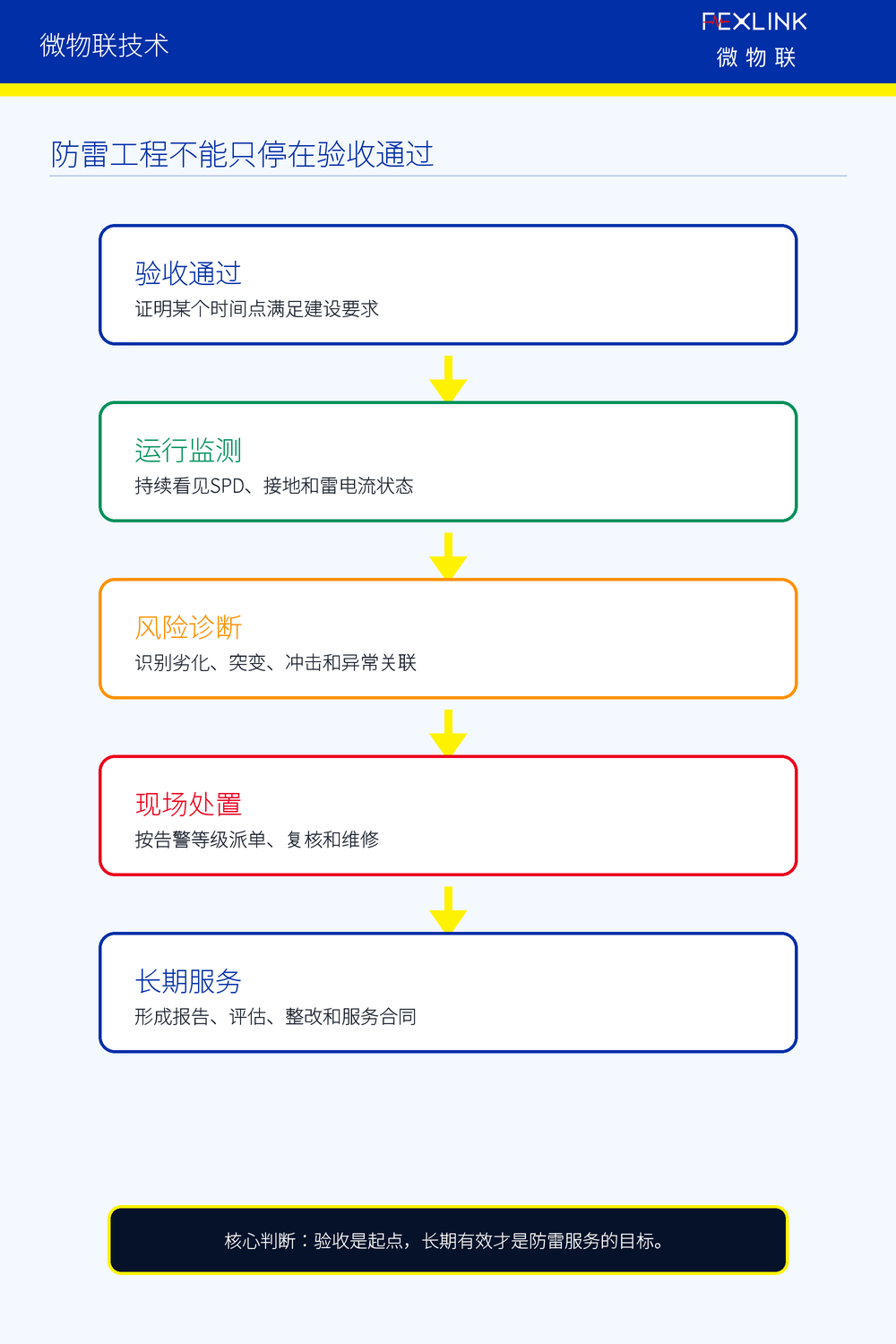
When many lightning protection projects are delivered, the process seems to be complete: site survey, scheme design, equipment procurement, engineering installation, inspection and acceptance, and data archiving. This process is very important during the construction phase, but the real test of the lightning protection system is not on the day of acceptance.
After the lightning protection system is put into operation, the site will experience lightning strikes, surges, equipment aging, grounding changes, line modifications and environmental corrosion. Is SPD still effective after a severe thunderstorm? Has the lightning protector deteriorated after multiple surges? After the on-site modification, have the grounding and equal potential been destroyed? None of these questions can be answered with acceptance data alone.
Therefore, passing the acceptance test can only show that the lightning protection system meets the requirements at a certain point in time; to prove that the lightning protection system is effective for a long time, it must rely on data, diagnosis and maintenance during the operation phase.
1. Why do traditional lightning protection projects tend to stop at the acceptance stage?
Traditional lightning protection projects are usually project-based businesses. Signing a contract, completing the project, passing acceptance inspection, completing payment collection, and entering after-sales service are the basic paths for many projects. Project-based business naturally ends with delivery, and the organizational focus of an enterprise is usually on construction and acceptance.
In the past, many lightning protection devices themselves rarely produced data continuously. Traditional SPDs, lightning protection boxes and grounding systems are mostly silent devices. They do not speak at ordinary times and are only discovered when problems occur. No one knows after the SPD tripped, no one knew the leakage current increased, no one knew the ground gradually deteriorated, and no event was recorded after the lightning strike occurred, all of which will lead to a lack of basis for follow-up services.
In the past, customers paid more attention to whether there was installation, whether there was grounding, whether the test report was qualified, and whether the acceptance documents were complete. However, as the requirements for digital operation and maintenance and security management increase, customers begin to care more about whether the protection status is visible, whether anomalies can be discovered remotely, whether risks can be explained, and whether disposal can leave traces.
2. Why does the real lightning protection risk occur during the operation stage?
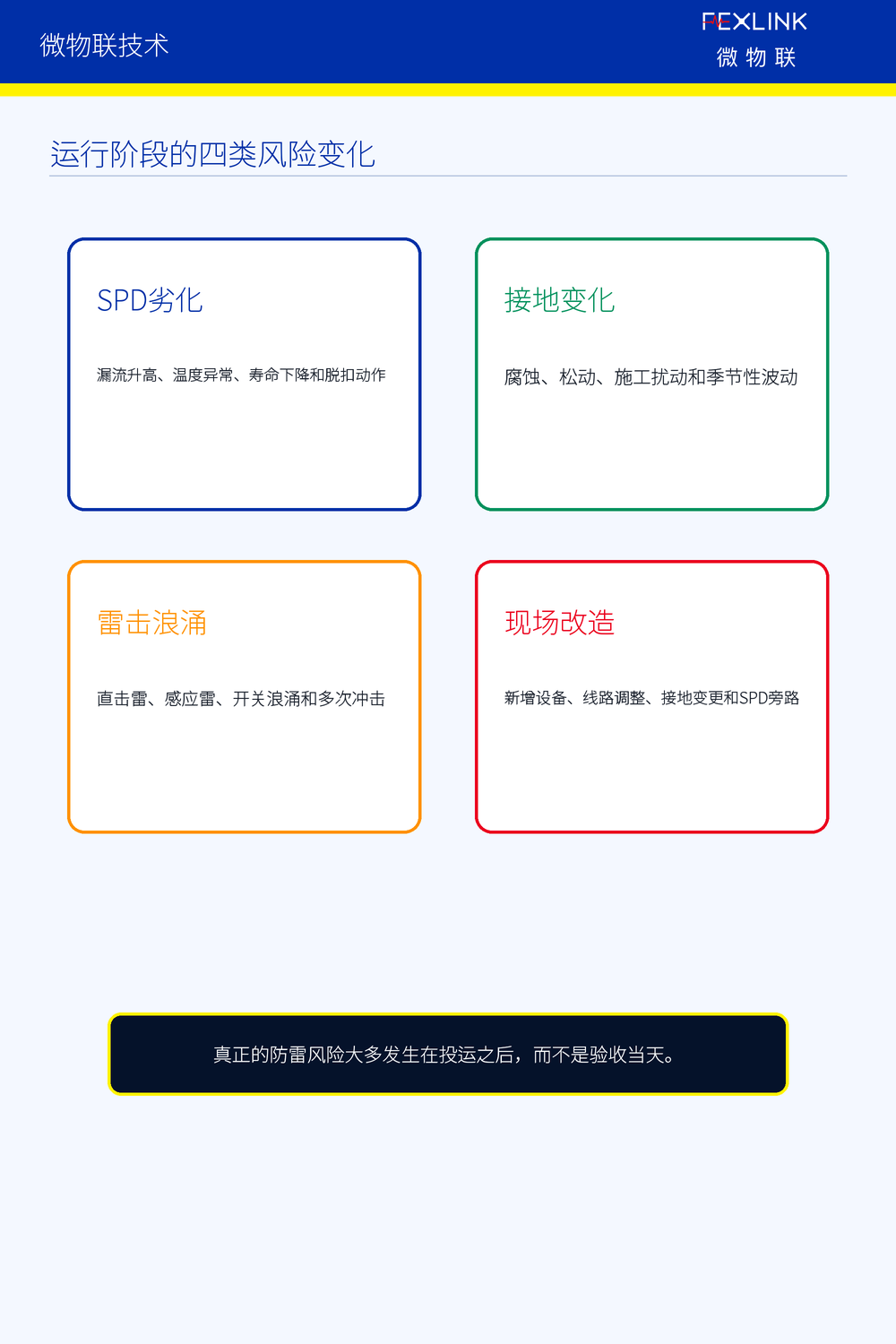
Lightning strikes and surges are events that occur during operations. The lightning protection system does not remain static after acceptance. Direct lightning strikes, induction lightning, switching surges, power grid disturbances, multiple impacts and equipment failures will continue to test the protection link after it is put into operation.
SPD is not a permanently effective device either. It may experience increased leakage current, abnormal temperature, decreased life, tripping actions, abnormal backup protection, and performance degradation after multiple surges. Without online monitoring, many degradation processes are not easily discovered before tripping.
Grounding systems also change. Soil moisture, corrosion, loose joints, construction disturbance, aging of the grounding body and local changes after lightning strikes may cause the grounding system that has passed the first inspection to gradually deviate from the safe state.
On-site modifications will also destroy the original protective links. New equipment, line modification, cabinet replacement, communication line expansion, grounding wire movement, and SPD being bypassed or removed will all cause new weaknesses in the original lightning protection design.
3. What should the long-term operation and maintenance services of intelligent lightning protection include?
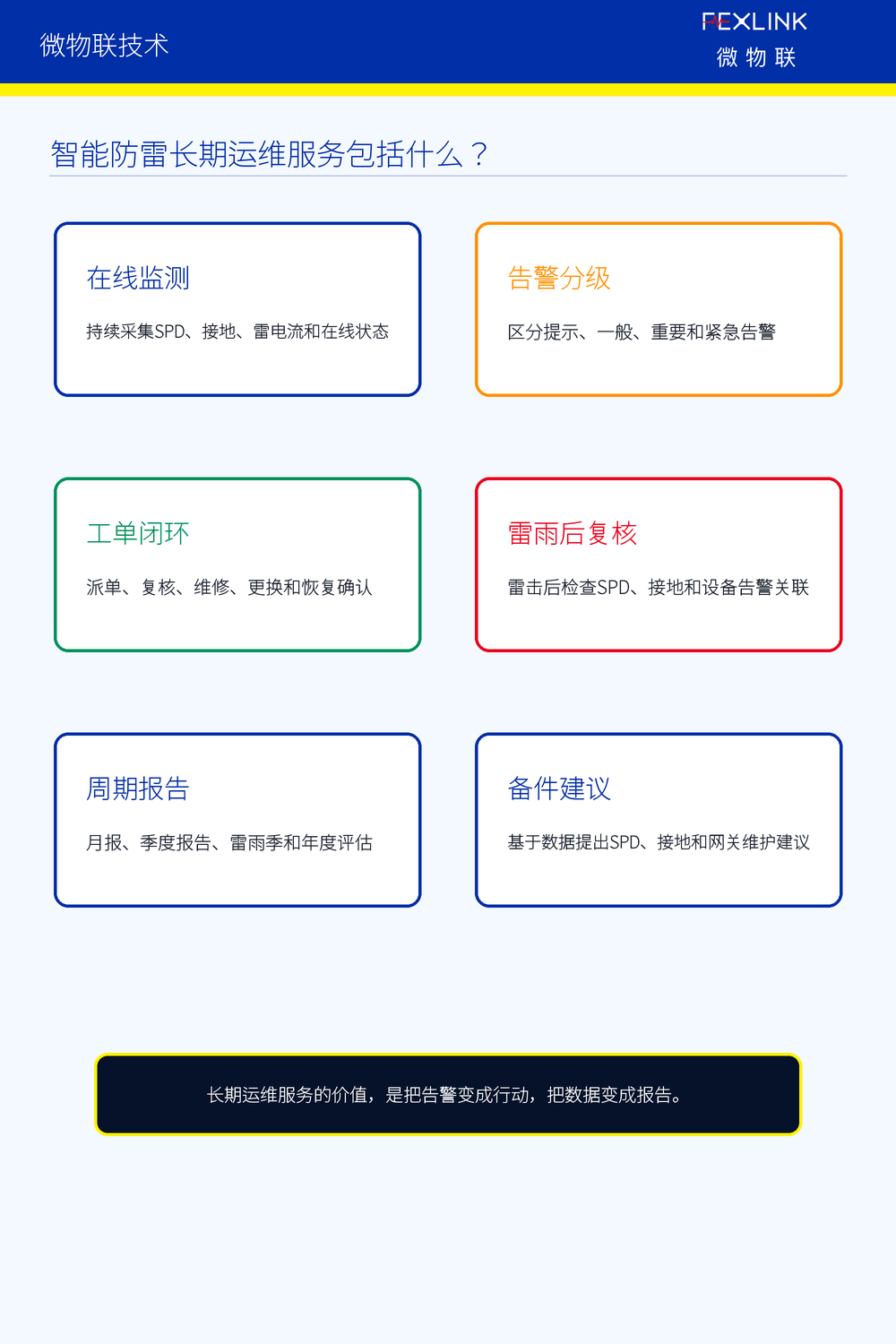
The first is an online condition monitoring service. It is necessary to continuously monitor SPD status, leakage current, temperature, backup protection, ground resistance, lightning current events, equipment online status and cabinet environment, so that the lightning protection system can change from a silent device to a visible state.
The second is alarm classification service. Not all exceptions should be handled equally. The terminal being offline for a short period of time can be used as a reminder. SPD remote signaling anomalies require plan review. SPD anomalies after lightning strikes should prioritize dispatching orders. Ground sudden changes after strong lightning strikes require rapid on-site review.
The third is the closed-loop service of work orders. After the alarm, someone must handle it. The complete process includes alarm generation, risk classification, dispatch of work orders, on-site review, repair and replacement, recovery confirmation and incident archiving.
The fourth is special review services after thunderstorms. After a thunderstorm, the platform can automatically screen sites where lightning current events occur, points where SPD status changes, areas where grounding mutations occur, and systems where equipment alarms occur simultaneously, and form review recommendations.
The fifth is periodic reporting services. Monthly lightning protection health reports, quarterly risk trend reports, thunderstorm season special reports, annual lightning protection status assessment reports and rectification suggestion reports are important carriers for transforming online monitoring into customer management results.
4. How can online monitoring data be turned into service products?
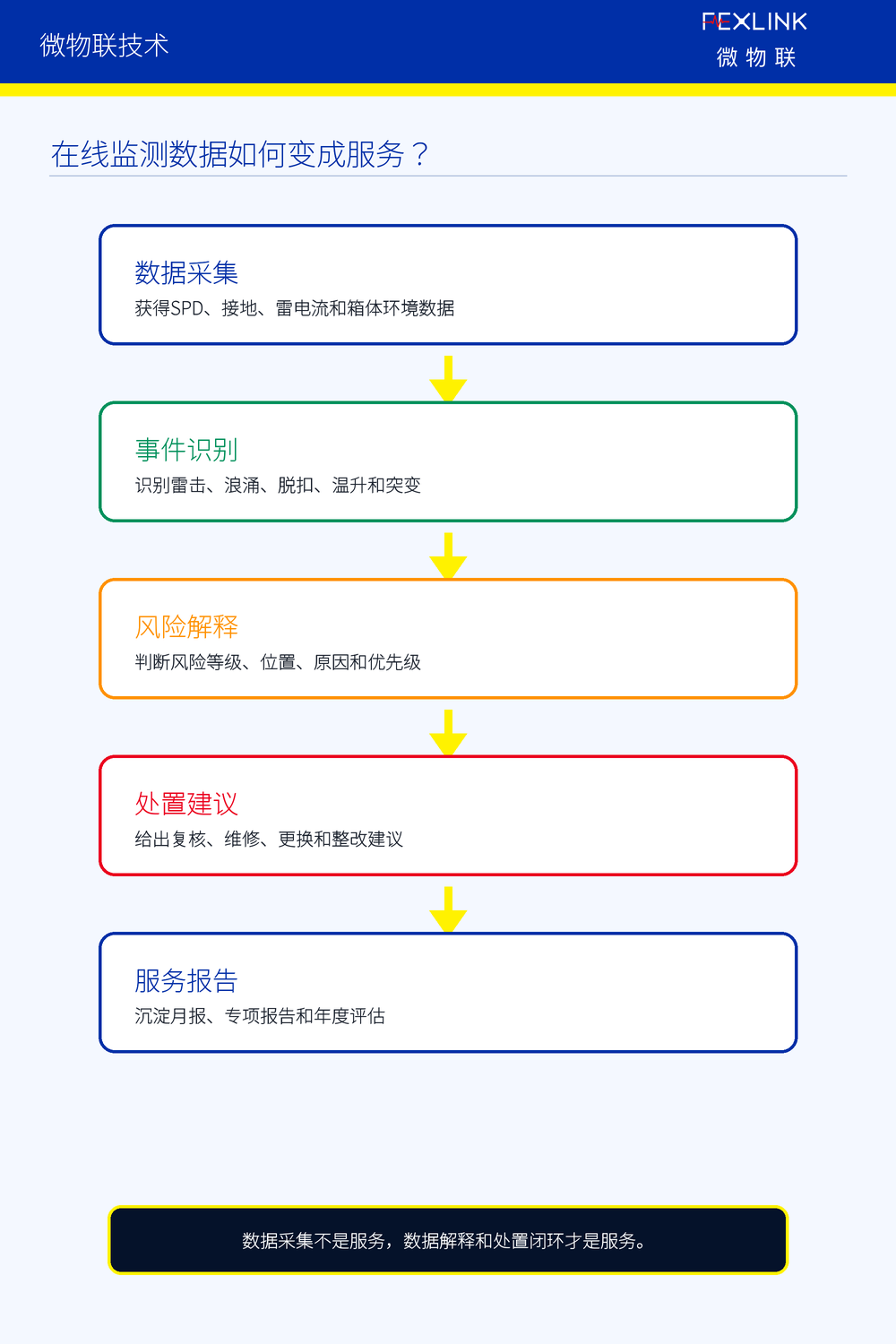
Data collection itself is not a service, data interpretation is a service. Customers do not necessarily need to see a lot of data. What customers really need to know is where the risk is, why the risk is, what the severity is, whether it needs to be processed, who will handle it, and whether it will be restored after processing.
Online monitoring data can first be transformed into event identification, such as lightning strikes, surges, tripping, abnormal leakage, abnormal temperature rise, sudden grounding changes and equipment offline. After event identification, the platform then combines thresholds, trends, multi-point comparisons and multi-source correlations to interpret risks.
After the risks are explained, the system should give executable disposal suggestions, such as on-site review, SPD replacement, backup protection inspection, ground connection retest, gateway maintenance or solution upgrade. Finally, these processes should be condensed into monthly reports, special reports and annual evaluations.
5. How can intelligent lightning protection services be designed in layers?
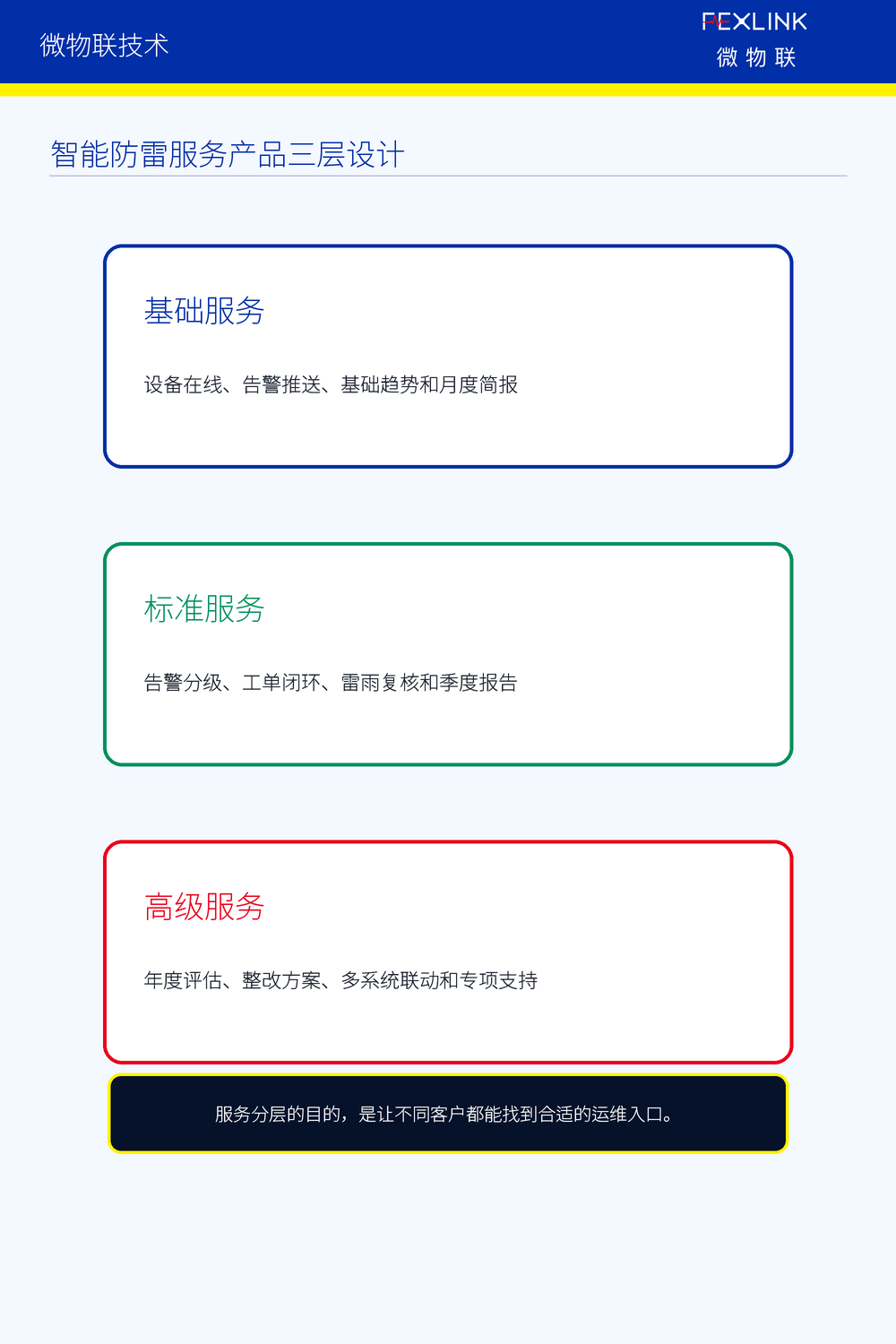
The basic service is suitable for customers who have just started using online monitoring, focusing on providing equipment online status, alarm push, basic trends and monthly briefings. It solves the problem of "can customers see the status remotely?"
The standard service is suitable for customers who already have certain operation and maintenance requirements, focusing on providing alarm classification, work order closed loop, post-thunderstorm review, quarterly reports and maintenance suggestions. It solves the problem of "whether the alarm can really be processed".
Advanced services are suitable for key scenarios and high-value customers, focusing on providing annual risk assessments, special rectification plans, multi-system linkage analysis, remote support for key scenarios and long-term data asset accumulation. It solves the problem of "whether data can support continuous security management of customers."
6. How does a lightning protection engineering company establish long-term operation and maintenance service capabilities?
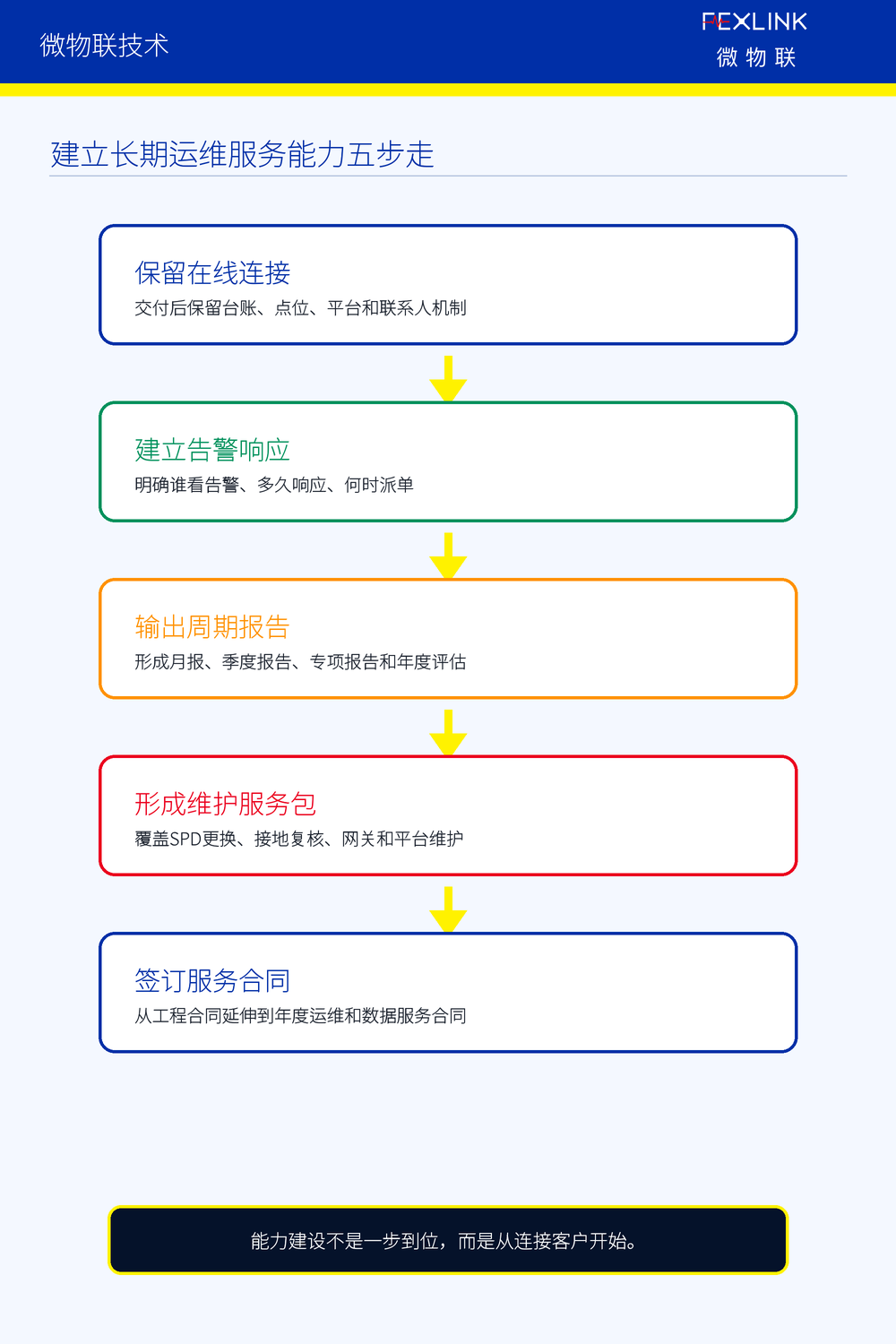
The first phase starts with retaining an online connection after the project is delivered. Do not disconnect the customer after delivery, and at least keep the equipment account, point list, platform account, and basic alarm and contact mechanisms.
In the second stage, an alarm response mechanism is established. It is necessary to clarify who sees the alarms, how long it takes to respond, which alarms require dispatching, which alarms are only observed, and how the processing results are recorded. A platform without a responsive mechanism can easily degenerate into a display page.
The third stage is to establish report output capabilities. Form fixed monthly reports, quarterly reports, special reports after thunderstorms, annual evaluation reports and rectification suggestion templates so that services have deliverables.
The fourth phase is to establish spare parts and maintenance service packages. Including SPD replacement, grounding retest, line inspection, backup protection inspection, gateway maintenance and platform configuration. The clearer the service package, the easier it is for customers to understand the long-term service value.
The fifth stage is to form a long-term service contract. Eventually, it evolved from a one-time engineering contract to an annual operation and maintenance service contract, platform service contract, equipment maintenance contract, risk assessment service contract and special rectification service contract.
7. How does FEXLINK understand intelligent lightning protection services?
FEXLINK believes that smart lightning protection services do not end when the lightning protection equipment is connected to the platform, but allow the lightning protection system to continue to produce explainable, traceable, and disposable data.
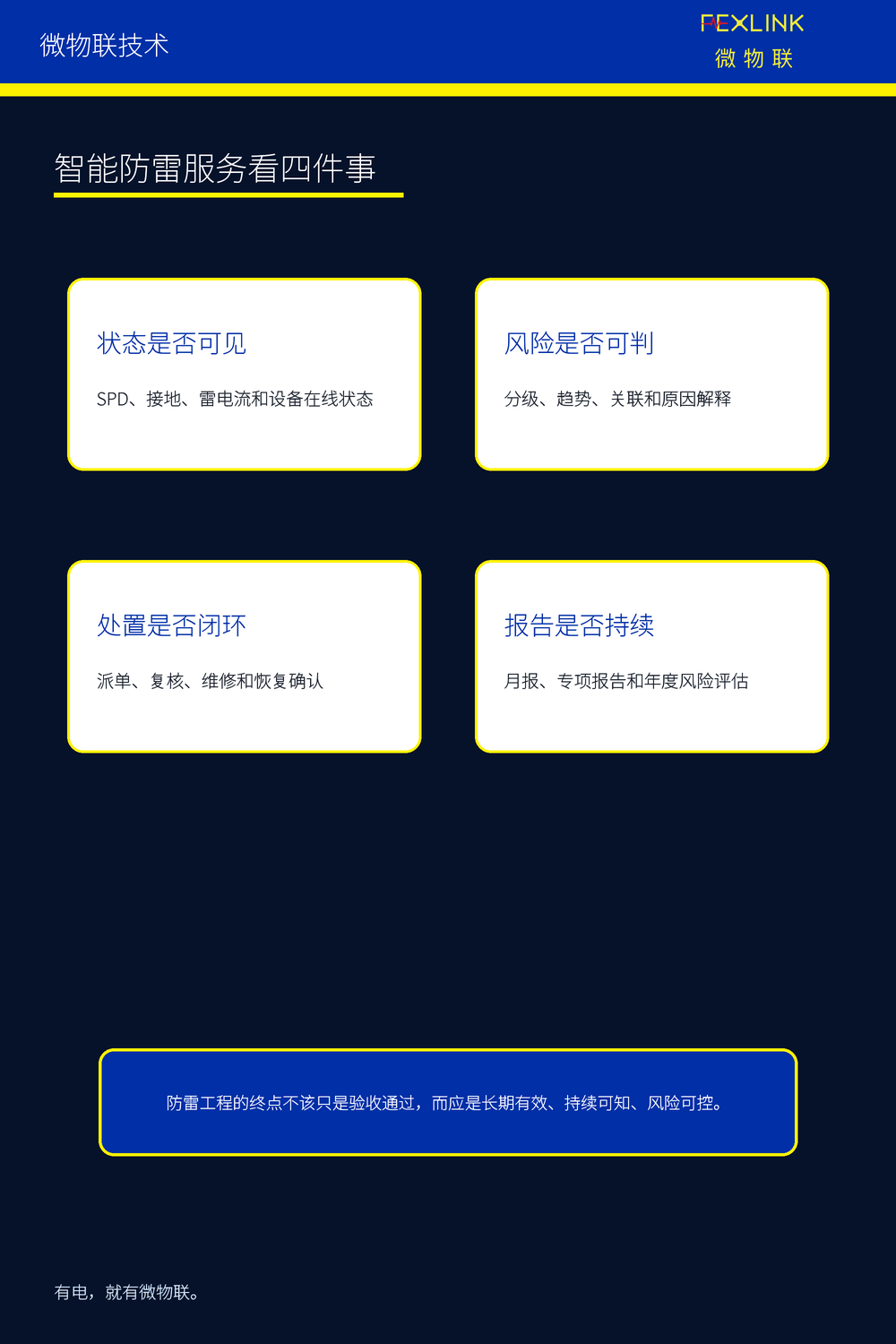
FEXLINK focuses on: whether the status is visible, whether events are traceable, whether risks can be explained, whether alarms can be graded, whether disposal can be closed-loop, and whether reports can be output continuously.
It can be summarized as three changes: from project acceptance to operating status management; from post-failure maintenance to risk trend warning; from one-time projects to long-term data services.
Conclusion: The end point of a lightning protection project should not just be acceptance.
Lightning protection engineering companies will not lose value because of intelligence. On the contrary, engineering companies that truly understand the site, construction, testing, and customer management have the best chance of developing smart lightning protection services.
But the premise is that engineering companies cannot only understand intelligence as equipment networking or platform display. Real long-term service comes from continuous data, professional judgment, timely disposal and periodic reporting.
The end point of a lightning protection project should not just be acceptance, but should be long-term effective, continuously knowable, and risk controllable.
FEXLINK technology will continue to share content related to intelligent lightning protection, early warning of electrical safety, digital power distribution, energy supervision and industrial Internet of Things.
FEXLINK/FEXLINK uses data to reconstruct energy efficiency and electrical safety.
Where there is electricity, there is FEXLINK.