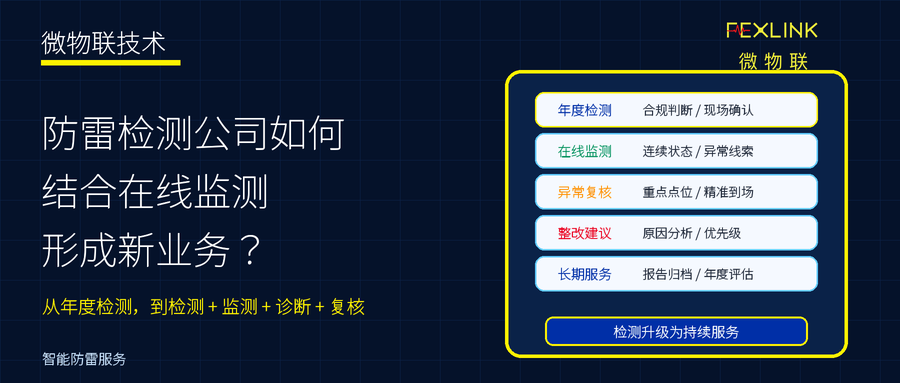
Cover image of public account: How lightning protection detection companies combine online monitoring to form new businesses
Abstract: Lightning protection detection is not unimportant, but it is a qualification judgment that cannot just stay at a certain point in time. The real risks of lightning protection systems often occur in the long-term operation stage: after lightning strikes, surges, SPD degradation, grounding changes, and on-site modifications. If lightning protection testing companies can combine traditional on-site testing with online monitoring data, they can upgrade from periodic testing reports to new services such as continuous risk diagnosis, special reviews after thunderstorms, abnormal point inspections, rectification suggestions, and annual lightning protection health assessments.
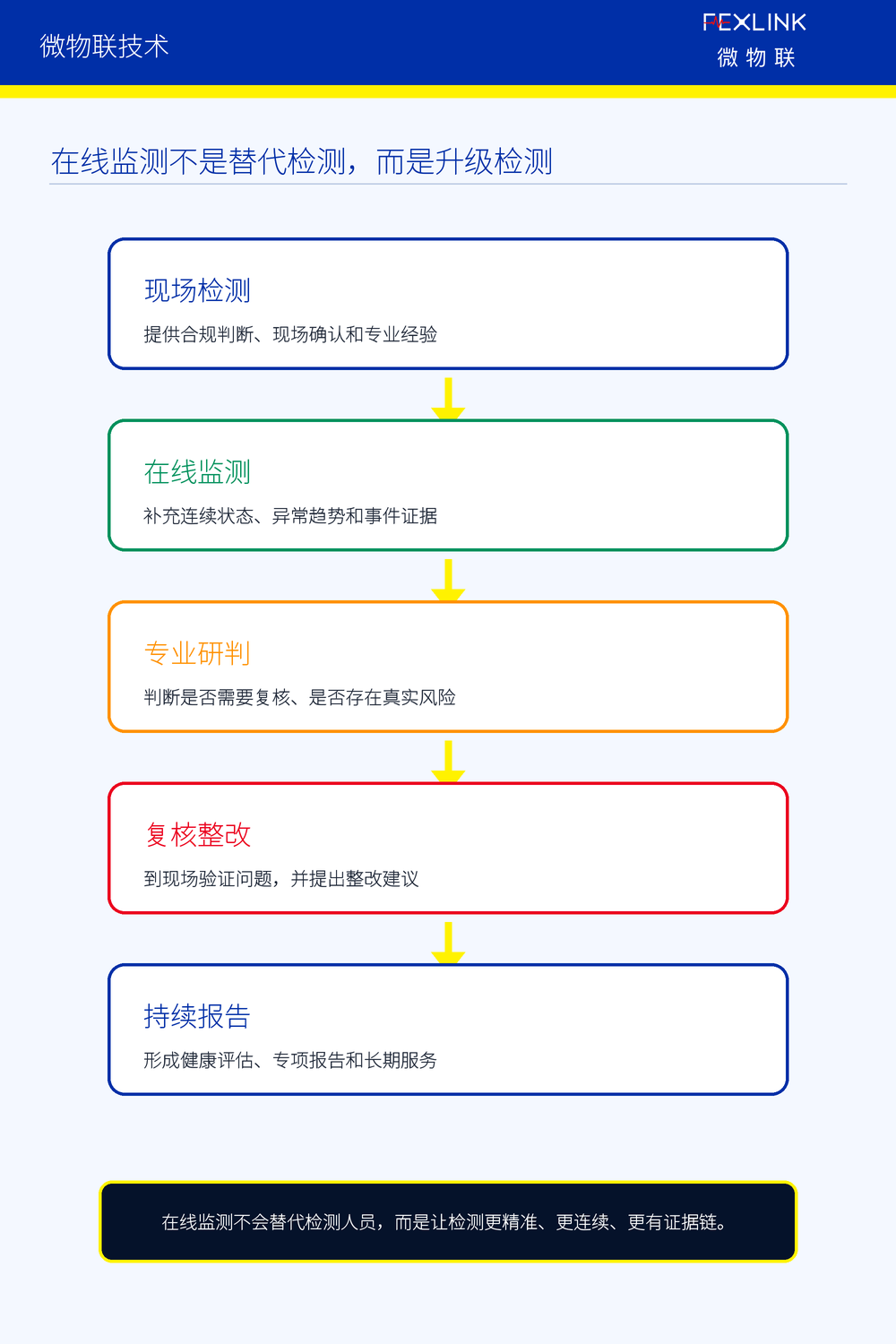
When many people talk about intelligent lightning protection, they easily mistakenly think that online monitoring will replace lightning protection detection. This understanding is not accurate. Online monitoring is not a replacement for testing, but allows testing companies to have more process data, detect problems earlier, and arrange on-site reviews more accurately.
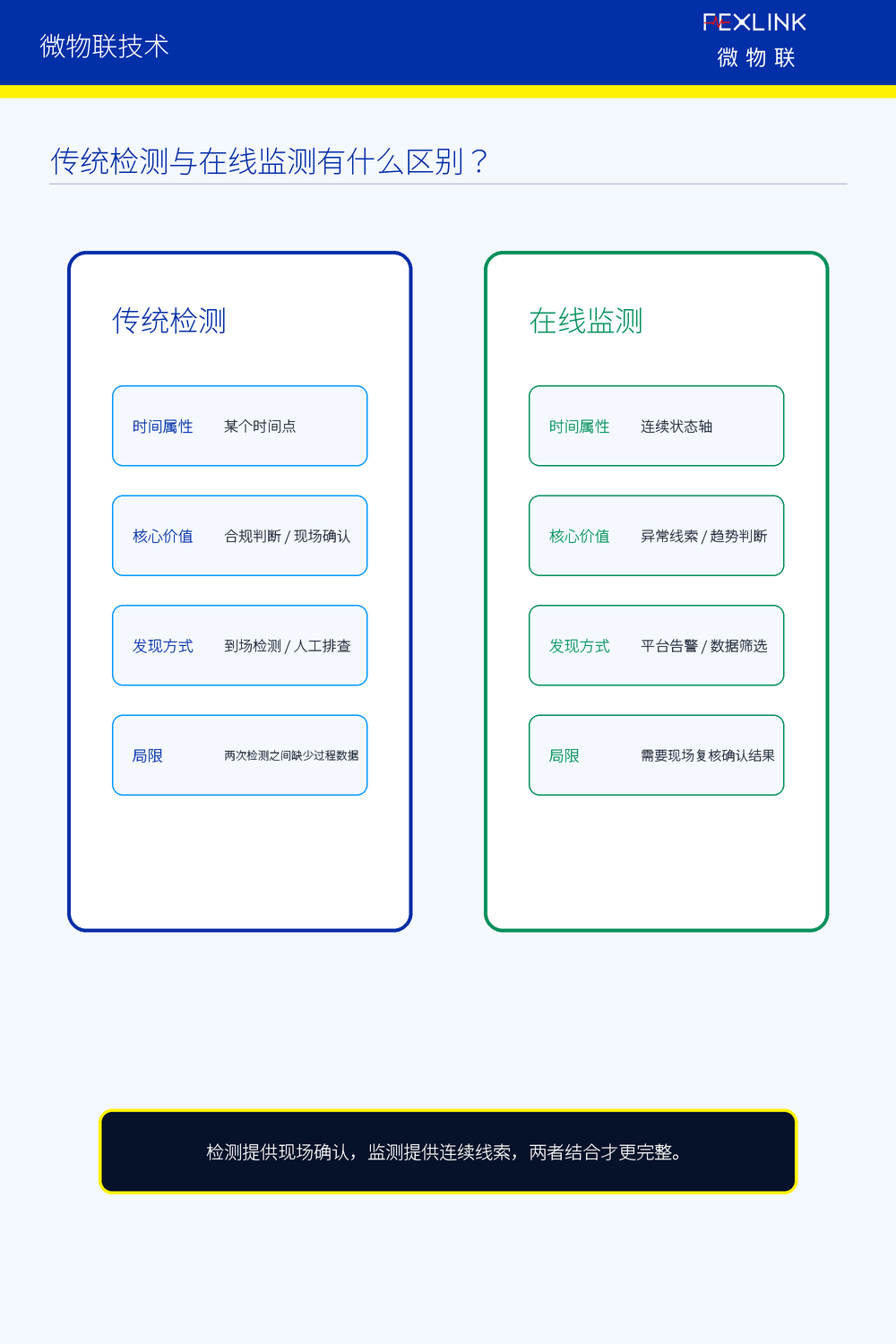
The traditional lightning protection test answers: whether the current requirements are met, whether the grounding resistance is qualified, whether the lightning protection device is complete, and whether the test report meets management requirements. The online monitoring further answers: whether the status has changed after the detection, whether there are any abnormalities after the lightning strike, whether the SPD gradually deteriorates, whether there is a sudden change in the grounding, and which points need to be reviewed first.
Therefore, the future of lightning protection testing will not move from offline to online, but from one-time testing to comprehensive services of “testing + monitoring + diagnosis + review”.
1. The value of traditional lightning protection detection is still irreplaceable
Lightning protection testing first provides a basis for compliance. Buildings, stations, parks, hazardous chemical sites, communication facilities, energy stations, etc. all need to confirm the status of lightning protection devices through testing, and form test reports required for management.
Lightning protection testing also provides on-site confirmation. Many issues must be checked on-site, such as whether the air-termination is complete, whether the down conductor is corroded, whether the connection point is loose, whether the ground terminal is reliable, whether the SPD is installed correctly, and whether the equipotential connection is standardized. These cannot be completely judged by relying on platform data alone.
Lightning protection testing also provides professional judgment. The same grounding resistance value may have different risk implications in different soils, seasons, structures and scenarios. The on-site experience, standard understanding and troubleshooting capabilities of the inspection personnel cannot be directly replaced by online monitoring.
Therefore, online monitoring does not replace inspectors, but provides continuous data and review clues to inspectors.
2. Why is testing once a year not enough?
The status of the lightning protection system will change. Changes in soil moisture, corrosion of grounding bodies, loose connection points, construction disturbances, new equipment, line modifications, SPD degradation, lightning strikes or surge impacts will all affect the long-term effectiveness of the lightning protection system. Passing the test once does not mean that the condition is stable throughout the year.
Many risks occur between tests. After the thunderstorm season, SPDs may deteriorate, grounding connection points may gradually loosen, on-site modifications may destroy equipotentials, equipment may be added without supplementary protection, and surges may occur repeatedly in a certain area. Without online data, inspection agencies often have to wait until the next inspection or incident to discover problems.
Customers are also increasingly demanding process evidence. Customers not only need a qualified report, but also want to know whether there have been lightning strikes this year, which points have experienced abnormalities, which alarms have been handled, which risks have reoccurred, and what should be focused on rectification in the next year.
3. What deficiencies can online monitoring data supplement in test reports?
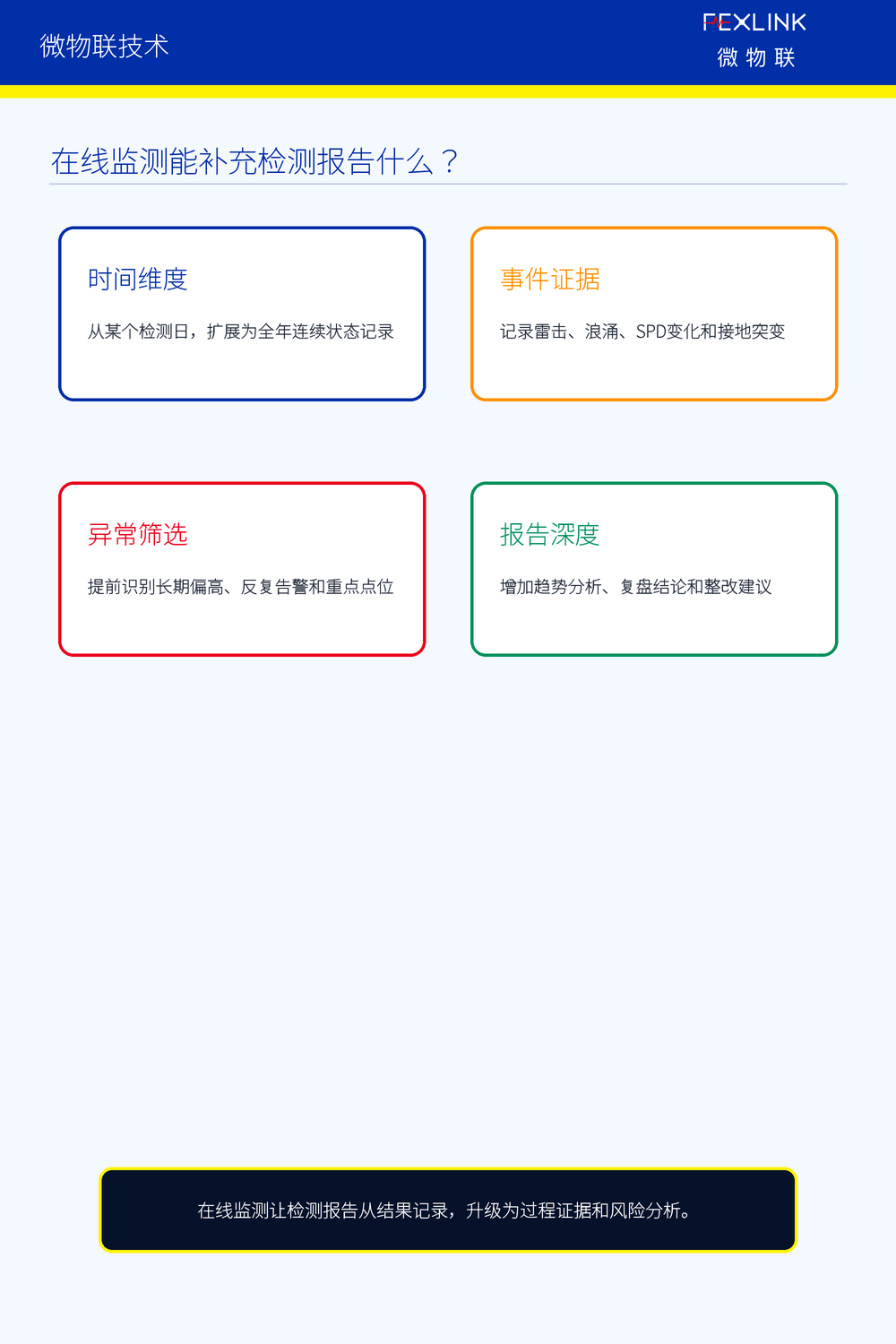
First, add the time dimension. Traditional detection is a certain point in time, while online monitoring is a continuous timeline. It can record the long-term trend of ground resistance, SPD status change trend, leakage temperature change, equipment offline record and lightning current event record.
Second, supplement the evidence of the incident. After a lightning strike or surge occurs, the platform can record the time of occurrence, peak intensity, impact point, SPD status change, whether the grounding is mutated, and whether the equipment alarms synchronously. This is more valuable than second-guessing.
Third, supplement abnormal screening. Online monitoring can help detection companies know in advance which points are high for a long time, which SPDs give repeated alarms, which areas have frequent lightning strikes, which equipment is often offline, and which grounding points need priority review. In this way, on-site inspection is no longer a blind census, but a review with questions.
Fourth, add depth to the report. Traditional reports are more about test results. When combined with online monitoring, trend analysis, abnormal review, special assessment after thunderstorms, rectification suggestions, closed-loop operation and maintenance records, and annual health scores can be added.
4. What new services can lightning protection testing companies form?
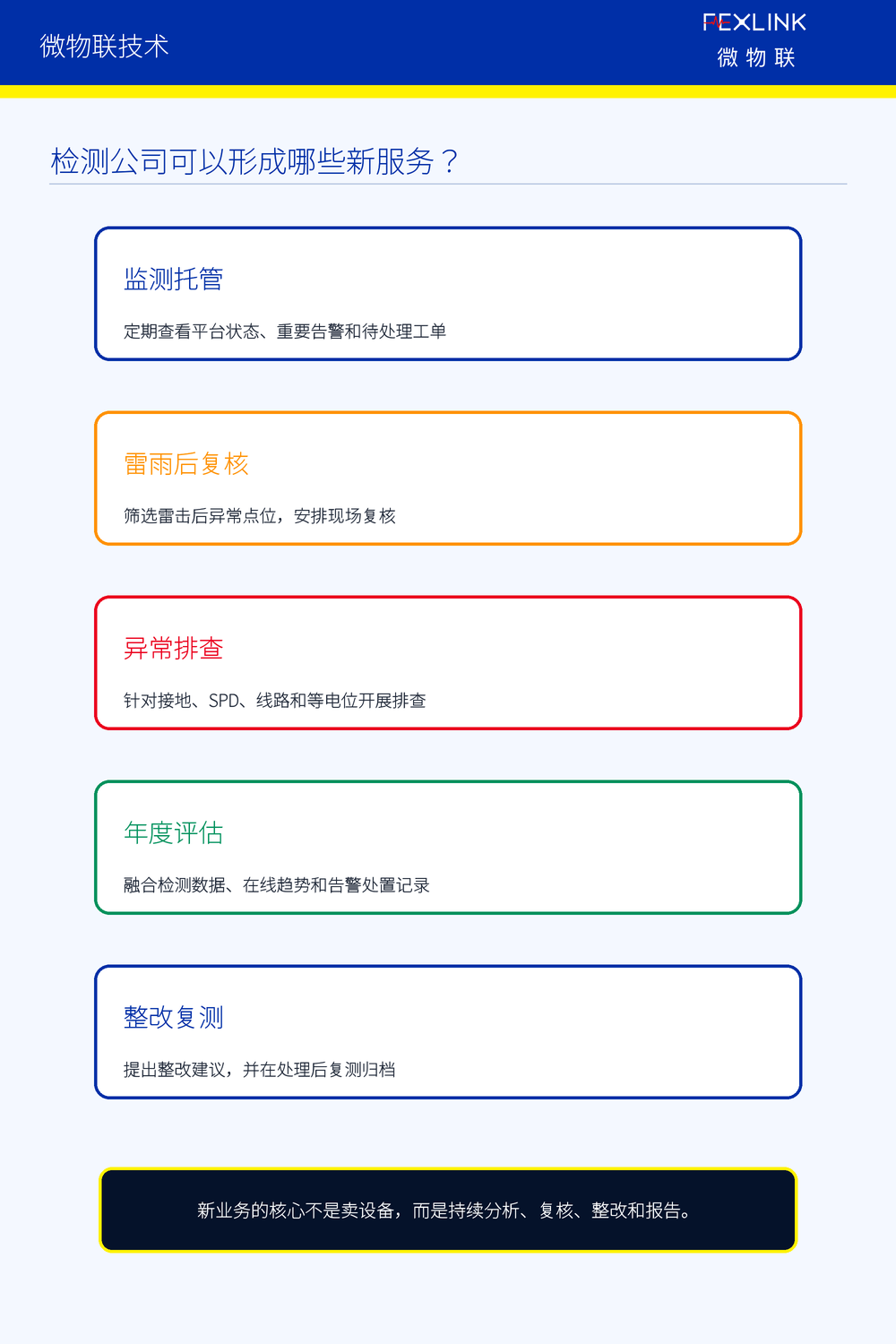
First, monitor hosting services online. Testing companies can regularly check platform data for customers, including equipment online status, SPD status, grounding trends, lightning current events, important alarms and pending work orders. This type of service is suitable for scenarios such as campuses, computer rooms, schools, hospitals, industrial enterprises, and communication sites.
Second, special review services after thunderstorms. After a thunderstorm, the testing company can screen key points based on platform data: points where lightning current events occur, points where SPD status changes, points where grounding mutations occur, points where equipment synchronization is abnormal, and points where repeated alarms occur, and then arrange for on-site inspection and review.
Third, on-site inspection services for abnormal points. After an abnormality is discovered on the platform, the testing company can provide services such as ground connection review, SPD status confirmation, line inspection, equipotential inspection, ground resistance retest, and lightning protection box inspection.
Fourth, annual lightning protection health assessment services. Upgrade the traditional annual inspection report to "test results + online monitoring trends + lightning current events + alarm handling records + rectification suggestions + annual risk portrait". This has more management value than a single detection report.
Fifth, rectification suggestions and retest services. Based on the data, the testing company can make suggestions such as replacing SPDs, adding monitoring points, optimizing grounding, making equal potentials, adjusting lightning protection zones, strengthening key equipment protection, etc., and conduct retesting and filing reports after rectifications.
5. How to combine online monitoring and offline testing?
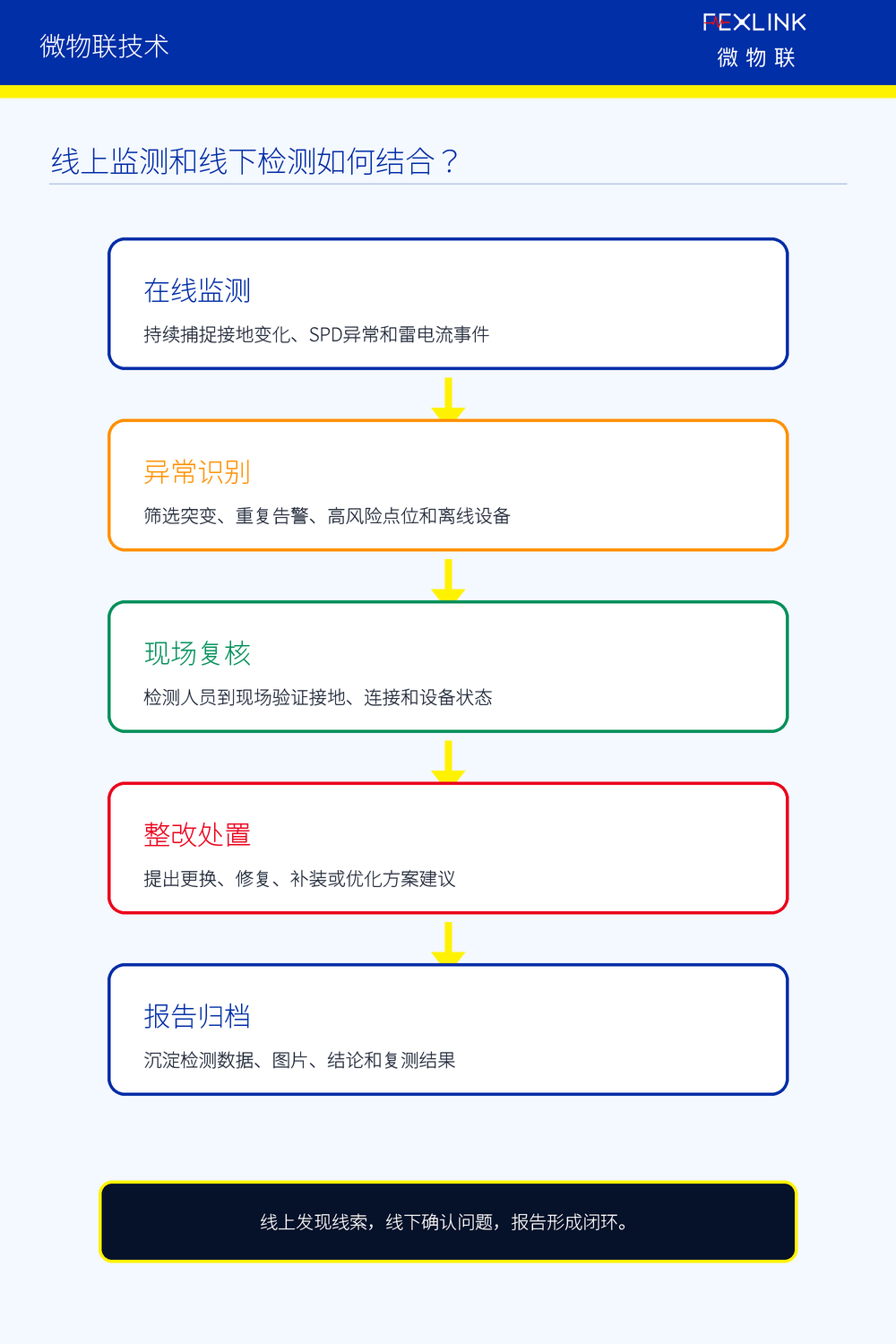
The first step is to detect problems through online monitoring. The platform continuously captures grounding changes, SPD anomalies, lightning current events, equipment offline and repeated alarms to form abnormal clues.
In the second step, the detection company conducts abnormal analysis and judgment. The inspectors use on-site experience to determine whether on-site review is required, whether it is a false alarm, whether it is related to thunderstorm weather, and whether the customer needs to handle it immediately.
The third step is on-site inspection and review. Go to the site to verify the ground resistance, connection status, SPD status, line status, equipotential conditions and installation environment.
The fourth step is to issue rectification suggestions. Instead of just saying "unqualified", explain where the problem is, what the risks are, how to make changes, what the priority is, and whether retesting is needed.
The fifth step is to form a closed-loop report. The final results are abnormal records, on-site photos, inspection data, rectification suggestions, processing results, retest conclusions and archived reports.
6. What are the pitfalls when upgrading a lightning protection testing company?
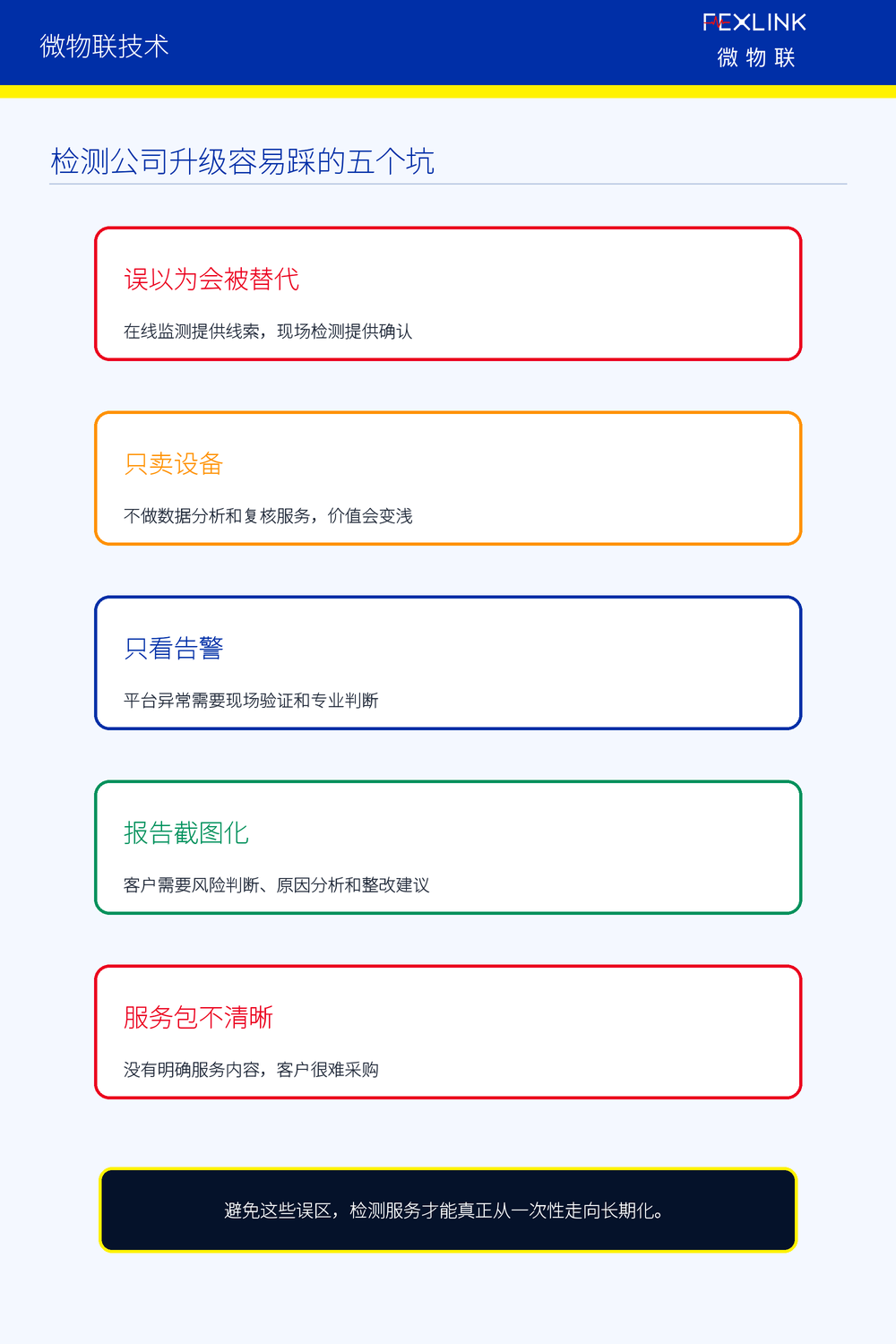
Misunderstanding 1: Online monitoring will replace testing. The correct understanding should be: online monitoring provides clues, and on-site testing provides confirmation. The relationship between the two is not a substitute, but a complementary relationship.
Misunderstanding 2: We only sell equipment and do not provide data services. If a testing company only sells monitoring equipment, it is easy to return to one-time sales. What’s really valuable is continuous viewing, analysis, review and reporting.
Misunderstanding 3: Only read platform alarms without conducting on-site review. Platform alarms require on-site verification, and the professional value of a testing company lies in its ability to convert online anomalies into offline confirmations.
Misunderstanding 4: Reports are just screenshots of data. Customers don't need a bunch of screenshots. What they need is risk judgment, cause analysis, rectification suggestions, review results and management conclusions.
Misunderstanding 5: There is no standard service package. If the service content is not clear, it will be difficult for customers to purchase. It is recommended to form a basic monitoring and hosting package, a post-thunderstorm review package, an annual health assessment package, a key point diagnosis package and a rectification and retest service package.
7. How does FEXLINK understand the combination of detection and online monitoring?
FEXLINK believes that the future of lightning protection detection is not to be replaced by online monitoring, but to obtain new service entrances through online monitoring. Online monitoring turns the originally invisible operating process into data clues, and inspectors turn the data clues into on-site confirmation and professional conclusions.
FEXLINK focuses on: whether detection data and online data can be unified, whether trend anomalies can be discovered in advance, whether lightning strikes can be traced, whether on-site reviews can be carried out accurately, whether rectification recommendations can be closed-loop, and whether customer reports can be continuously output.
It can be summarized as three changes: from regular testing to continuous observation; from result reporting to process evidence; from one-time testing to long-term service.
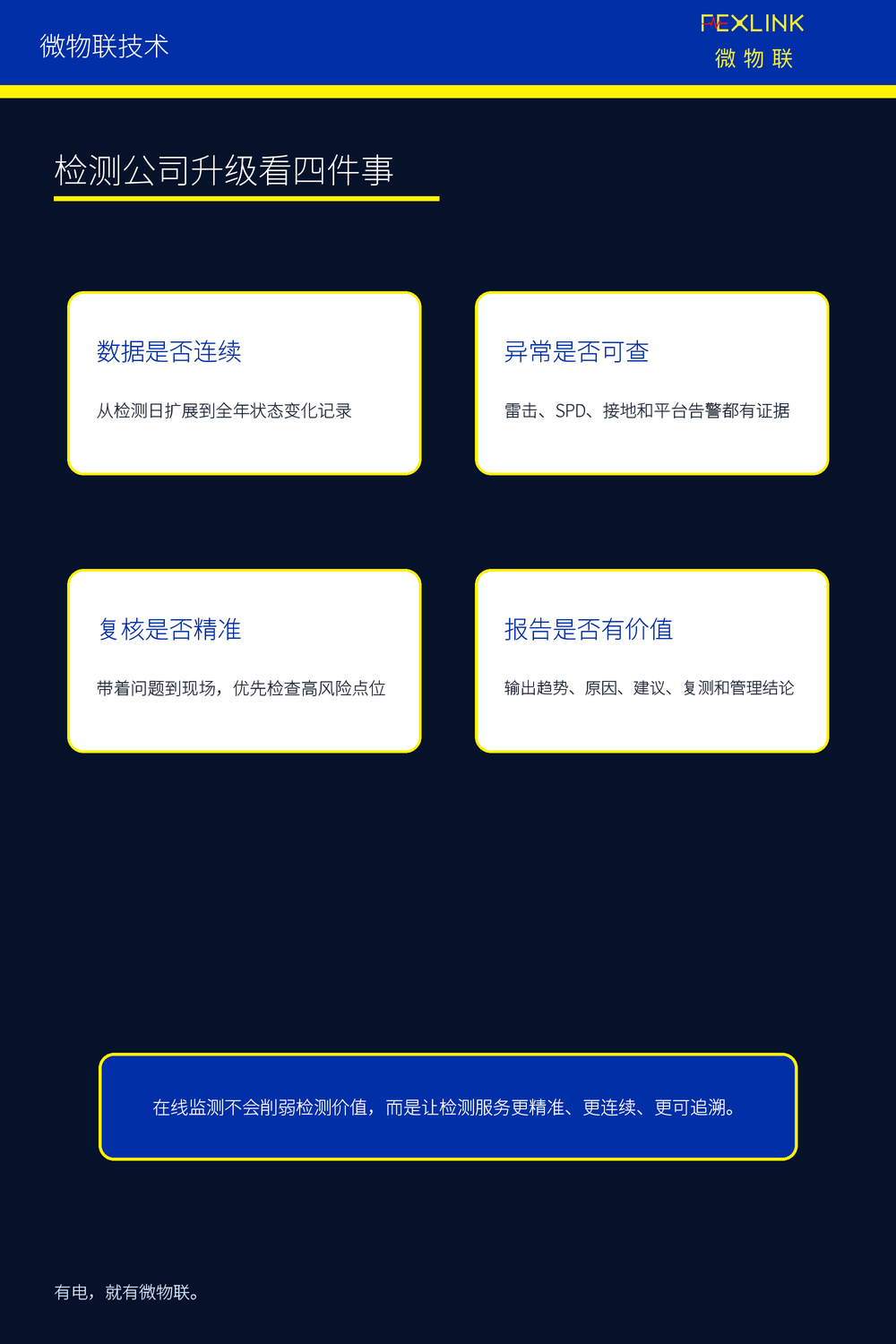
Conclusion: Online monitoring makes testing services more accurate, more continuous, and more evidence-based.
The professional value of a lightning protection detection company will not be reduced by online monitoring. On the contrary, with online monitoring, the testing company's services can be more accurate, continuous, and have a chain of evidence.
In the future, customers will need not just a test report, but a set of lightning protection security services that can continuously identify, explain, review, rectify and archive problems.
If lightning protection testing companies can combine on-site professional experience with online monitoring data, they have the opportunity to upgrade from annual testing services to long-term lightning protection safety services.
FEXLINK technology will continue to share content related to intelligent lightning protection, early warning of electrical safety, digital power distribution, energy supervision and industrial Internet of Things.
FEXLINK/FEXLINK uses data to reconstruct energy efficiency and electrical safety.
Where there is electricity, there is FEXLINK.