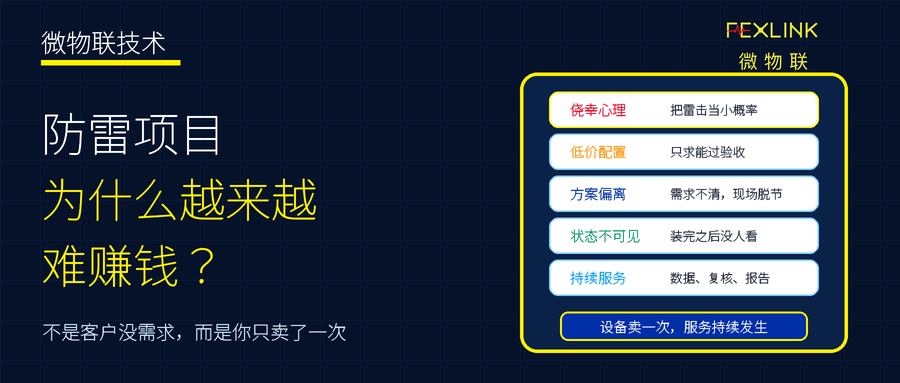
Public account cover picture: Why is it increasingly difficult to make money from lightning protection projects?
Abstract: Many lightning protection manufacturers, power distribution manufacturers and engineering companies will feel that projects are becoming more and more difficult to complete: customers compare prices, profits are suppressed, relationships weaken after project acceptance, and they may not necessarily return to the original service provider for the next order. The problem is not necessarily that customers do not need lightning protection, but that the traditional model makes lightning protection a one-time project. At the same time, there is also a common fluke mentality in the industry: it is believed that lightning strikes are a small probability event, and the product is installed and it is done. Even the product quality and solution configuration may not really match the on-site risks. The value of intelligent lightning protection is to turn the long-term operating status after installation into continuous services: online monitoring, review after thunderstorms, abnormality troubleshooting, maintenance and replacement, periodic reports, annual evaluations and rectification suggestions. Only by allowing customers to continue to see risks, see disposals, see reports, and see the value of management can lightning protection projects have the opportunity to transform from one-time delivery to long-term relationships.
It’s not that there’s no demand for many lightning protection projects, but it’s becoming increasingly difficult to make money. It’s not that customers don’t install lightning protection, but they often only care about whether they can pass the acceptance inspection, whose price is lower, and whether all the information can be submitted. After the project is completed, customers rarely look at the lightning protection system again, and it is difficult for service providers to naturally make the next purchase.
For enterprises, the result is that equipment is sold thinner and thinner, projects become more and more complicated, after-sales service becomes more and more difficult to explain, and customer relationships quickly weaken after acceptance. It’s not that the lightning protection industry has no long-term value, but many companies have only completed the first delivery and have not designed entrances for the second, third and long-term services.
More importantly, many people regard lightning protection as a small probability event, regard lightning protection products as acceptance accessories, and regard lightning protection plans as paper configurations. The project appears to be completed, but the real risks are not continuously managed, and the customer does not see the subsequent value.
1. Why are traditional lightning protection projects so easy to end at once?
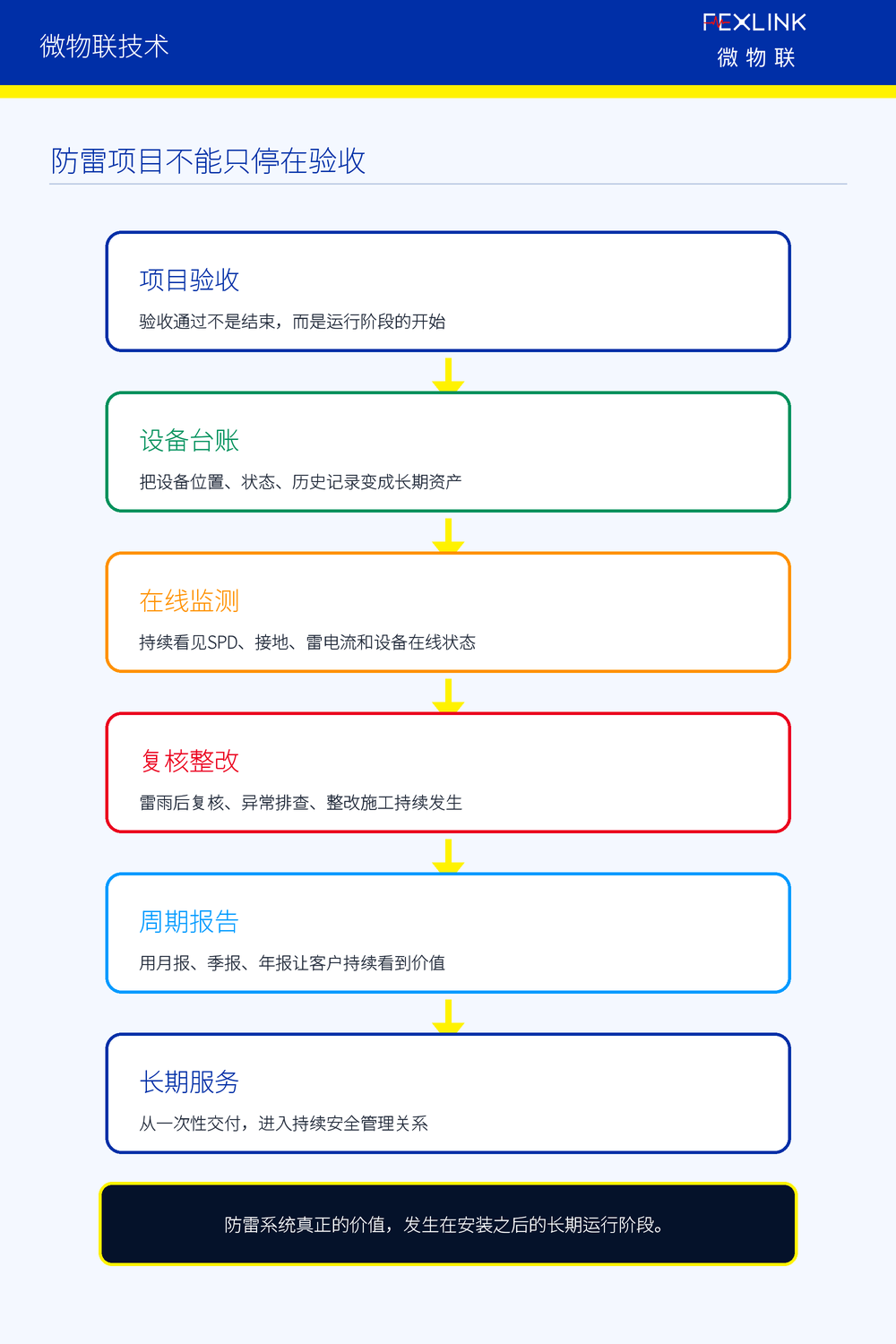
The common processes of traditional lightning protection projects are on-site survey, scheme design, equipment procurement, construction and installation, inspection and acceptance, data archiving and project settlement. There is nothing wrong with this process itself, but it naturally takes "acceptance passing" as the end point. The thing is, the real value of a lightning protection system occurs during the operational phase.
Most traditional SPDs, lightning protection boxes and grounding systems are silent devices. Normally, customers cannot see whether the SPD has deteriorated, whether the leakage current has increased, whether the temperature is abnormal, whether the grounding has changed, whether a lightning strike has occurred, or whether the alarm has been handled. If you can’t see the data, you can’t see the value; if you can’t see the value, it’s difficult to continue paying.
There is another awkward point about the lightning protection system: when it works, the customer may not feel it; when there is no accident, the customer feels it is unnecessary; when an accident occurs, the customer feels that it is not well protected. Therefore, enterprises must make the implicit security value explicit.
2. Many lightning protection projects plant low-value seeds from the beginning.
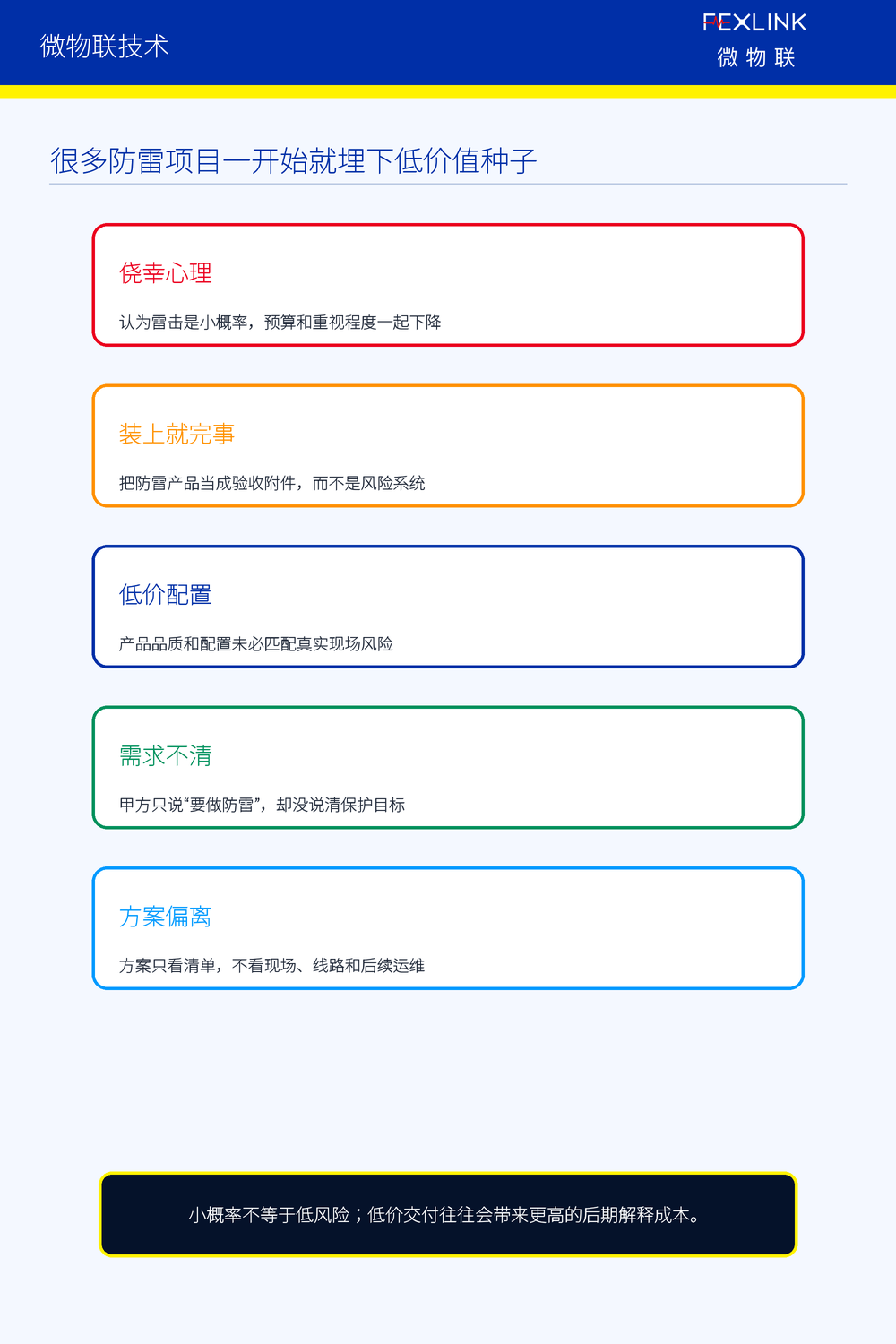
The first is luck. Many customers and project parties do not need lightning protection at all, but they think that there have been no accidents before, there should not be many lightning strikes in this place, and it is enough to install a lightning protector and it can pass the acceptance test, and the probability of an accident is small. As a result, the budget was reduced, the plan was simplified, and subsequent operation and maintenance was weakened.
But low probability does not mean low risk. Problems such as lightning strikes, surges, grounding abnormalities, and SPD degradation may not necessarily be visible at ordinary times, but once they occur, they may cause equipment damage, communication interruption, system shutdown, data loss, safety accidents, and liability disputes. Many electrical safety risks are worth managing precisely because they are low-frequency but high-loss.
The second is the mentality of “install it and you’re done”. Many projects understand lightning protection as having it in the drawings, installed in the cabinet, passing the test, and filing the data. A truly effective lightning protection system is not a single-point product, but a complete link including risk identification, lightning protection zoning, lightning conductors, grounding equal potential, power SPD, signal SPD, communication line protection, installation technology, post-testing, online monitoring and post-thunderstorm review.
The third is that product quality and configuration may not match the actual scenario. Many projects appear to be configured on paper, but there may be problems such as mismatch between product grade and on-site risk, flow capacity only looking at parameters but not application boundaries, only configuring power SPD but ignoring signals and communication lines, unreasonable backup protection configuration, product status unable to be remotely monitored, and low-configuration solutions still being used in key scenarios. The cheaper the lightning protection product, the more cost-effective it is, but the less likely it is to match the risk, and the higher the cost of subsequent explanation.
The fourth is that the demand side does not understand the real demand. Many demands put forward by Party A are only "need to be lightning protection", "need to meet acceptance", "need to equip several SPDs" and "need a test report". But what should really be analyzed is what the protection objects are, whether the equipment is of high value, whether the downtime loss is significant, whether the lines are introduced outdoors, whether the weak current communication control lines need protection, whether the grounding system is stable, whether the local thunderstorm activity is strong, and whether there are subsequent operation and maintenance capabilities.
Many lightning protection solutions are not poorly designed, but the requirements are simplified from the beginning. What the customer asked was "I want to install a lightning protector", but the real demand may be "I want to ensure the continuous operation of the equipment, reduce the risk of shutdown during thunderstorms, and be able to trace the cause after an accident." If the requirements are not re-translated into risk language, the plan will easily become a product allocation based on a list, rather than a system based on scenarios.
3. Why are customers unwilling to continue investing?
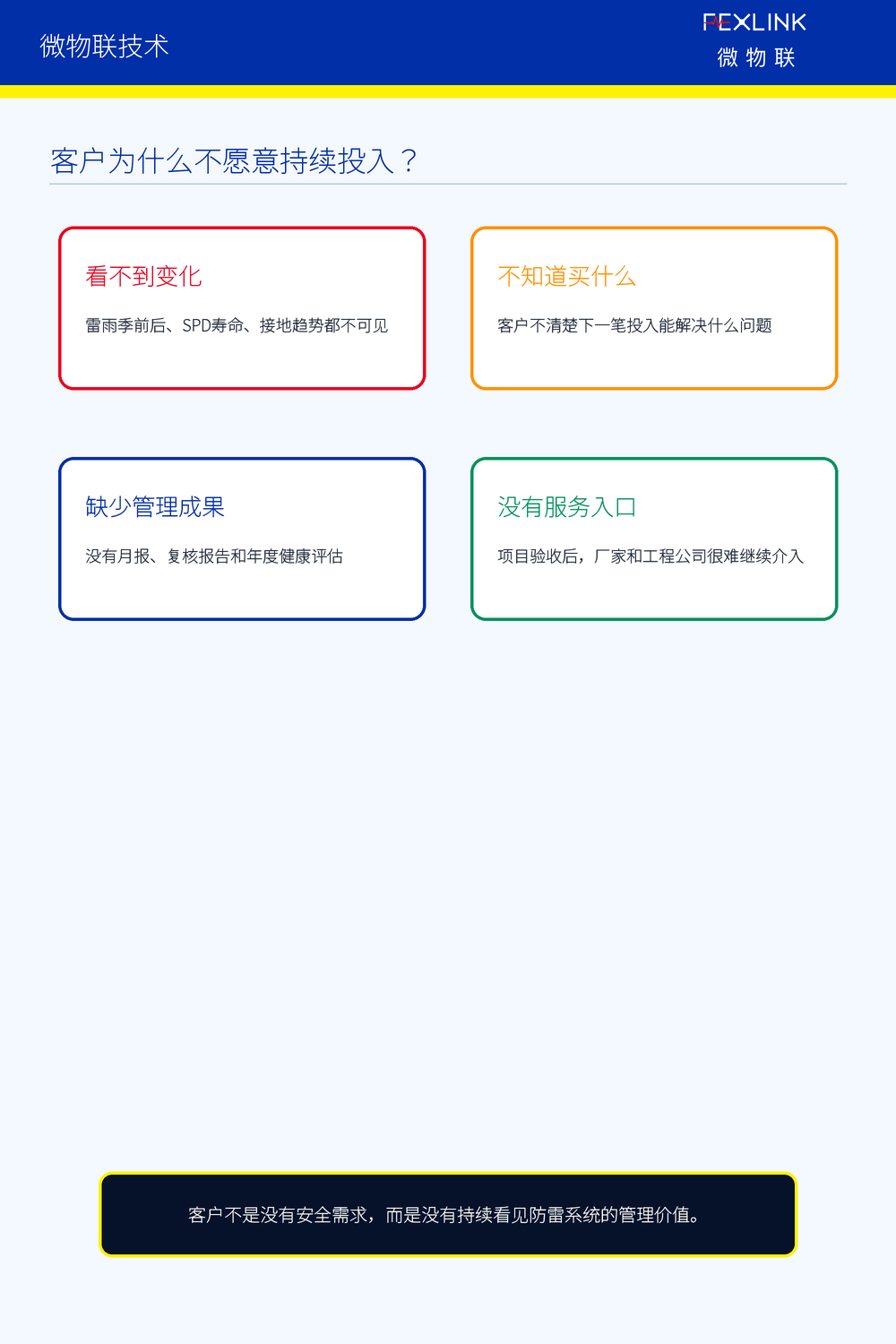
It's not that customers often don't have security needs, it's that they don't see continued change. What customers see is that it has been installed, tested, accepted, and the information is complete, but they rarely see the status changes before and after the thunderstorm season, SPD life changes, grounding trend changes, risk changes at key points, and the relationship between equipment abnormalities and lightning protection events.
Customers also don’t know what they will buy with their next money. If a company only says to add another set of monitoring equipment, add another platform, and do another upgrade, customers can easily ask: Why? What's the use? What will happen if you don’t do it? What problems can be solved? Therefore, products must be turned into service results.
Another big reason is that customers don't receive ongoing reports. After many projects are installed, customers can no longer see the staged results. Without monthly status reports, post-storm review reports, quarterly risk trends, annual health assessments, and a list of recommended improvements, customers will naturally feel that the lightning protection program is over.
4. How can lightning protection projects change from one-time to continuous?
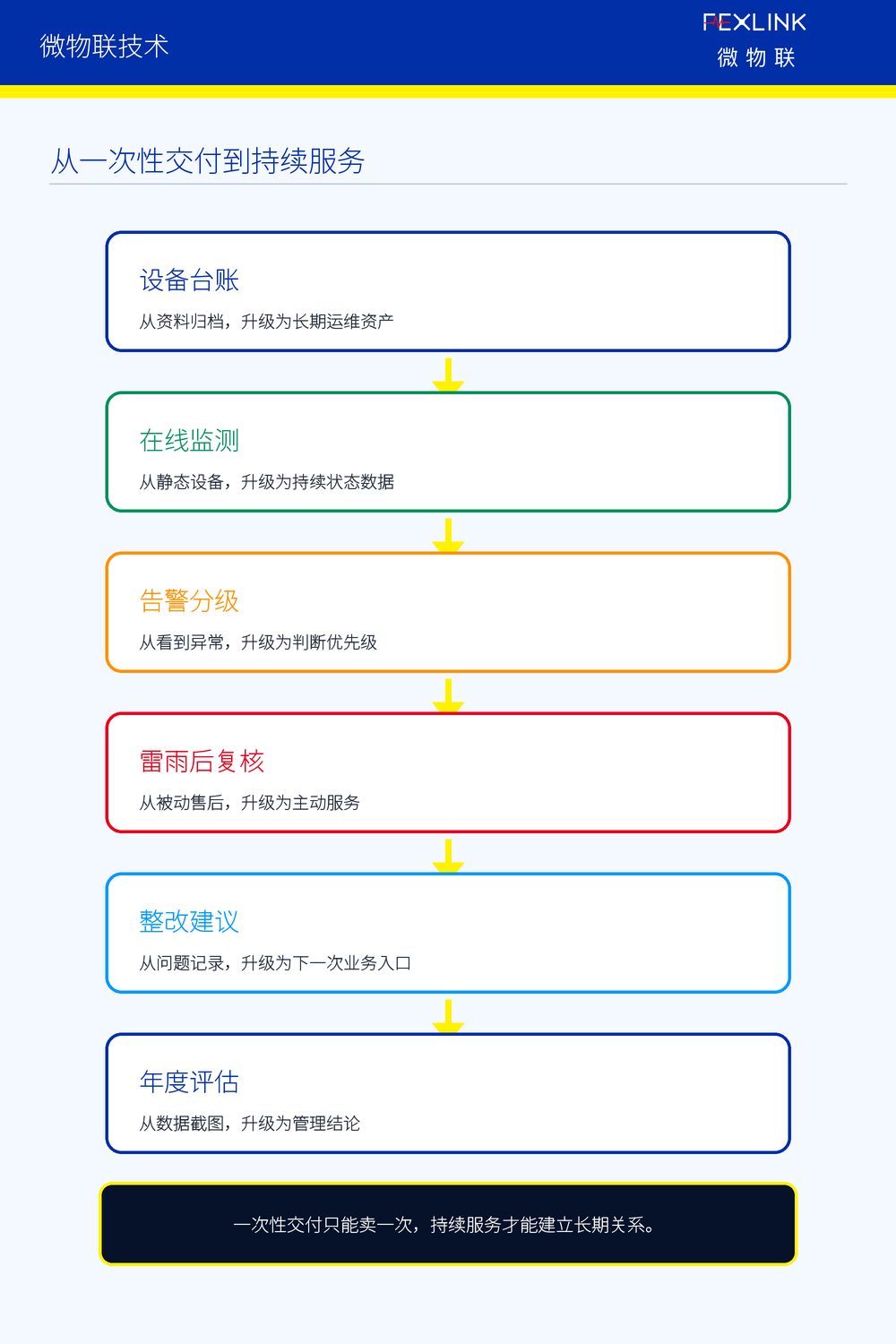
First, turn the equipment ledger into a long-term asset. It not only records what equipment is installed, where it is installed, when it was installed, who did the work, and whether it was accepted, but also records equipment status, alarm history, replacement records, lightning strike events, review records, and rectification records. The ledger is not a data archive, but a long-term service portal.
Second, turn online monitoring into a service portal. Online monitoring is not just for showing pages to customers, but also for continuously discovering SPD status abnormalities, grounding changes, equipment offline, lightning current events, temperature anomalies and repeated alarms. Monitoring data itself is not the end, but data-based judgment and services are.
Third, make post-thunderstorm review a regular service. After a thunderstorm, customers actually need to know which points have experienced lightning strikes, which SPD status changes, which grounding status mutations, which equipment synchronization abnormalities, and which points require on-site review. This kind of service makes it easy for customers to feel the value.
Fourth, turn the report into a result that customers can understand. Don’t just export the data table, but output management conclusions: what is the overall status this month, which points have increased risks, which equipment needs to be replaced, which alarms have been handled, which problems have reoccurred, and what is recommended for the next step. Reports are the visible deliverables of the service.
Fifth, turn the rectification suggestions into the next business entrance. Continuous services will eventually lead to SPD replacement, grounding optimization, new monitoring points, signal lightning protection reinforcement, lightning protection box or power distribution cabinet upgrades, platform service renewal and annual maintenance contracts. This is not a hard sell, but a natural extension based on data and risk.
5. How can intelligent lightning protection services be packaged?
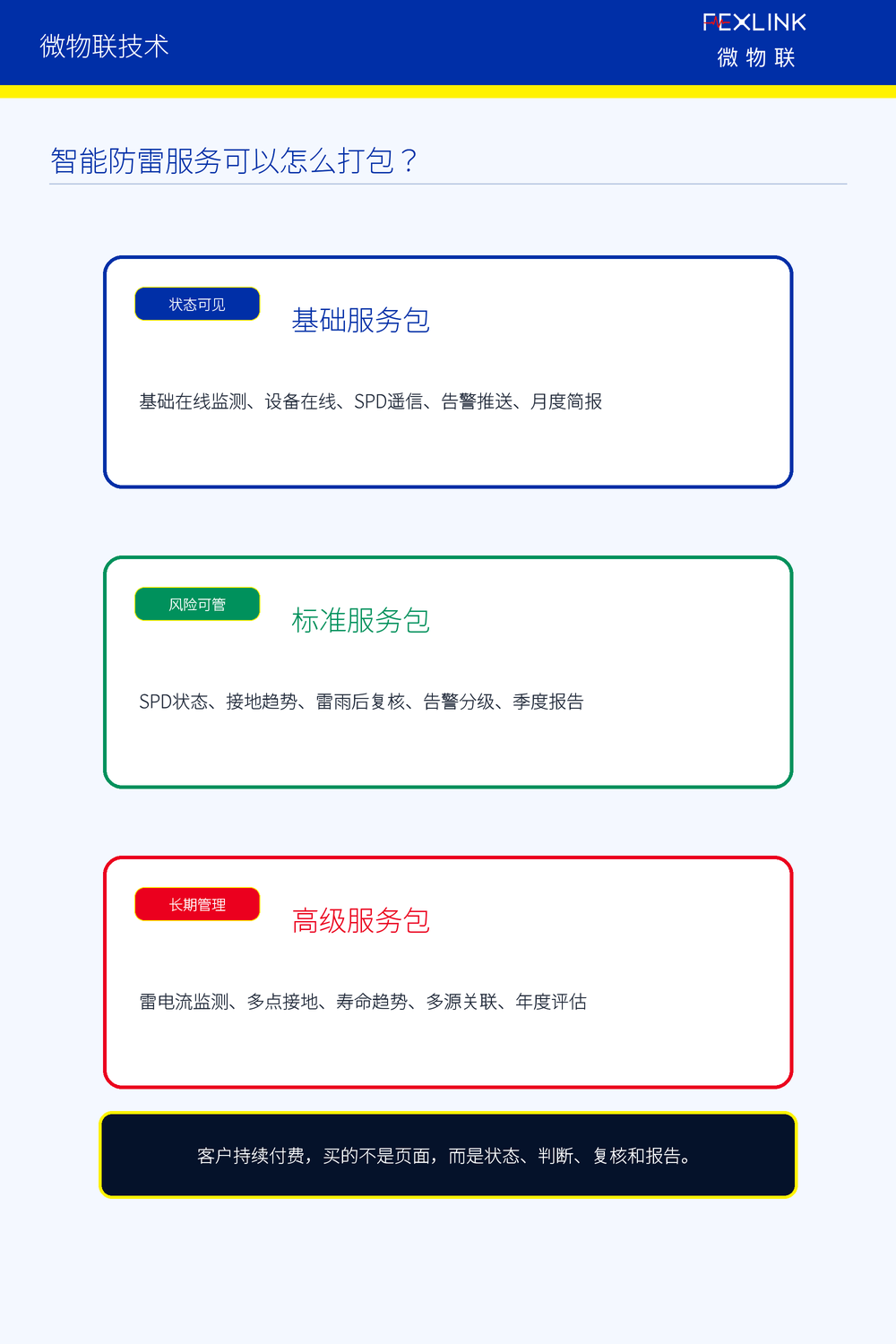
The goal of the basic service package is to make status visible to customers. Suitable for customers with limited budgets or those who are just starting to become intelligent, the content can include basic online monitoring, equipment online status, SPD remote signaling status, basic alarm push and monthly briefings, achieving a transition from "installed and unaware of the status" to "remotely visible".
The goal of the standard service package is to allow clients to manage risks. It is suitable for power distribution rooms, computer rooms, parks, schools, hospitals, communication sites and new energy stations. The content can include SPD status monitoring, grounding trend monitoring, post-thunderstorm review suggestions, alarm classification, work order closed loop and quarterly risk reports, realizing the transition from "abnormal discovery" to "abnormal handling".
The goal of the Advanced Service Package is long-term security management. It is suitable for petroleum and petrochemicals, wind power, photovoltaic energy storage, data centers, transportation facilities and large industrial parks. The content can include lightning current monitoring, multi-point grounding monitoring, SPD life trend, multi-source data correlation, annual risk assessment, special rectification suggestions and expert review services, realizing the transformation from "single point monitoring" to "risk management system".
6. How should different enterprises find their own service entrances?
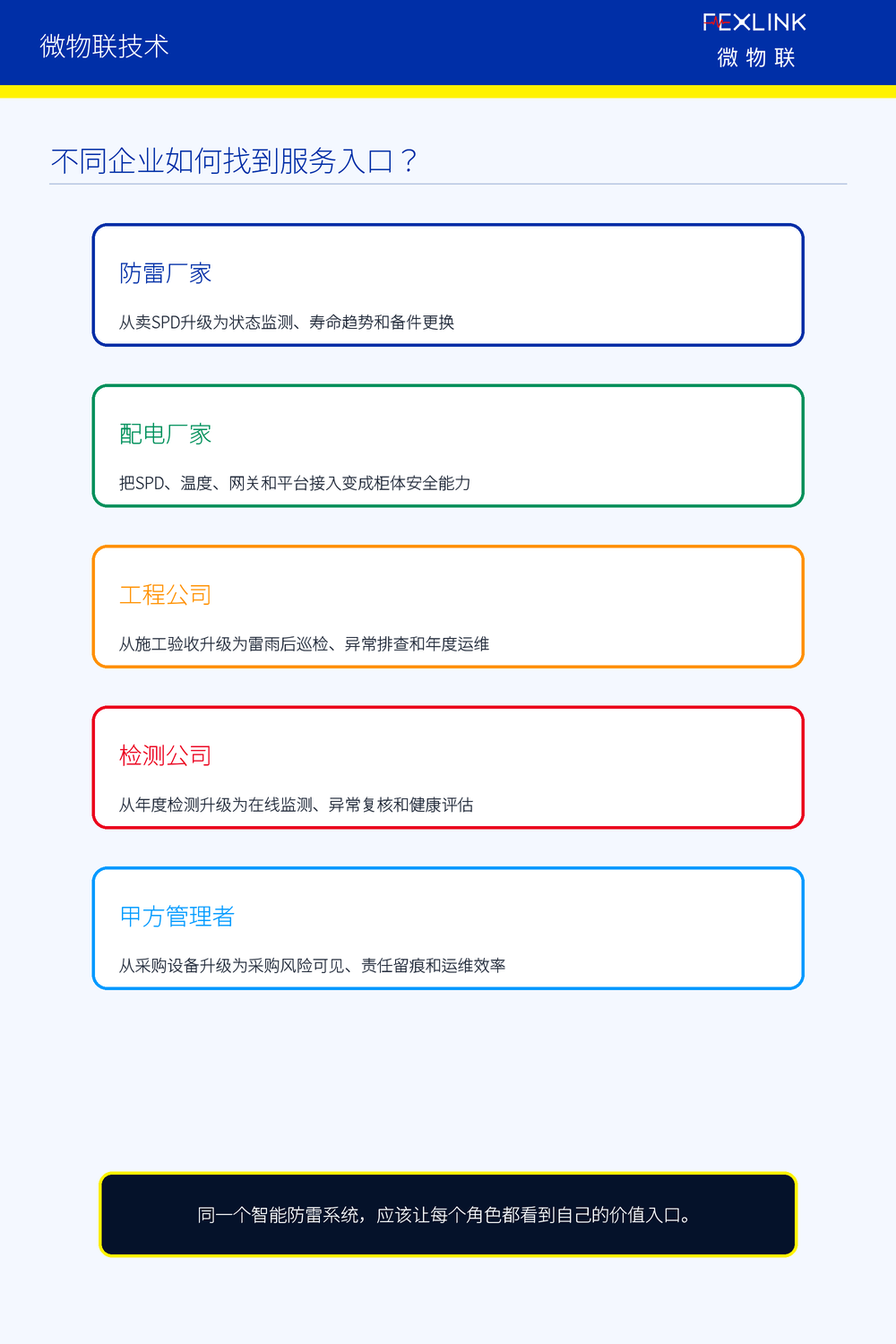
Lightning protection manufacturers can upgrade from selling SPD to SPD status monitoring, life trend judgment, post-lightning review recommendations and spare parts replacement services. In this way, the product is not just installed, but continues to participate in the customer's security management.
Power distribution manufacturers can upgrade from selling cabinets to smart power distribution cabinets in a safe state, combining SPD monitoring, temperature monitoring, communication gateways, remote alarms and platform access in the cabinets into power distribution security capabilities.
Engineering companies can upgrade from construction acceptance to annual operation and maintenance contracts, post-thunderstorm inspections, abnormality investigation, rectification construction and report delivery. Project acceptance is not the end of the relationship, but the beginning of long-term service.
Testing companies can upgrade from annual testing to "testing + online monitoring + abnormal point review + annual health assessment + rectification and retesting". The test report determines whether it is qualified at a certain point in time, and the online monitoring determines whether the operation process is continuous and stable.
Party A and managers must also upgrade from purchasing equipment to purchasing continuous security services, making purchasing risks visible, traces of responsibility and operation and maintenance efficiency, rather than just looking at the price of a certain product.
7. How does FEXLINK understand the long-term value of lightning protection projects?
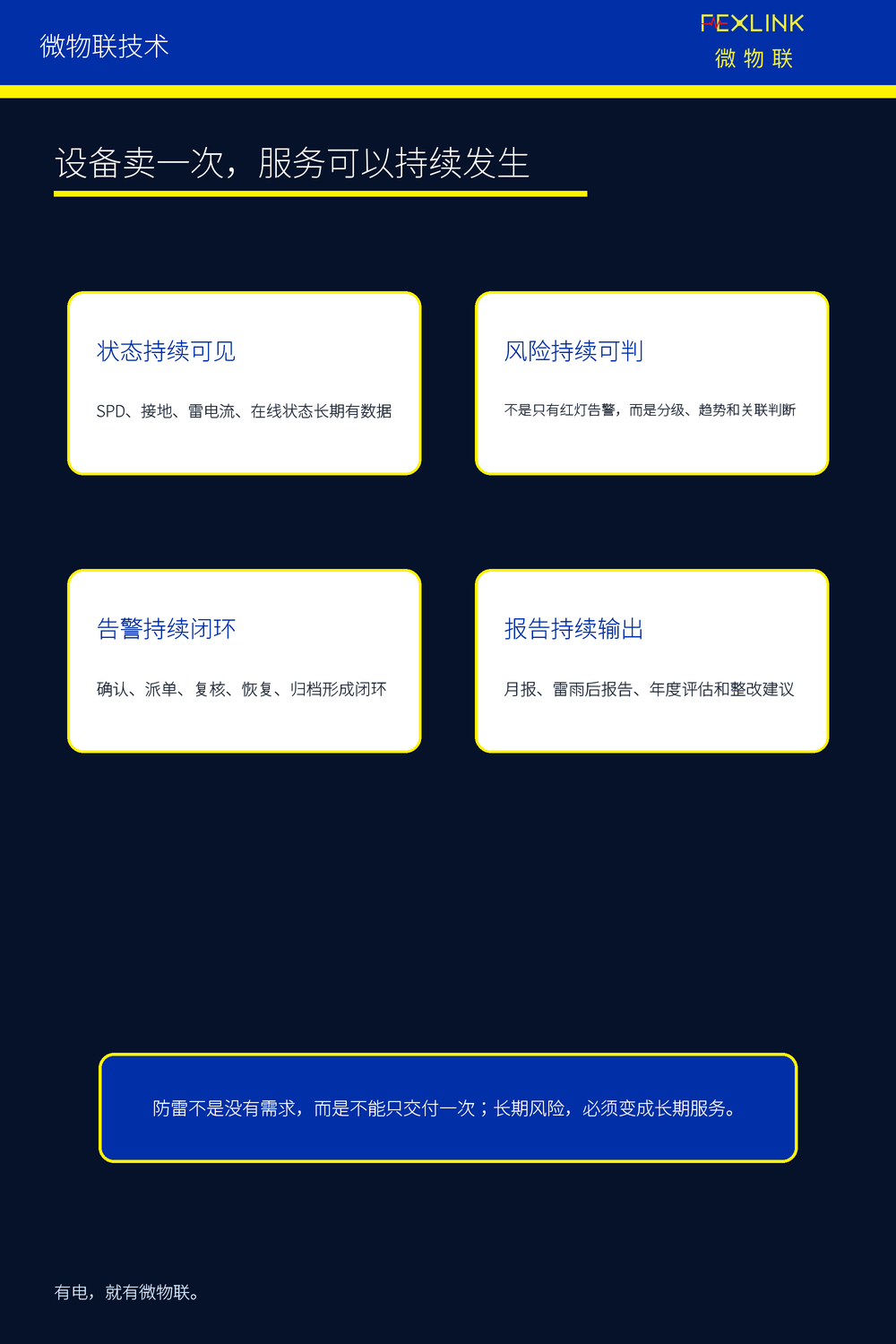
FEXLINK believes that lightning protection projects should not just stay in the installation and acceptance stage, but should become a long-term system that continuously produces safety data, continues to support operation and maintenance decisions, and continues to output service reports.
What FEXLINK focuses on is not that the customer buys an extra device, but whether the status is continuously visible, whether the risk continues to be judged, whether the alarm continues to be closed, whether the report continues to be output, and whether the service continues to occur.
A truly viable smart lightning protection project should form a closed loop of “equipment delivery → condition monitoring → risk diagnosis → review and rectification → report and evaluation → continuous service”. In this way, lightning protection is no longer just an acceptance cost, but a part of the customer's long-term safety management.
Conclusion: Lightning protection does not mean that there is no demand, but it cannot be delivered only once.
It is becoming increasingly difficult to make money on lightning protection projects, not because customers have no safety needs, but because many companies are still stuck in the one-time delivery model. The equipment can be sold once and the project can be done once, but the risk is always there. Thunderstorms come every year, SPDs will age, grounding will change, sites will be renovated, and customers' safety management requirements will become higher and higher.
More importantly, luck, low-price configuration, unclear requirements and off-site solutions will cause lightning protection projects to lose their long-term value from the beginning. Whoever can transform these long-term changes into data, judgment, review, rectification and reporting will have a better chance of jumping out of the low-price competition.
Intelligent lightning protection in the future is not just about installing products, but also about making the system continuously visible, risks continuously clear, alarms continuously closed, and reports continuously delivered.
FEXLINK technology will continue to share content related to intelligent lightning protection, early warning of electrical safety, digital power distribution, energy supervision and industrial Internet of Things.
FEXLINK/FEXLINK uses data to reconstruct energy efficiency and electrical safety.
Where there is electricity, there is FEXLINK.