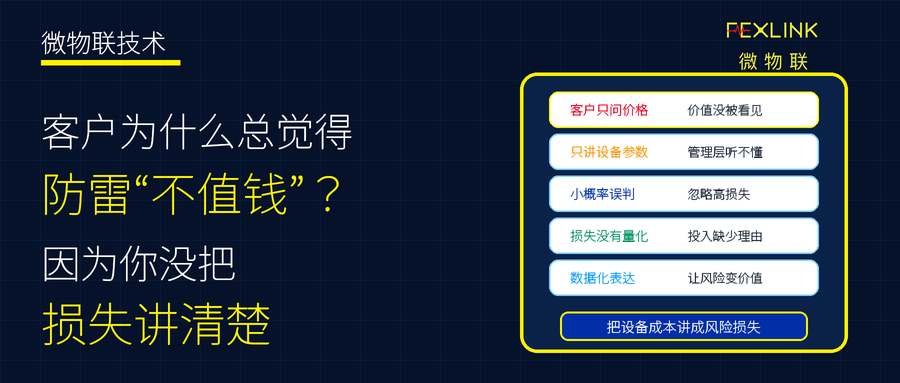
Public account cover picture: Why do customers always feel that lightning protection is “not worth the money”
Abstract: Many lightning protection manufacturers, power distribution manufacturers, engineering companies and testing institutions will encounter the same problem: a lot of product parameters are discussed, but customers still ask "how much" in the end; a lot of solution design is done, but Party A still thinks it can pass acceptance; the online monitoring platform displays many functions, but customers are not necessarily willing to continue investing. The root cause is often not that customers do not have lightning protection needs, but that we have not clearly explained the losses behind lightning protection. What customers see is the price of the equipment, but not the downtime losses, equipment damage, communication interruptions, liability risks, and operation and maintenance costs. The value of intelligent lightning protection is to use data to turn originally invisible risks and losses into management results that customers can understand, manage, and continuously evaluate.
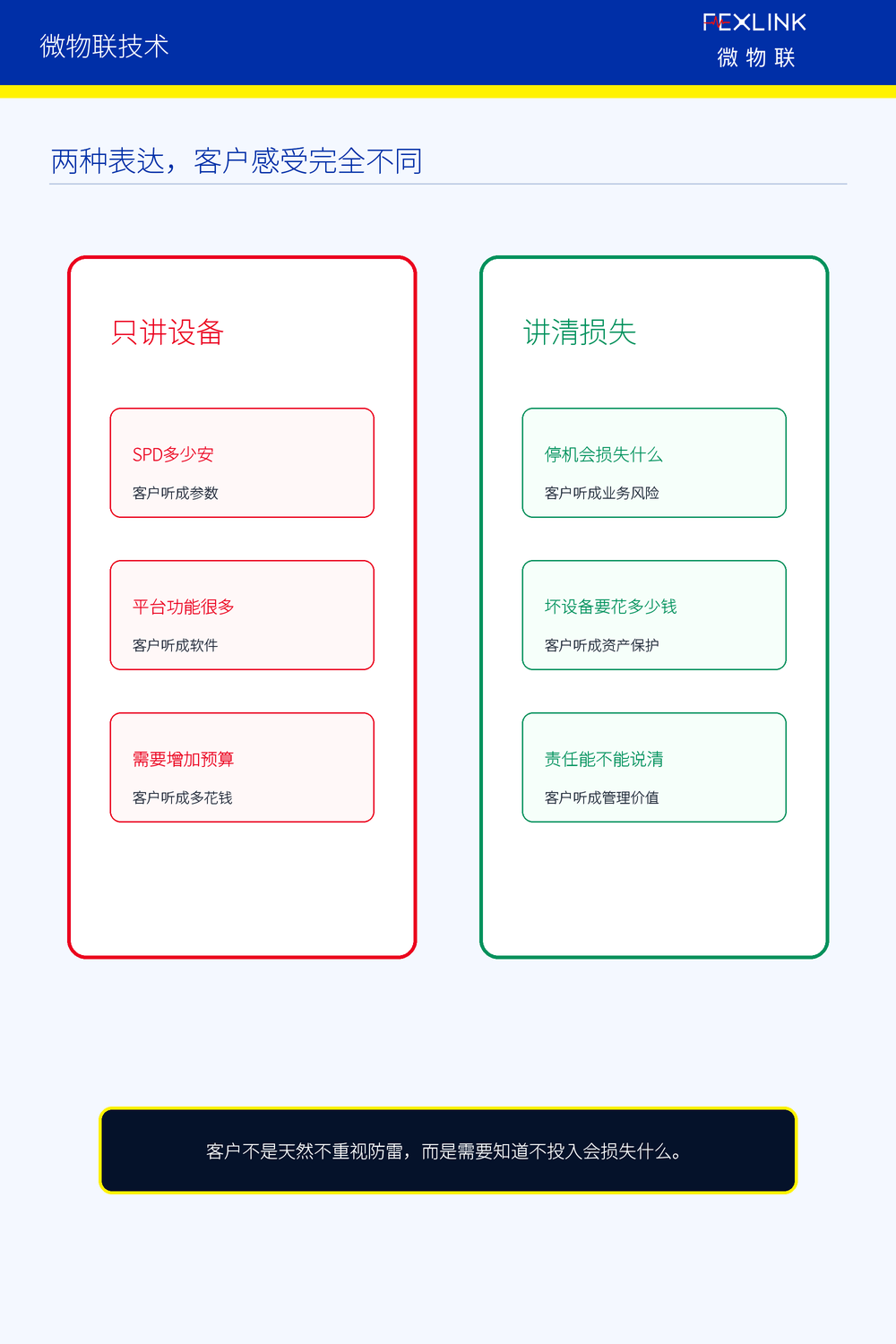
Customers feel that lightning protection is "not valuable", which does not necessarily mean that customers do not pay attention to safety. Many times, it is lightning protection companies that say the wrong thing. We are used to talking about SPD flow capacity, protection level, response time, platform functions, and monitoring points, but what customers really care about is: What will be lost if they don’t do it? If we do it, will there be one less machine downtime, one less equipment breakage, one less responsibility dispute, and one less operation and maintenance trouble?
The most difficult thing about lightning protection is that its value is often reflected in "no accidents". No damage, no downtime, no communication outages, no liability disputes, these are all values, but without data and reporting, they are difficult to perceive by customers. If customers do not perceive value, they will naturally only look at price.
Therefore, Part 51 must clarify a core issue: Lightning protection should not only talk about equipment, but also about losses; it should not only talk about parameters, but also about customers’ business risks; it should not only talk about one-time delivery, but also about long-term operation status, review, reporting and services.
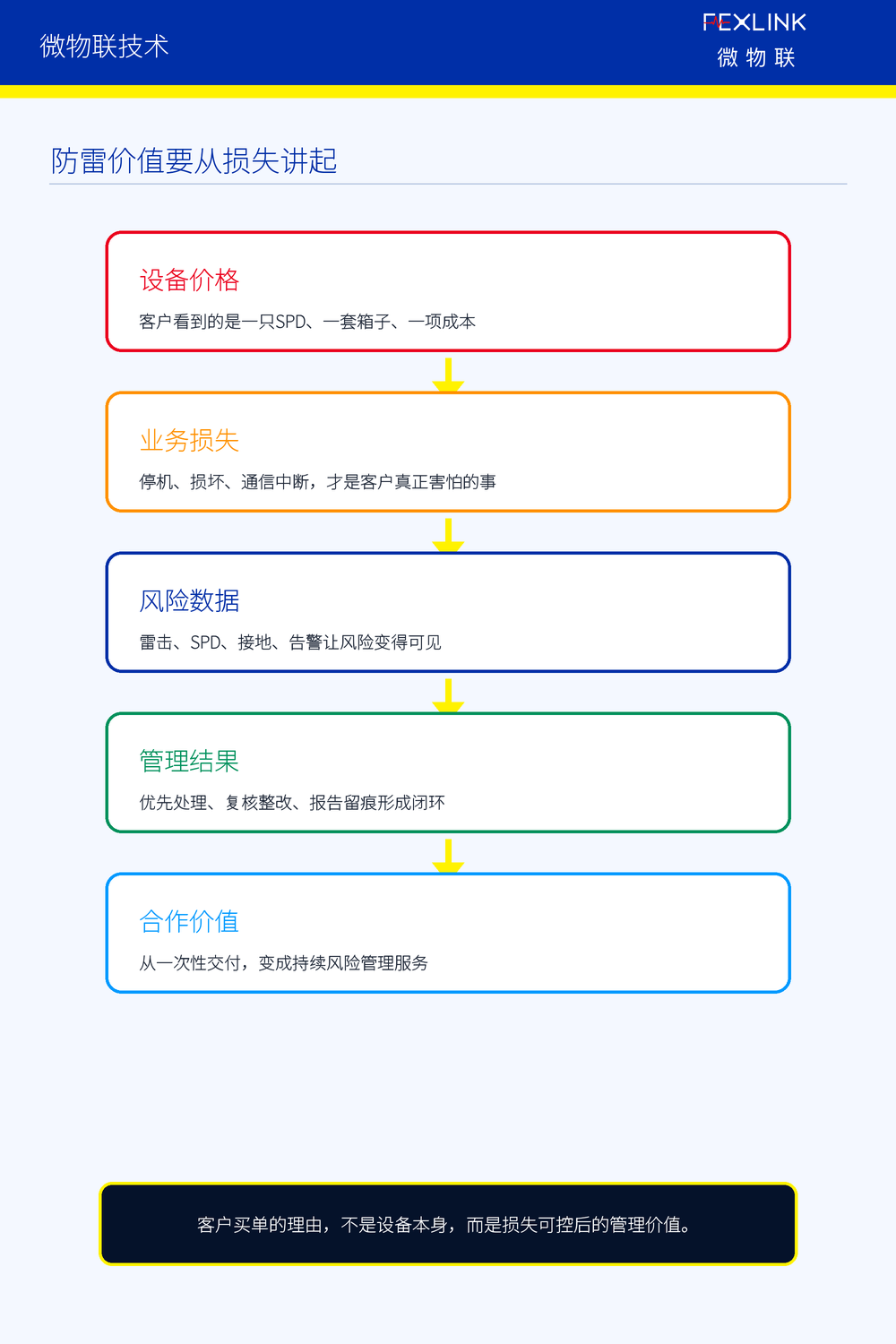
1. Why do customers always feel that lightning protection is “worthless”?
First, customers see costs, not losses. In many projects, lightning protection is included in the purchase list, project budget and acceptance materials. The first thing customers see is how much an SPD costs, how much a set of lightning protection boxes costs, and how much a set of platforms cost. However, customers have not seen simultaneously how much costs will be incurred in downtime, repair, replacement, troubleshooting and liability communication if key equipment is damaged by lightning surges.
Second, customers hear parameters, not results. Maximum discharge current, protection level, response time, remote signaling status, and sampling period are important to technicians, but for managers, they must be translated into result language: Which equipment is protected? Can abnormalities be discovered in advance? Can it be reviewed after a thunderstorm? Can you explain clearly what went wrong? Can an annual assessment report be produced?
Third, lightning protection is often regarded as an acceptance item. Many parties do not proactively raise lightning protection requirements from the perspective of business continuity and safety management. Instead, they require this configuration in the project, this information for acceptance, and this report for testing. When lightning protection is understood only as a compliance cost, it can hardly be considered “valuable.”
Fourth, many people misjudge lightning protection as a low-probability event. Lightning strikes, surges, and ground anomalies do not happen every day, but low probability does not mean low risk. On the contrary, low-frequency and high-loss risks require more management. Mass damage to equipment, communication interruption, or system shutdown during a thunderstorm season may be much higher than the lightning protection budget saved in the early stage.
Fifth, the lack of data prevents value from being continuously visible. After installing traditional lightning protection equipment, customers usually cannot see whether the SPD has deteriorated, whether the grounding has changed, whether a lightning strike has occurred, or whether the alarm has been handled. Without status data, event data, disposal data and reporting data, it will be difficult for customers to form a willingness to continue investing.
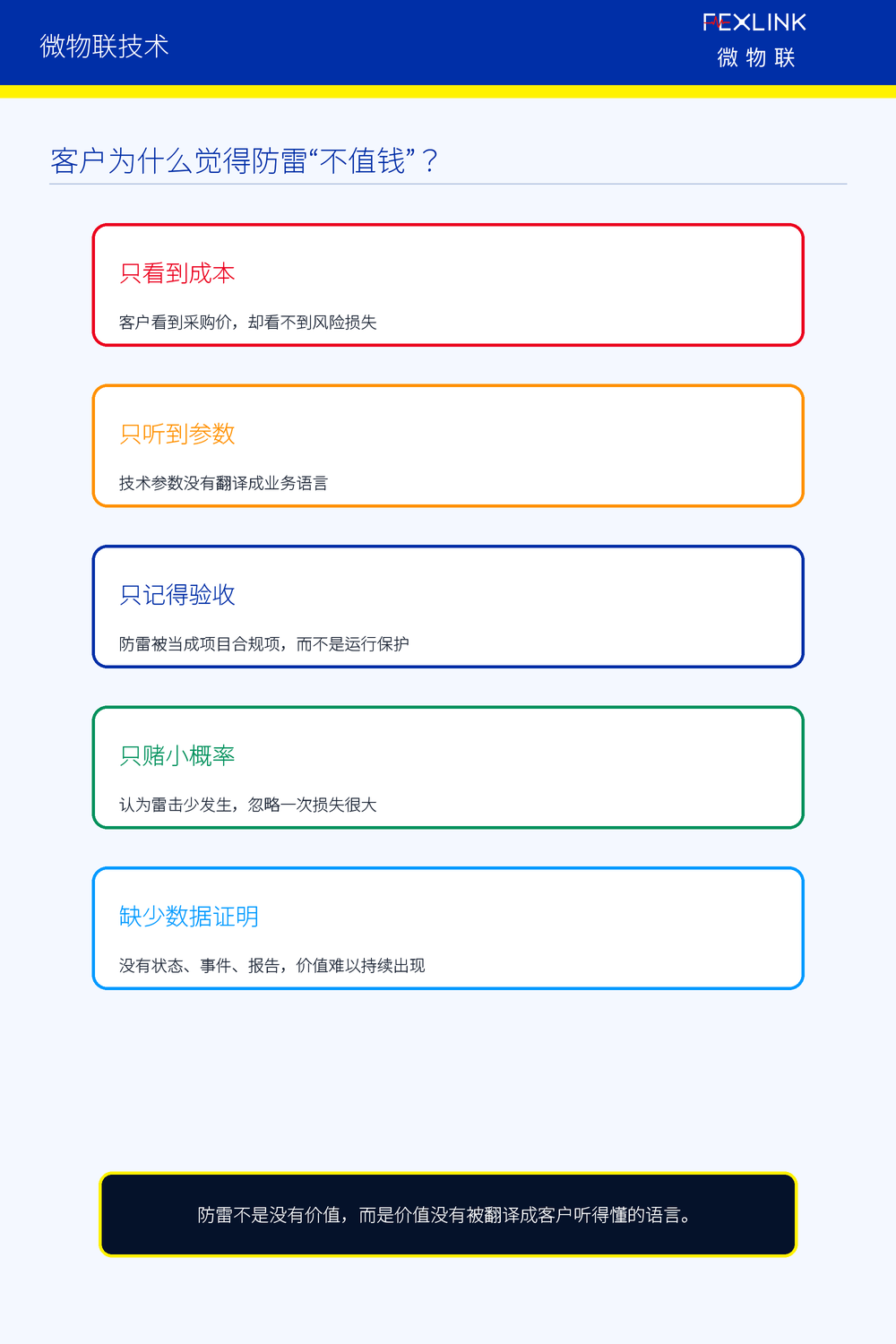
2. What will happen if the loss is not explained clearly?
First, it will push the project into a price war. Customers cannot understand the technical differences and cannot see the loss differences, so they can only compare prices. Choose whoever is cheaper; choose whoever can pass the inspection; choose whoever can submit the information quickly. In the end, the more the company talks about parameters, the more customers only look at the quotation.
Second, it will gradually under-allocate the plan. After the budget is reduced, product levels, hierarchical protection, signal line protection, grounding monitoring, online status monitoring and other contents may be simplified. It may seem like you’re saving money, but you’re actually burying later risks.
Third, it will shorten the cooperative relationship. One-time delivery only solves the problem of "installation or not", but does not solve the problem of "whether it continues to be effective during operation". Customers cannot see long-term value, and it is difficult for engineering companies, manufacturers and testing institutions to form continuous services.
Fourth, it will make it harder to clarify responsibility. After a problem occurs, the customer will ask if the lightning protection was not done well, the manufacturer will ask if it is a problem with the on-site conditions, the engineering company will ask if it was damaged by subsequent modifications, and the testing company can only tell whether it is qualified at a certain point in time. Without data evidence, many disputes can only be judged by experience.
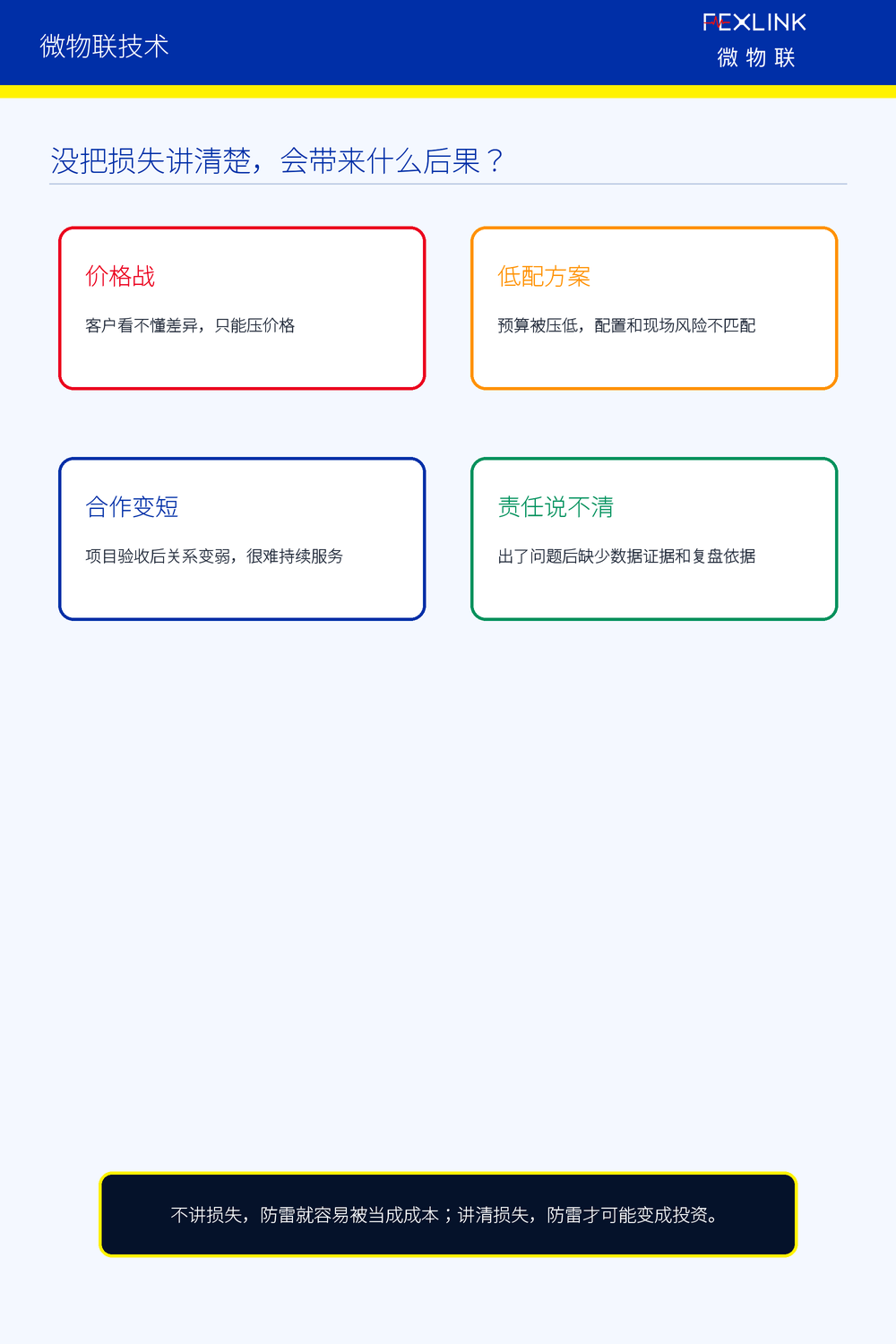
3. The value of lightning protection must be translated from “equipment language” to “loss language”
If you only talk about equipment, it is easy for customers to think that you are increasing costs; only by explaining the losses clearly can customers understand that this is a risk management investment. For example, instead of saying "SPD monitoring needs to be added at this point", it is better to say "This point protects the core controller. If abnormalities are not detected in time after a thunderstorm, the entire production line may be shut down for inspection."
It is difficult to impress customers by only talking about platform functions. Customers do not need another complicated page. Customers need to know where the abnormality is, whether it is serious or not, why it is abnormal, who will handle it, whether it will be restored after processing, and whether a report can be generated at the end of the month. The value of the platform is not the number of pages, but the management conclusion.
If you only talk about increasing the budget, you are more likely to be rejected. A better way to express it is: This investment corresponds to which risks can be reduced, which losses can be controlled, which responsibilities can be left behind, and which operations and maintenance work can be reduced. Customers are not disgusted with investment, but they are disgusted with not being able to see the results of investment.
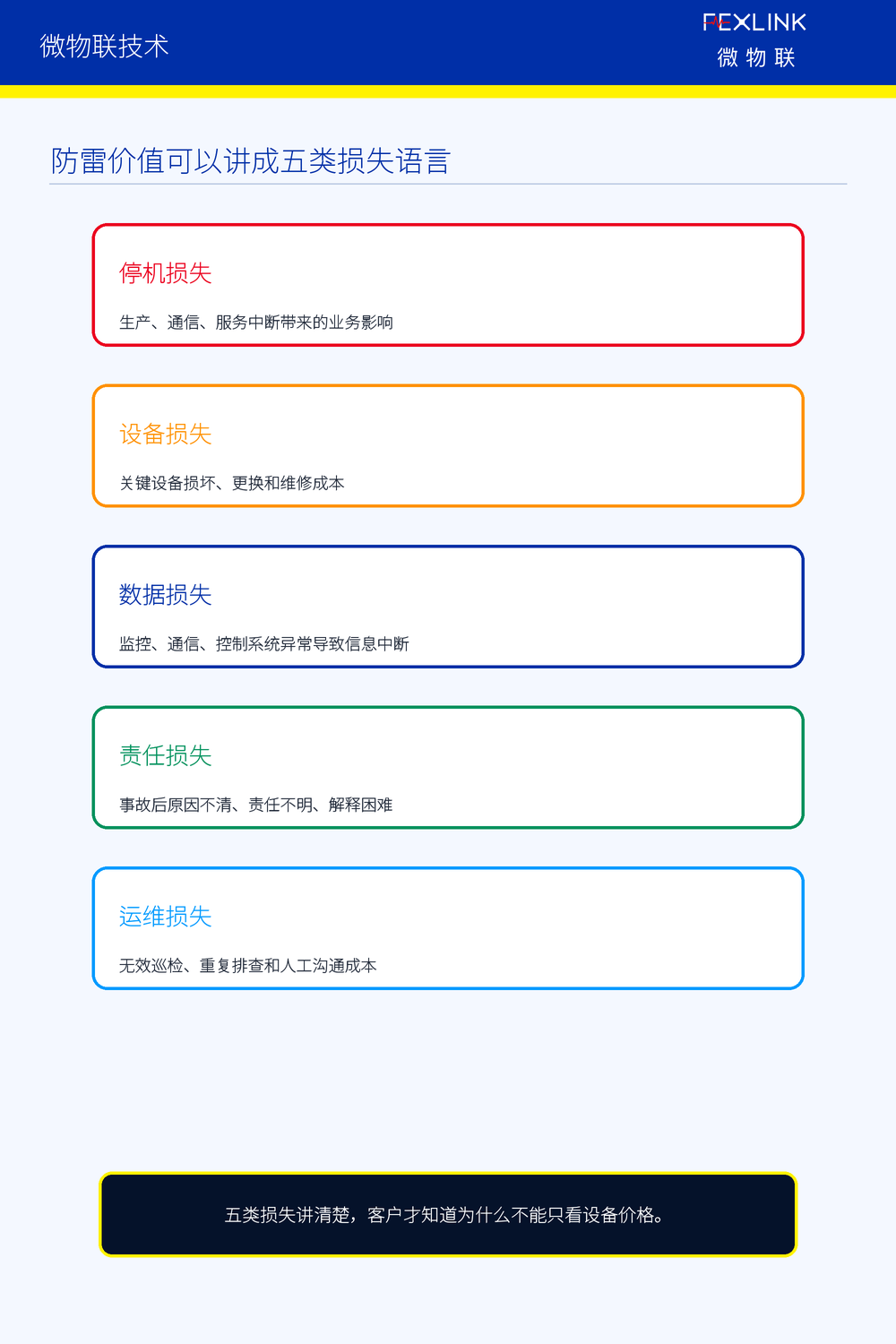
4. The value of lightning protection can be divided into five types of losses
The first category is downtime losses. For data centers, communication base stations, photovoltaic power plants, wind farms, factory production lines, and transportation electromechanical systems, short-term downtime may cause business interruption, manual investigation, and customer complaints. The price of lightning protection equipment is often only a fraction of the cost of downtime.
The second category is equipment loss. Lightning strikes and surges may affect power modules, communication modules, controllers, sensors, cameras, gateways, PLCs, inverters and other equipment. What customers really need to compare is not the SPD price, but the repair and replacement costs after critical equipment is damaged.
The third category is data and communication losses. Many field equipment damages do not necessarily come from the power supply side, but may also come from signal lines, communication lines, control lines and network lines. Communication interruptions, monitoring offline, and control abnormalities will prevent managers from seeing the on-site status when they need information most.
The fourth category is liability loss. After an accident occurs, if there are no lightning strike records, SPD status, grounding trends, equipment alarms and work order records, it will be difficult to judge whether the problem is related to lightning strikes and whether maintenance is timely. The responsibility cannot be clearly stated, which is itself a management cost.
The fifth category is operation and maintenance losses. There is no online status and alarm classification, so manual inspection and experience troubleshooting can only be relied on after thunderstorms. There are many locations, few manpower, and recurring problems, which can easily lead to ineffective inspections and repeated communication. Intelligent lightning protection can transform operation and maintenance from passive inspection to focused review.
5. How to make customers feel that lightning protection is “valuable”?
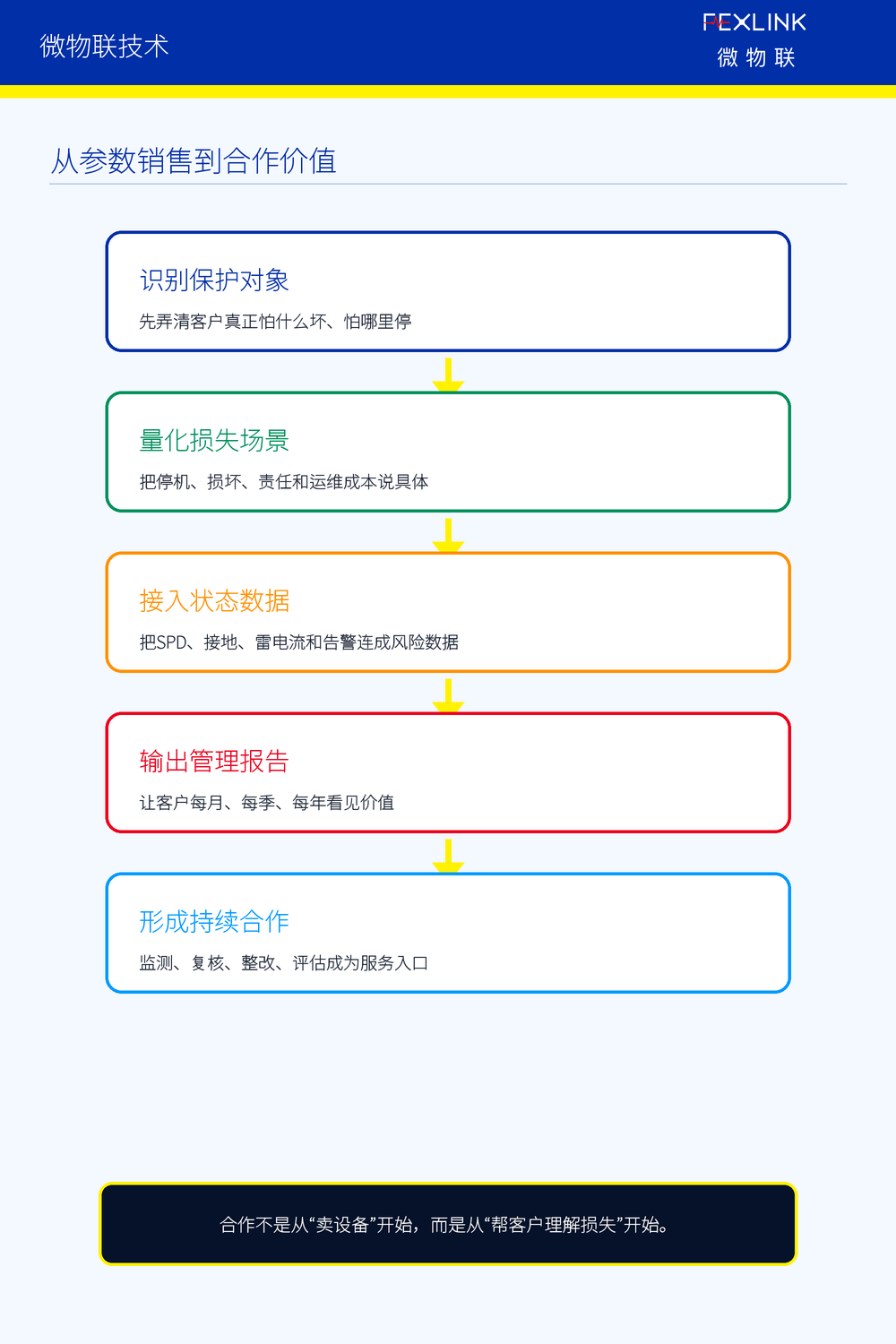
First, identify the objects of protection. Don’t start with a product list, but start by asking: What type of equipment do you want to protect? Is the equipment valuable? Will the downtime have a big impact? Are the lines introduced outdoors? Are there weak current, communications, control and sensor lines? Will there be operation and maintenance capabilities in the future?
Second, be specific about the loss scenario. If customers only hear "Lightning protection is important", it will be difficult for them to decide to invest; if they hear "Once the communication in this control cabinet is interrupted after a thunderstorm, the on-site equipment cannot be remotely monitored, and troubleshooting requires at least personnel to be present", the understanding will be completely different.
Third, prove the risks with data. Intelligent lightning protection is not to connect devices to the Internet, but to connect lightning strikes, SPD status, grounding changes, temperature abnormalities, equipment offline and alarm handling, so that risks have data, time, location, and handling records.
Fourth, use reports as visible deliverables. The prerequisite for customers to continue paying is to continue to see results. Monthly status reports, post-thunderstorm review reports, quarterly risk trends, annual health assessments and lists of rectification recommendations are all important ways to make the value of lightning protection explicit.
Fifth, turn services into long-term relationships. Lightning protection does not end after installation. The thunderstorm season will come repeatedly, SPD will age, grounding will change, the site will be modified, and customers' safety management requirements will also increase. Monitoring, review, rectification, evaluation and reporting are the entrance to long-term cooperation.
6. How does FEXLINK understand the customer value of lightning protection?
FEXLINK believes that what customers really buy is not isolated lightning protection equipment, but visible risks, controllable losses, traceable responsibilities and worry-free operation and maintenance. If a lightning protection company only talks about products, it is easy for customers to only look at the price; if it can connect equipment status, lightning events, grounding trends, alarm work orders and periodic reports, what customers will see is a set of continuously operating risk management capabilities.
What FEXLINK is more concerned about is not simply networking lightning protection equipment, but allowing the lightning protection system to continuously produce status data, risk data, disposal data and report data, helping lightning protection manufacturers, power distribution manufacturers, engineering companies, testing companies and parties to transform lightning protection from one-time delivery to long-term services.
For partners, FEXLINK/FEXLINK can be used as a data base and service base for intelligent lightning protection: the front end provides status sensing and monitoring terminals, the middle provides communication access and platform management, and the back end provides trend judgment, alarm closed loop, review suggestions and report output. In this way, customers see not just equipment, but continuously deliverable management value.
Conclusion: It’s not that customers don’t need lightning protection, but they need to see losses
Customers feel that lightning protection is "worthless". In many cases, it is not because lightning protection has no value, but because the value has not been clearly explained. What customers see is the equipment cost, but they do not see the downtime loss, equipment loss, communication loss, liability loss and operation and maintenance loss.
In the future, lightning protection companies, power distribution manufacturers, engineering companies, and testing companies will not only sell products, perform projects, and issue reports, but also clearly explain the risks and losses behind lightning protection, turn operating status into data, turn data into judgments, turn judgments into reports, and turn reports into continuous services.
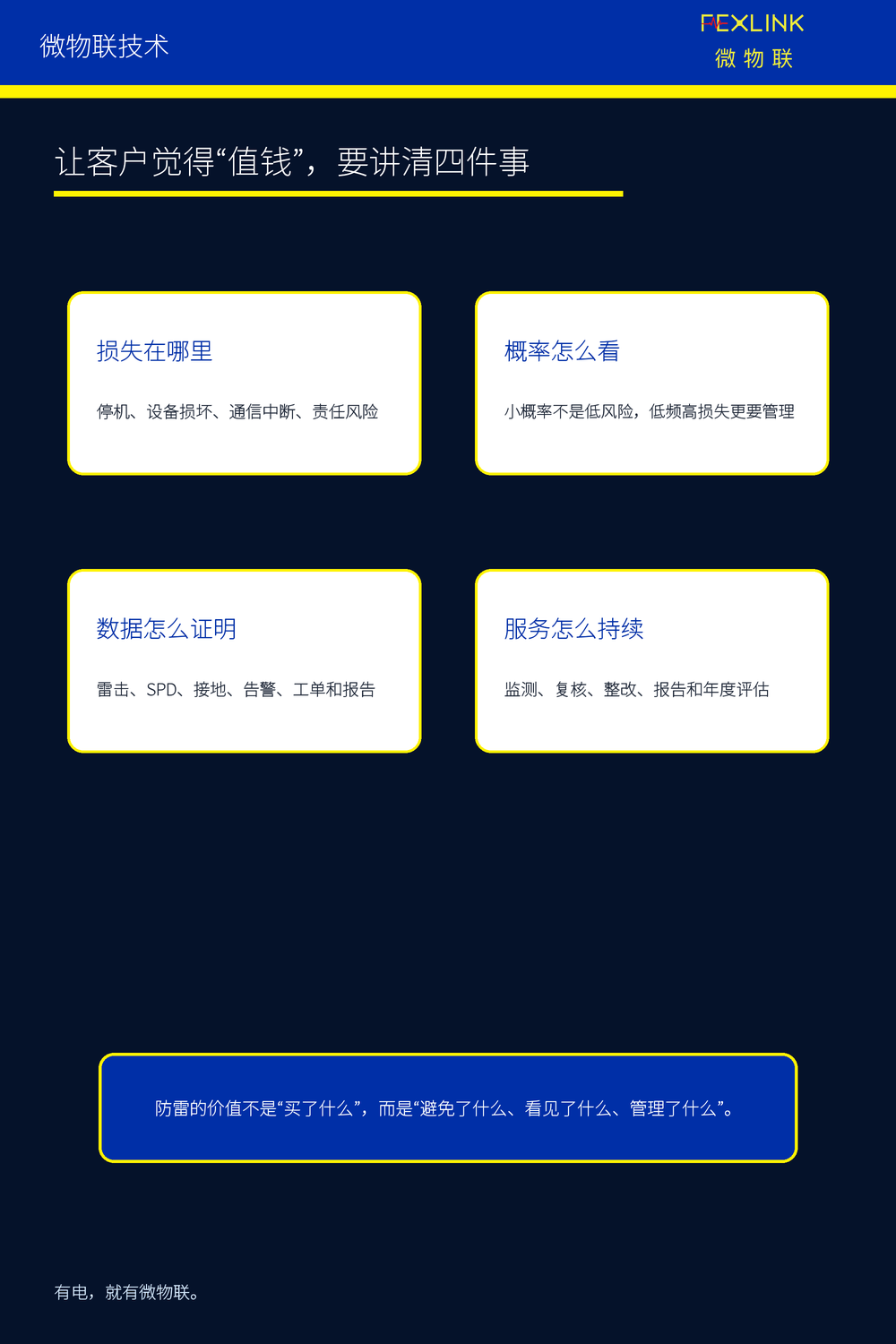
The value of lightning protection is not "what you bought", but "what you avoided, what you saw, and what you managed." Whoever can explain this clearly will have a better chance of making customers willing to invest, cooperate, and continue to purchase.
FEXLINK technology will continue to share content related to intelligent lightning protection, early warning of electrical safety, digital power distribution, energy supervision and industrial Internet of Things.
FEXLINK/FEXLINK uses data to reconstruct energy efficiency and electrical safety.
Where there is electricity, there is FEXLINK.