Abstract: Series arc occurs in the load circuit, and the current is limited by the load and does not necessarily exceed the traditional overload protection threshold. However, local arc temperatures are high and continue to occur repeatedly, which may bring serious fire risks. Therefore, series arc requires waveform level, half-cycle level and scene-based identification.
In arc faults, series arcs are particularly easily overlooked. It does not form a huge current like a phase-to-ground or phase-to-phase short circuit. Instead, it is hidden in the load circuit and manifests as unstable contact, intermittent discharge, and abnormal waveforms.
The danger of this type of risk is that the current may not seem exaggerated, but the local temperature at the arc point is very high. After repeated occurrences for a long time, it is enough to cause insulation carbonization, material damage and fire hazards.
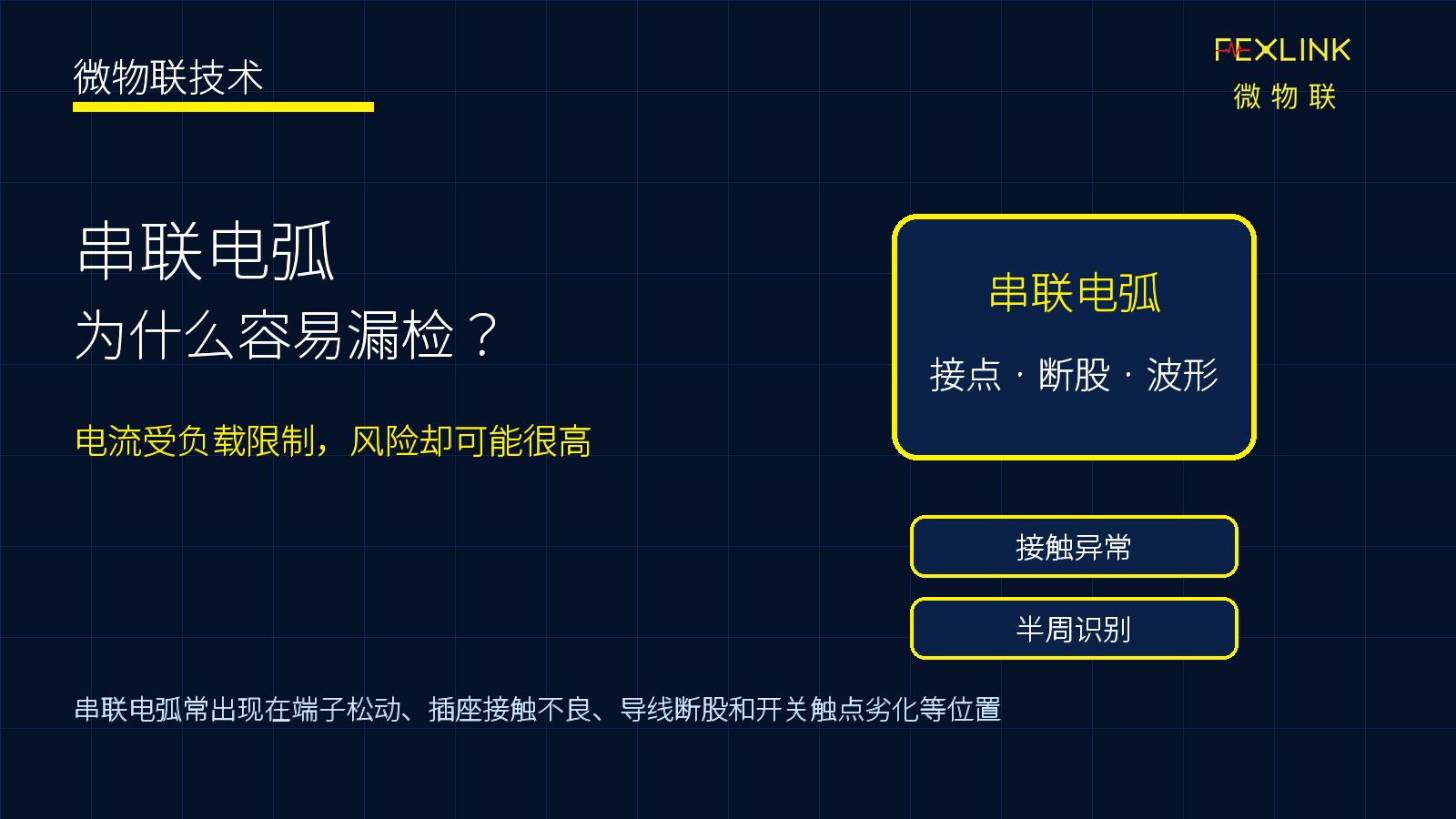
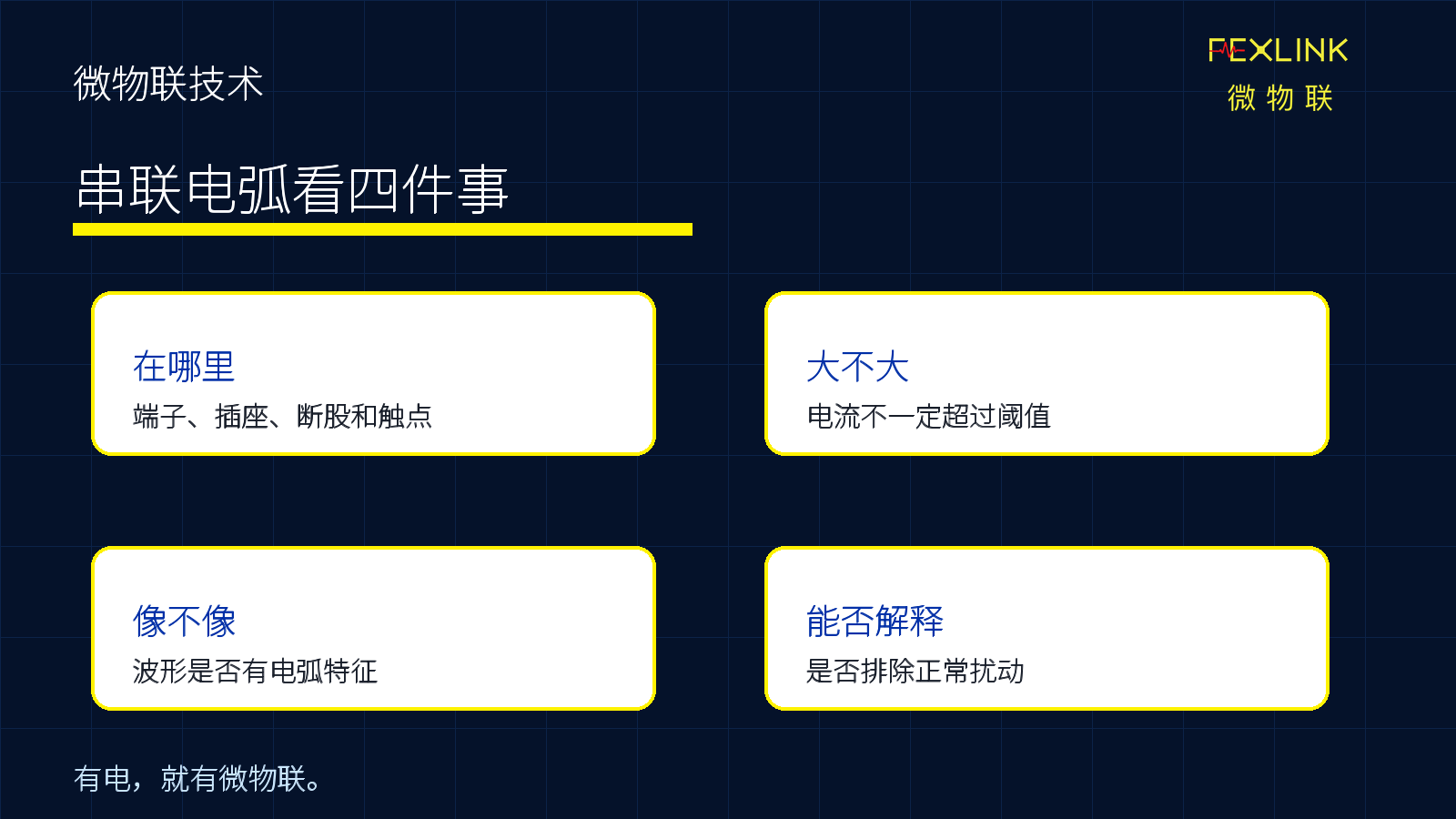
1. Where does series arc usually occur?
Series arcing is common in loose terminals, poor contact in plugs and sockets, broken wires, deterioration of switch contacts, weak crimping, and oxidation of line connection points. These positions are not necessarily completely disconnected from the beginning, but are in a state of unstable contact.
When the load current passes through the unstable contact, intermittent discharge may occur. The scene may only show occasional flickering, local heating, abnormal restart of the equipment, or unexplained malfunctions.
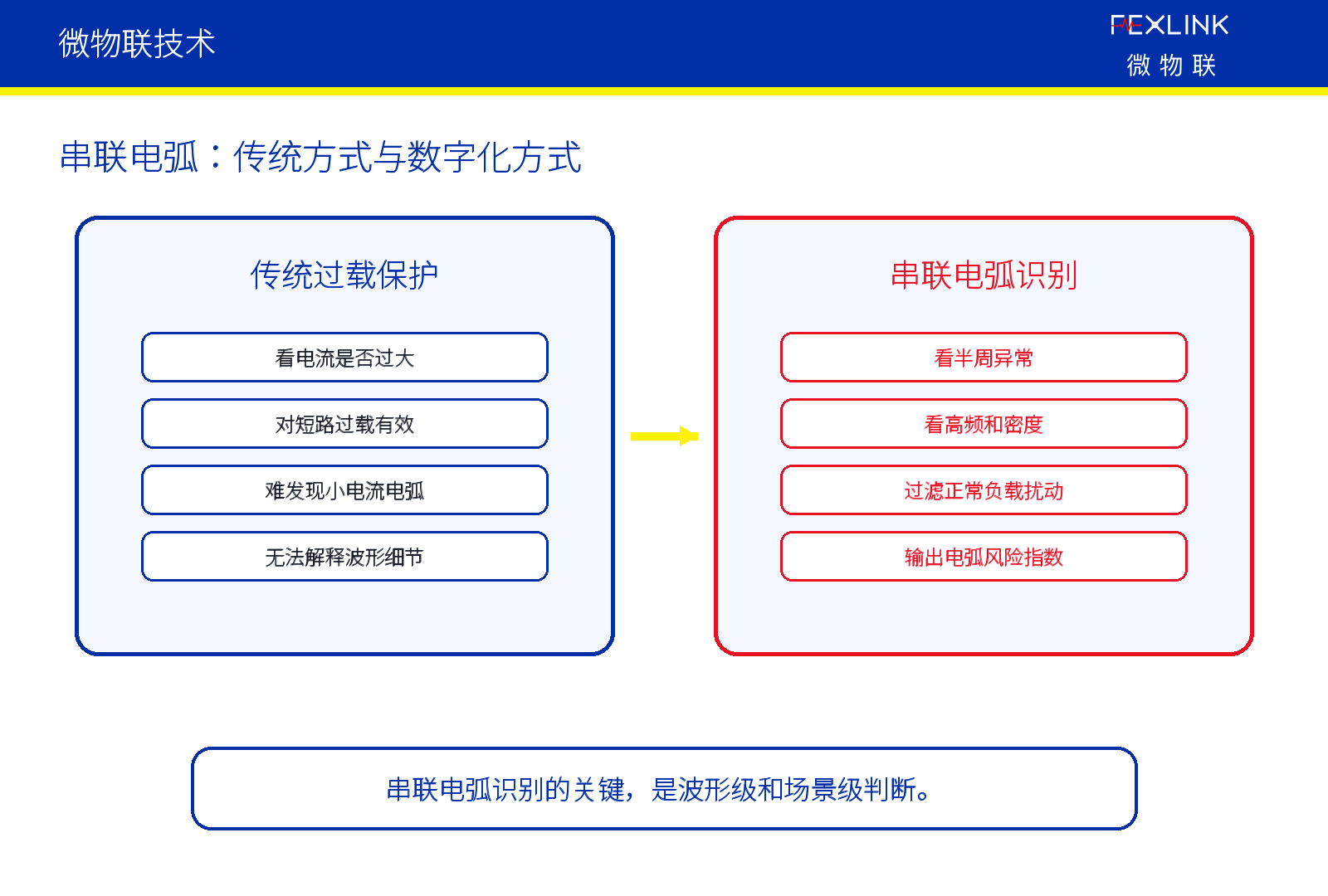
2. Why is the series arc current not necessarily large?
The series arc is in the load loop and the current is limited by the load. Even if an arc occurs at the contact, the total loop current may still be within the normal operating range and may not necessarily reach the circuit breaker overload operation condition.
This is the fundamental reason why series arcs are easily missed: traditional protection focuses on large current faults, while the dangers of series arcs are more reflected in local high temperatures, discontinuous waveforms, and continuous repetitions.
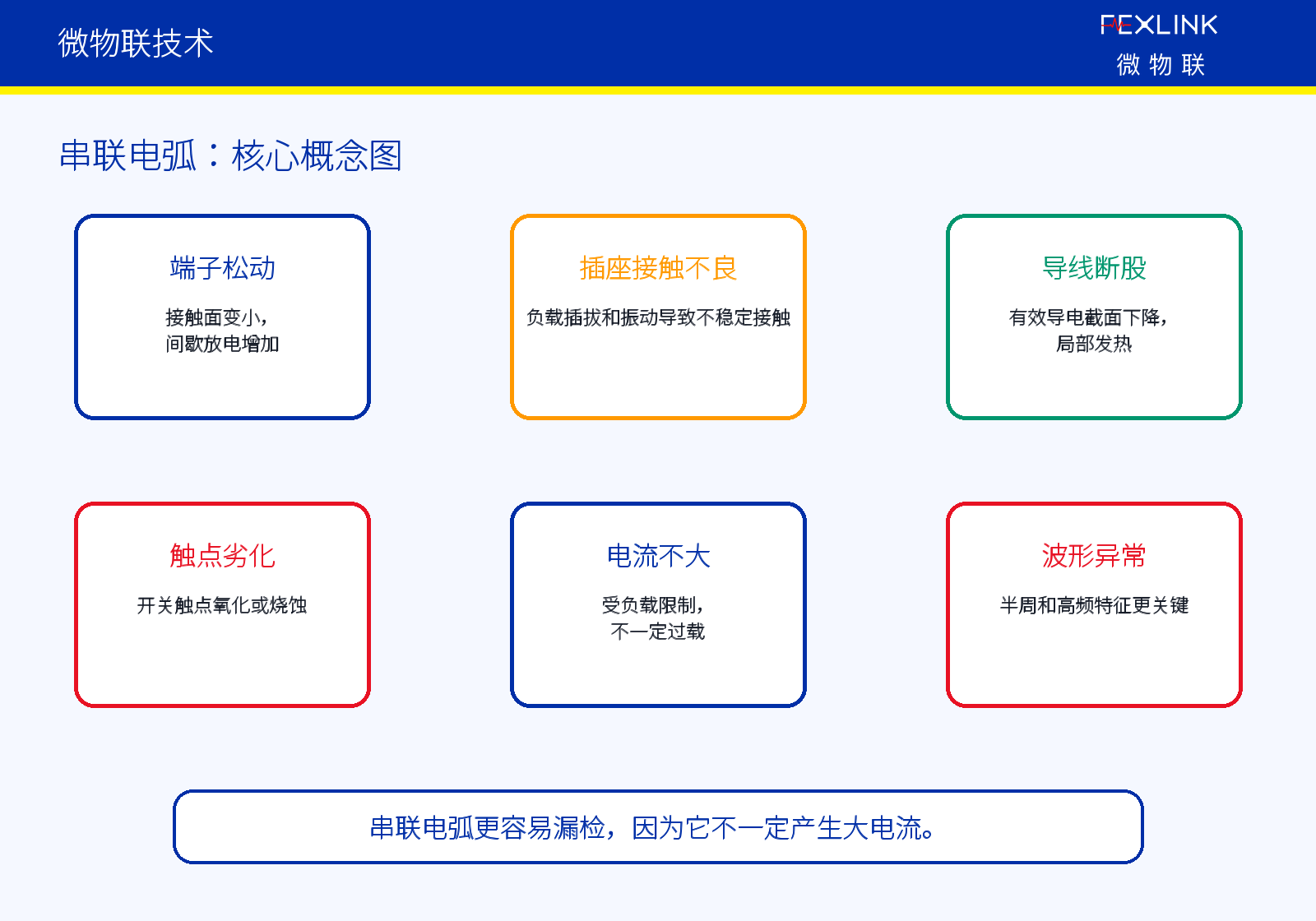
3. What are the signal characteristics of series arc?
Series arcs tend to be intermittent, random, and load dependent. It may appear abnormal in certain current half cycles, or may appear or disappear with changes in vibration, temperature, and load.
On the signal, it may appear as current waveform distortion, discontinuities, high-frequency pulses, increased noise density, and half-cycle anomalies. These features are difficult to see based on ordinary current rms values alone.
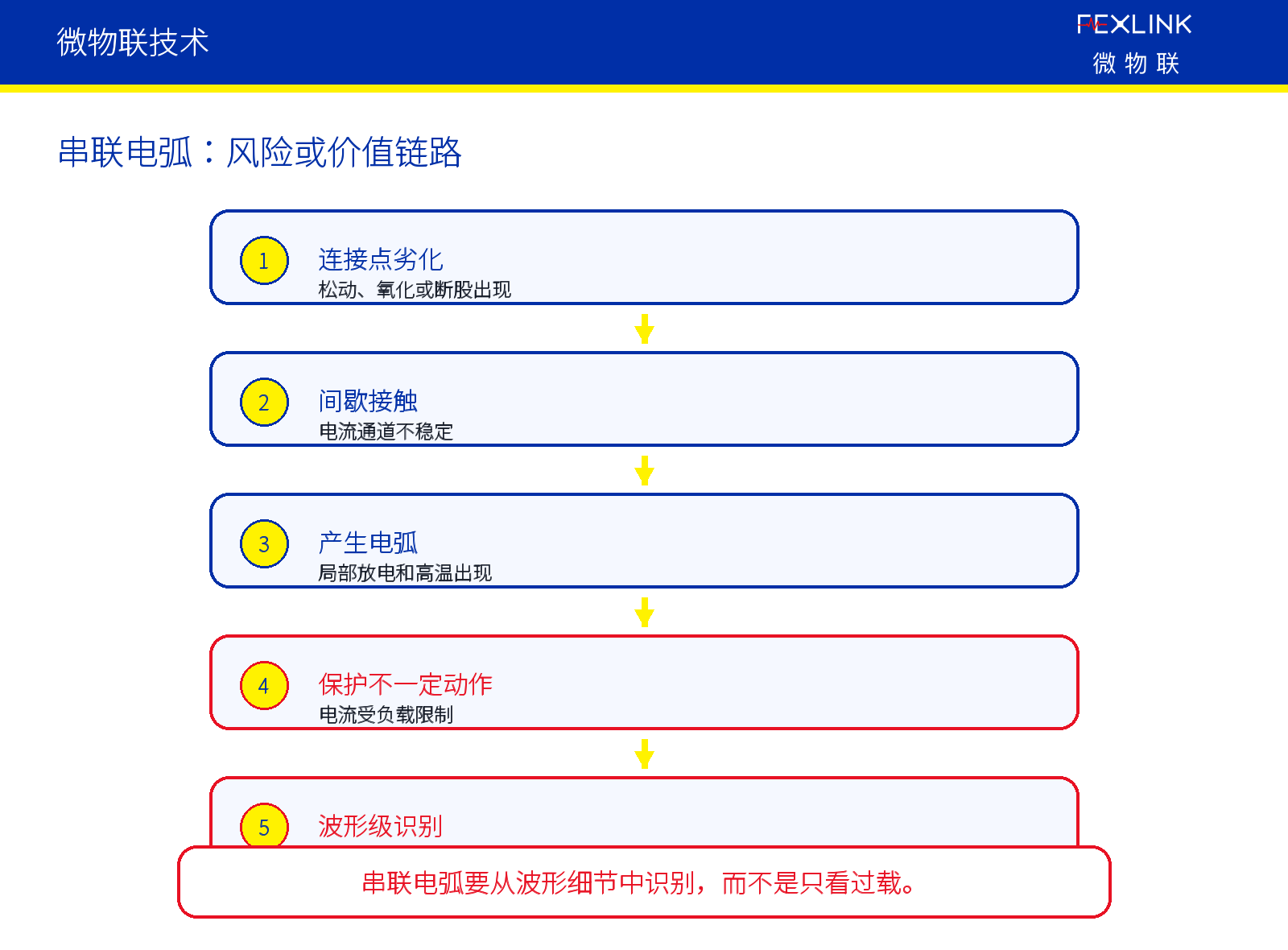
4. Why is half-cycle level and waveform level identification needed?
The key risk of series arcing is hidden in the waveform details. Half-cycle level identification can observe whether there are abnormal intermittent, peak or unstable discharges in each cycle; waveform level identification can further distinguish between normal switching disturbances, load startup and dangerous arcs.
If you only do minute-level or second-level statistics, many details will be averaged out. A truly effective algorithm must look at both transient characteristics and time persistence.
5. How does FEXLINK understand series arc detection?
FEXLINK believes that series arc detection cannot rely solely on a single frequency point or a single threshold. FEXLINK should combine low-frequency electrical parameters, high-frequency events, harmonic changes, half-cycle waveforms, time density and scene self-learning to form an interpretable arc risk index.
Especially in scenarios such as charging piles, motors, construction site power supplies, distribution cabinets, and communication base stations, load disturbances are complex, and it is even more necessary to filter false alarms through multi-dimensional features.
Conclusion: The difficulty with series arcs lies in "not large current" but "high-risk partial discharge"
Series arc is the easiest to miss because it may not necessarily trigger traditional overload protection, but it may continue to generate local high temperatures and discharge risks. To identify series arcs, one must proceed from current magnitude to waveform characteristics and time behavior analysis.
FEXLINK technology will continue to share content related to intelligent lightning protection, early warning of electrical safety, digital power distribution, energy supervision and industrial Internet of Things.
FEXLINK/FEXLINK uses data to reconstruct energy efficiency and electrical safety.
Where there is electricity, there is FEXLINK.