Abstract: Lightning protection in computer rooms is not simply about installing a few more SPDs. There are power lines, signal lines, communication lines, grounding lines and a large number of sensitive electronic equipment in the computer room. Surge risks may enter from multiple paths. The value of digital lightning protection in computer rooms is to put the status of protective devices, lightning surge events, grounding status, equipment alarms and operation and maintenance processing into the same data link, so that lightning protection can move from "installation qualified" to "operation knowable".

Many computer room projects will be equipped with lightning arresters, grounding systems and equipotential bonding during the construction phase. At the time of acceptance, it seemed that all the equipment had been installed and the drawings basically met the requirements. But after the computer room was put into operation, the real question began to arise: Has the SPD experienced surge shock? Has it deteriorated? Has the grounding status changed? Is the equipment abnormality related to a certain surge? It is difficult for traditional lightning protection systems to continuously answer these questions.
The biggest difference between computer rooms and ordinary buildings is the high density of equipment, strong system coupling, and high business continuity requirements. A seemingly small power disturbance may cause the switch to restart; a signal line surge may affect video surveillance, access control or control systems; unstable grounding may also reduce the discharge capacity of the protection device. Therefore, the lightning protection of the computer room needs to be upgraded from "what is installed" to "whether it is still effective during operation."
1. Why is computer room lightning protection easily underestimated?
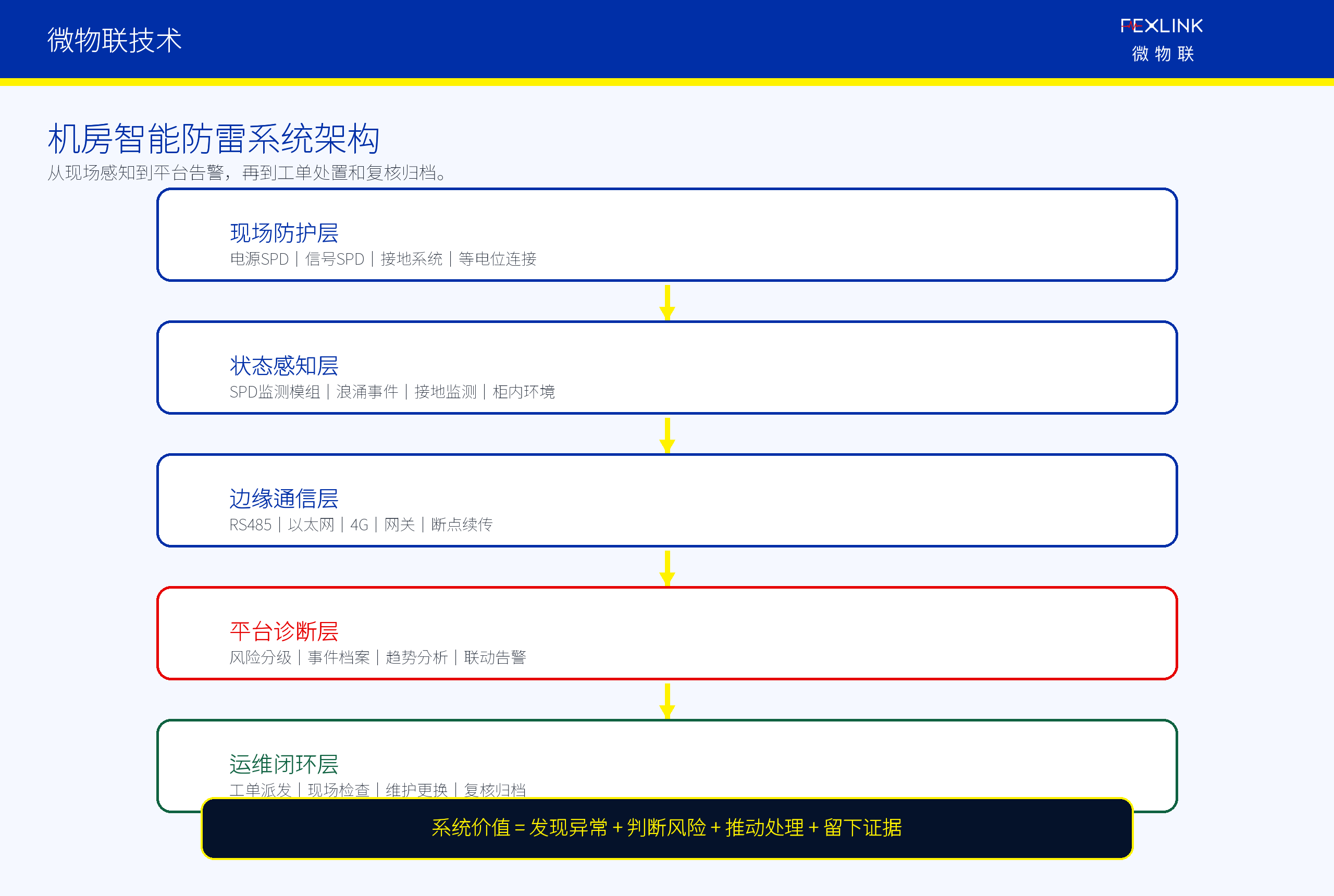
Equipment in the computer room generally relies on stable power supply and reliable communication. Servers, switches, UPS, precision air conditioners, security, access control, video surveillance and dynamic loop systems often share power, grounding and communication links. Once a surge enters from the power side, signal side or grounding system, it does not necessarily affect a single device, but may affect the entire infrastructure.
Many sites only focus on power SPD, but ignore signal SPD, communication link protection and grounding status. There are also some projects that attach great importance to lightning protection detection during the construction period, but lack status data during the operation period. The result is that the lightning protection system usually seems to "exist", but when it actually fails, it is unclear whether it is functioning.
2. Main blind spots in traditional computer room lightning protection
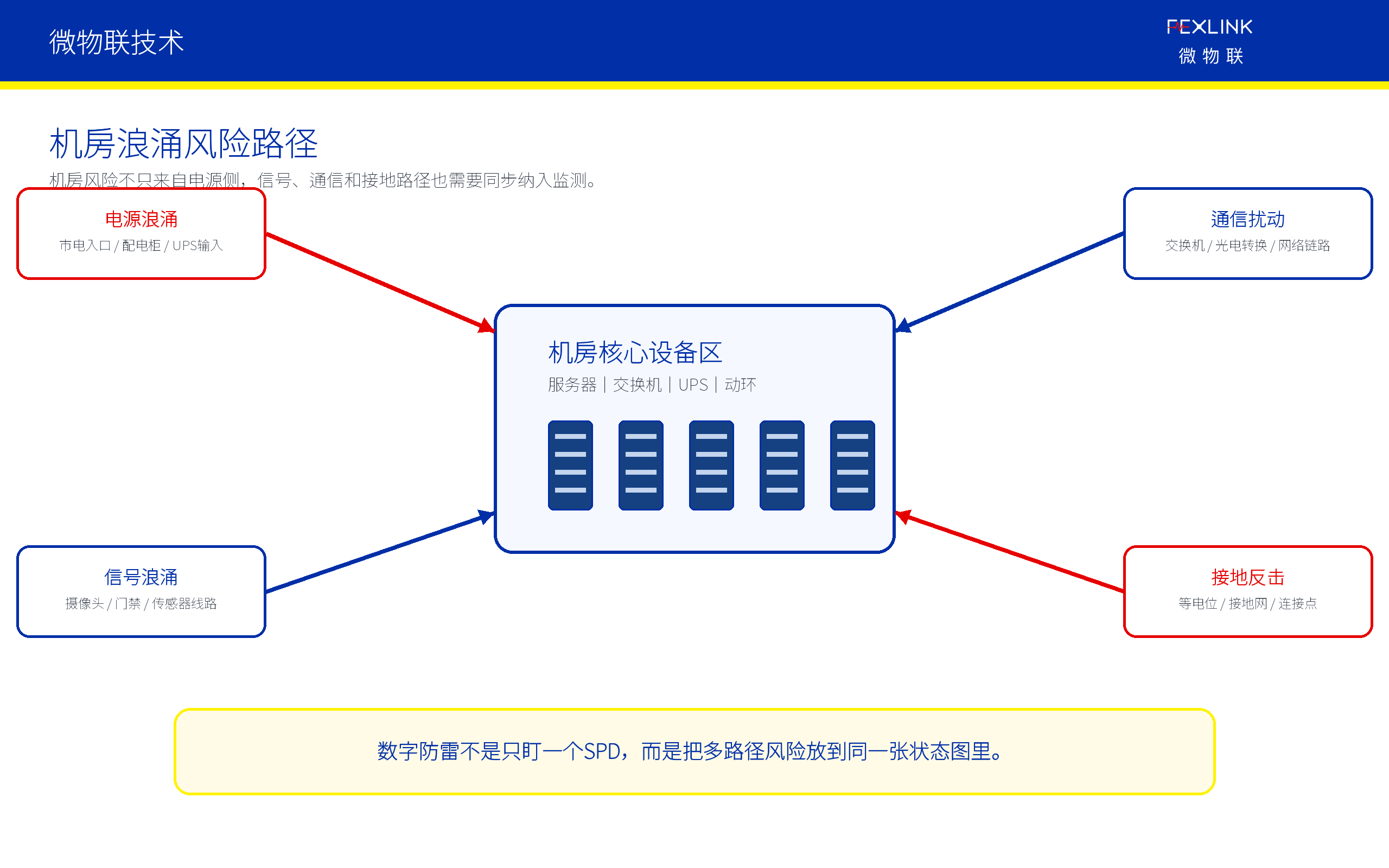
Lightning protection in traditional computer rooms is not without value. Graded SPD, equipotential bonding, grounding system and standardized construction are still the basis for safe operation of the computer room. But the biggest shortcoming of the traditional method is that the running process is invisible. After the SPD trips, if there is no remote monitoring, it can only be discovered during manual inspection; the fact that the SPD has not tripped does not mean that it has not deteriorated; after a lightning strike or surge occurs, if there is no event record, it will be difficult to determine whether the equipment abnormality is related to the surge afterwards.
The bigger problem is that disposal does not close the loop. Even if there are local alarms in many computer rooms, it is difficult to confirm whether the alarm has been pushed, whether an order has been dispatched, and whether there has been on-site review. The management value of the lightning protection system should not stop at an indicator light, but should enter the operation and maintenance process.
3. What should be monitored for digital lightning protection in the computer room?
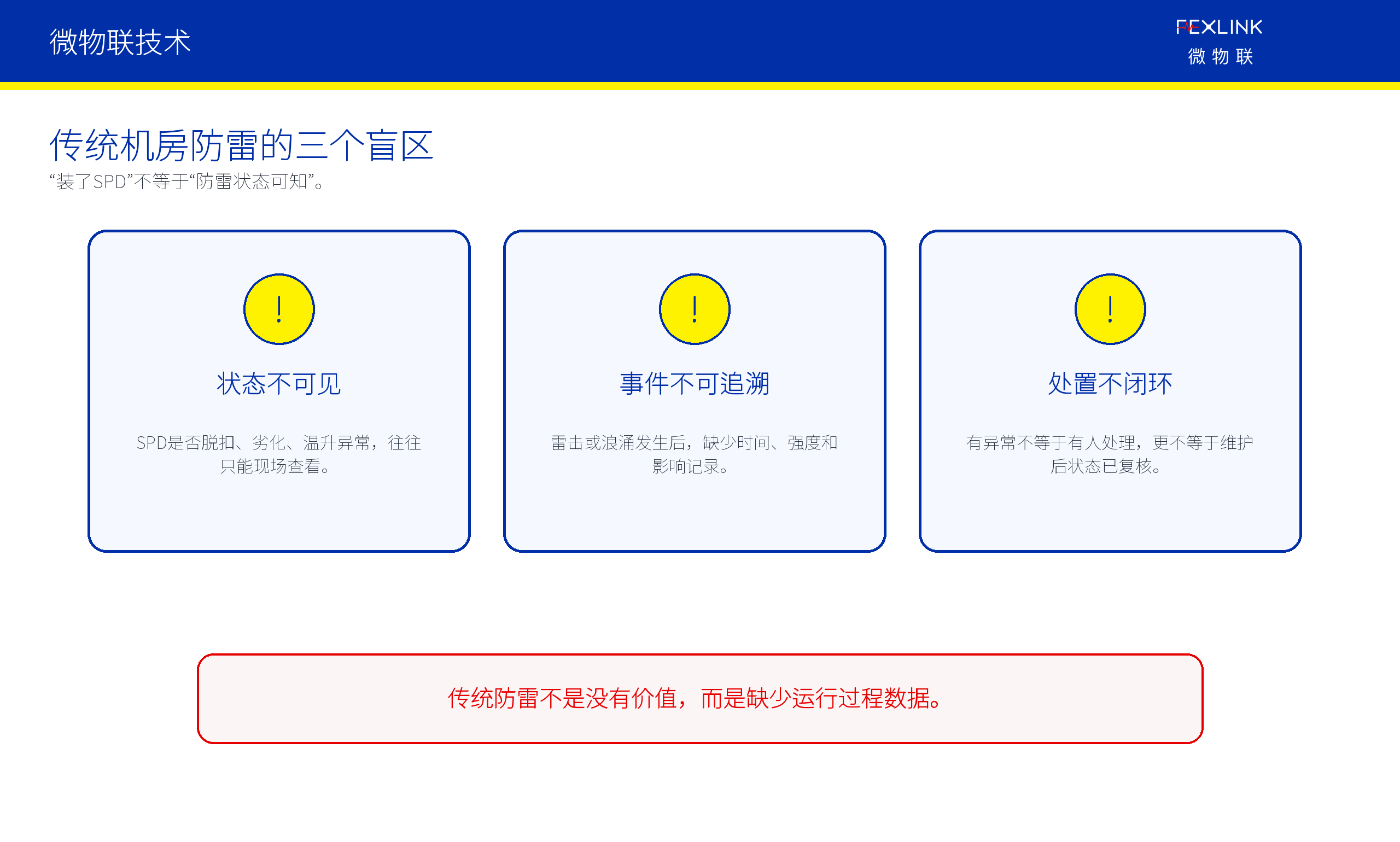
Digital lightning protection in the computer room must first monitor the status of the protection device, including power SPD, signal SPD, backup protection, tripping status, temperature rise and degradation trend. Secondly, the surge event must be recorded, at least to know the time of occurrence, the influencing circuit and the event level. Third, pay attention to the status of the grounding system, including ground resistance, equipotential bonding and long-term trends.
At the same time, computer room lightning protection data cannot exist in isolation. Temperature and humidity inside the cabinet, UPS alarms, switch abnormalities, distribution cabinet alarms and dynamic environment system data can all help explain the impact of lightning protection events. A truly valuable system does not display each indicator individually, but puts these data on the same timeline to determine whether risks are expanding.
4. How to design the intelligent lightning protection system for the computer room?
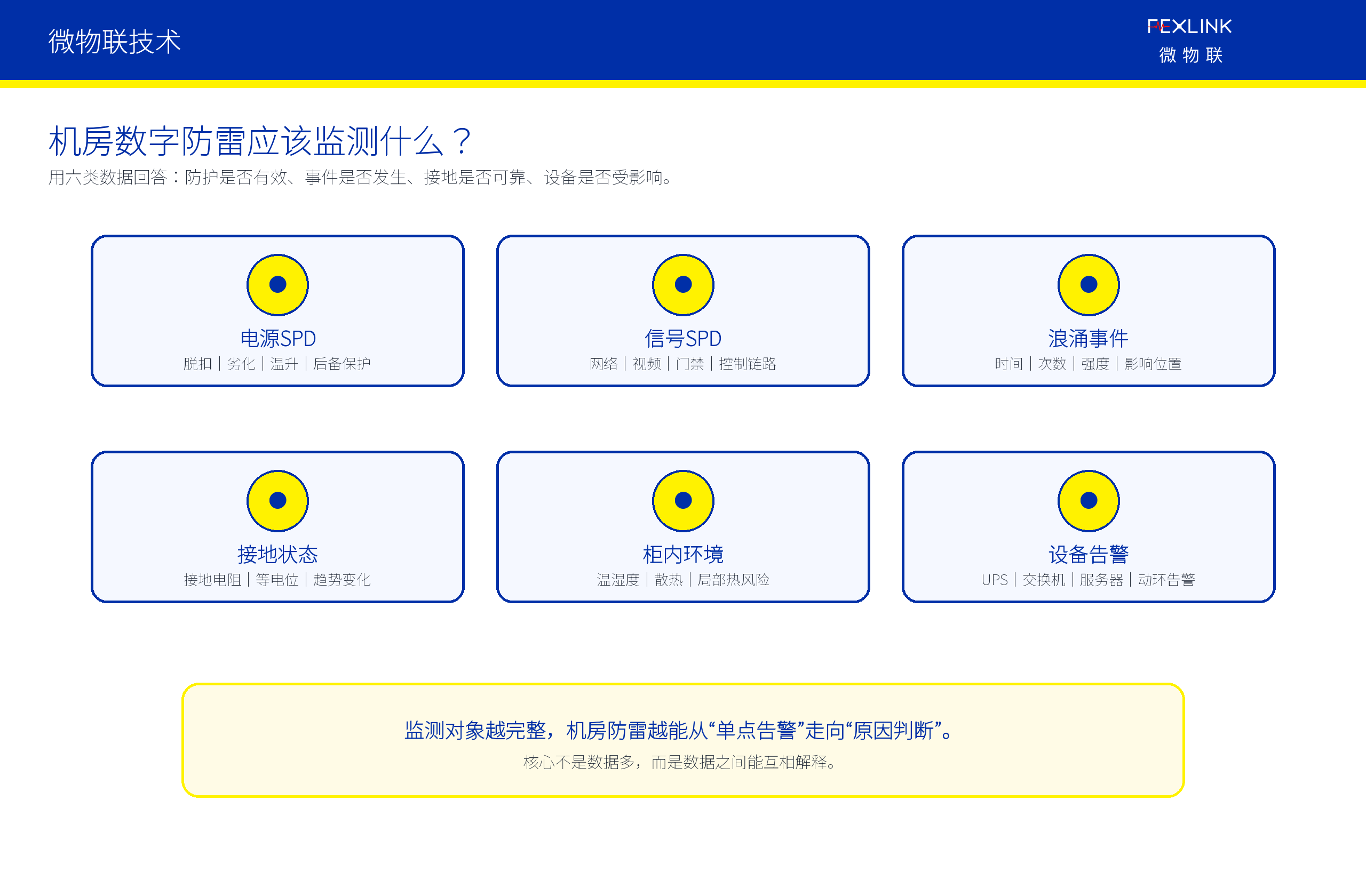
A complete computer room intelligent lightning protection system should at least include on-site protection layer, status awareness layer, edge communication layer, platform diagnosis layer and operation and maintenance closed-loop layer. The on-site protection layer solves basic protection problems; the status awareness layer collects SPD, surge, grounding and environmental status; the communication layer is responsible for stable uploading; the platform layer is responsible for alarm classification, trend analysis and event files; the operation and maintenance layer is responsible for dispatching, processing, review and archiving.
This kind of design can allow lightning protection in the computer room to enter the actual management process. For example, if the system finds that the power supply SPD is abnormally degraded and the grounding status fluctuates, the platform should not only prompt "alarm", but should increase the risk level and remind the operation and maintenance personnel to check the corresponding power distribution cabinet, SPD module, ground connection and historical surge events.
5. How does micro-IoT understand intelligent lightning protection in computer rooms?
Micro-IoT believes that the core of intelligent lightning protection in computer rooms is not to simply connect traditional lightning protection devices to the Internet, but to transform computer room lightning protection from a static device into a continuously operating data system. What the computer room really needs is that the status can be known, events can be checked, risks can be judged, and the processing can be closed-loop.
The FEXLINK digital lightning protection system hopes to correlate power supply protection, signal protection, grounding status, surge events and equipment alarms, so that computer room operation and maintenance no longer only relies on regular inspections and post-mortem inspections. For computer rooms, digital lightning protection is not a decorative platform, but a part of infrastructure reliability management.

Conclusion: Lightning protection in computer rooms must move from “qualified installation” to “knowable status”
Computer room lightning protection cannot just stay at the configuration list during the construction stage, nor can it only rely on the test results once a year. During the long-term operation of the computer room, surge events, protector status, grounding status and equipment alarms will all change. Without seeing these changes, it is difficult to truly manage risk.
The value of digital lightning protection is to allow the computer room lightning protection system to continuously produce data that can be used for judgment and processing, so that abnormalities can be discovered in a timely manner, events can be traced, and operation and maintenance can form a closed loop.
FEXLINK technology will continue to share content related to intelligent lightning protection, early warning of electrical safety, digital power distribution, energy supervision and industrial Internet of Things.
FEXLINK/FEXLINK uses data to reconstruct energy efficiency and electrical safety.
Where there is electricity, there is FEXLINK.