[Electrical Safety Early Warning] How does intelligent lightning protection enter the electrical safety early warning system?
Abstract: Intelligent lightning protection cannot just stay inside the lightning protection system. Lightning strikes, surges, SPD degradation, grounding abnormalities, equipotential connection problems and equipment alarms will all affect the operation of power supply systems, communication systems, control systems and key equipment. Really valuable intelligent lightning protection should enter the electrical safety early warning system and be linked with multi-dimensional electrical data such as voltage, current, leakage, temperature, arc, harmonics, and contact status to form a more complete risk identification capability.
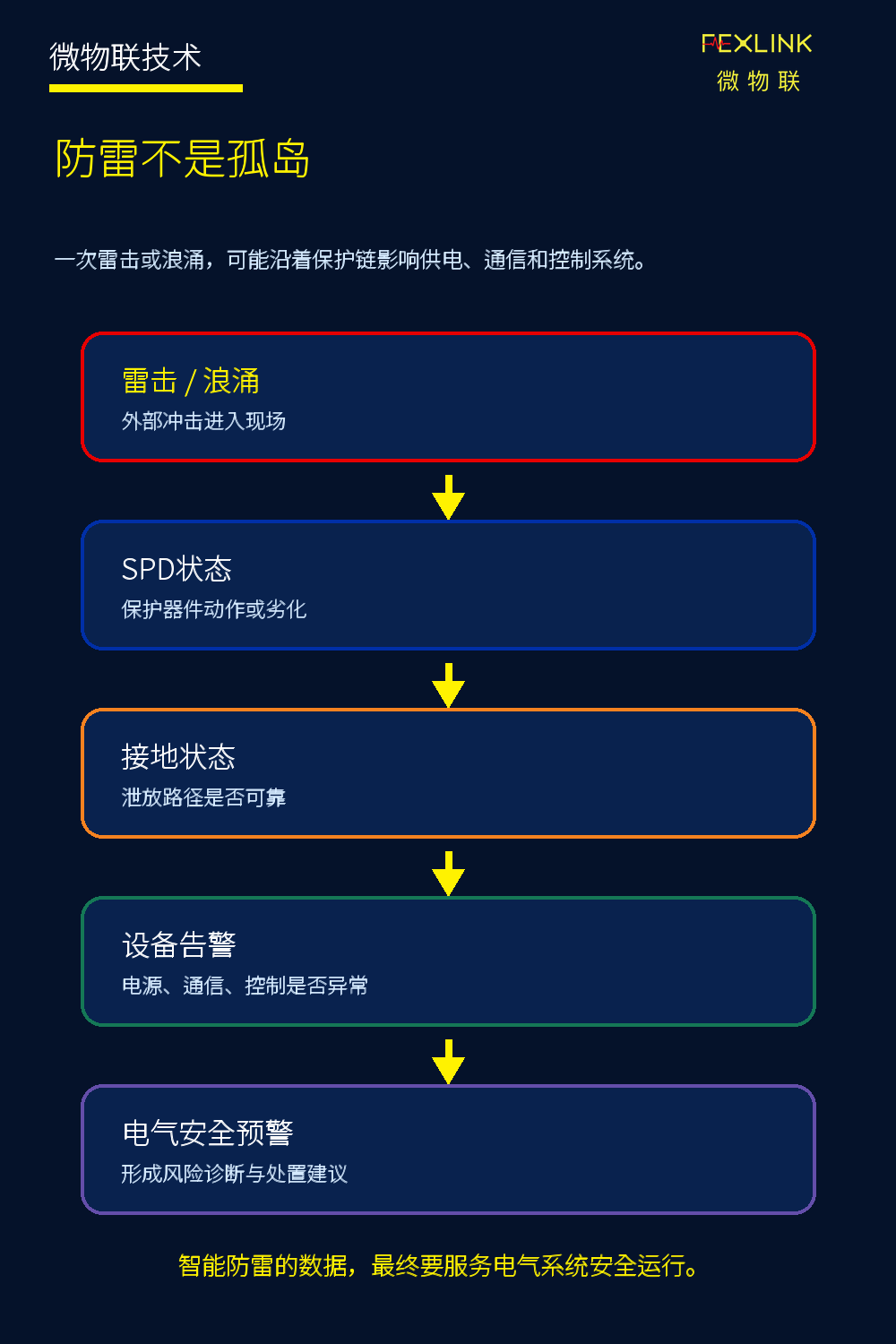
When many people understand the lightning protection system, they will regard it as a relatively independent system: air terminal, down conductor, grounding device, equipotential connection, SPD, lightning protection detection, and lightning strike record. This understanding is not wrong, but it only sees the lightning protection system itself, but does not see the relationship between the lightning protection system and the protected electrical system.
In real scenes, lightning strikes and surges do not stop at lightning protection devices. An external impact may cause the SPD to operate or deteriorate, which may cause changes in grounding status. It may also cause communication equipment to go offline, power module damage, control system restarts, sensor false alarms, and even leave hidden dangers of subsequent insulation degradation or equipment instability.
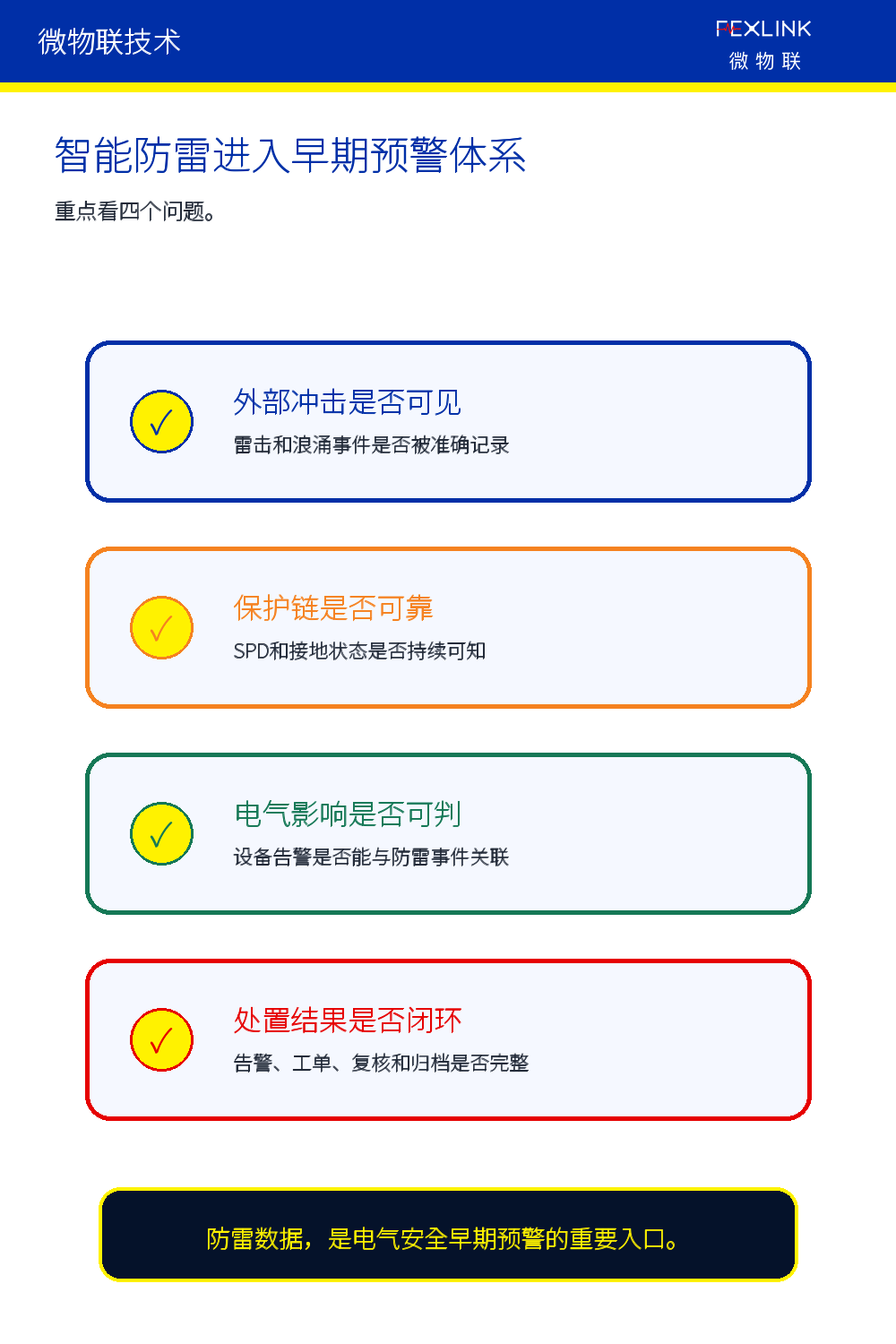
Therefore, intelligent lightning protection cannot only answer whether there is a lightning strike, whether the SPD has tripped, and whether the grounding resistance is qualified. It further answers: Did this lightning strike affect the electrical system? Does it cause equipment abnormality? Will it bring any subsequent risks? Do you need to enter the electrical safety warning chain?
1. Lightning protection risks are essentially part of electrical safety risks
The object protected by the lightning protection system is not the lightning protection device itself, but the power supply system, communication system, control system, sensing system and business equipment behind it. The goal of lightning protection is not to make the lightning protection equipment "look normal", but to make the protected electrical system operate stably and safely for a long time.
Lightning currents and surges ultimately affect power supply continuity, insulation safety, equipment reliability, communication stability, control system operation, and electrical fire risks. If the lightning strike event is only regarded as an internal event of the lightning protection system, it is easy to underestimate its impact on the overall electrical safety.
For example, if a site experiences communication abnormalities after a thunderstorm, if you only look at the communication equipment itself, it may be judged as a network failure; but if you see lightning current events, SPD status changes, and grounding mutations at the same time, you can get closer to the real risk chain.
2. What early warning data does intelligent lightning protection provide?
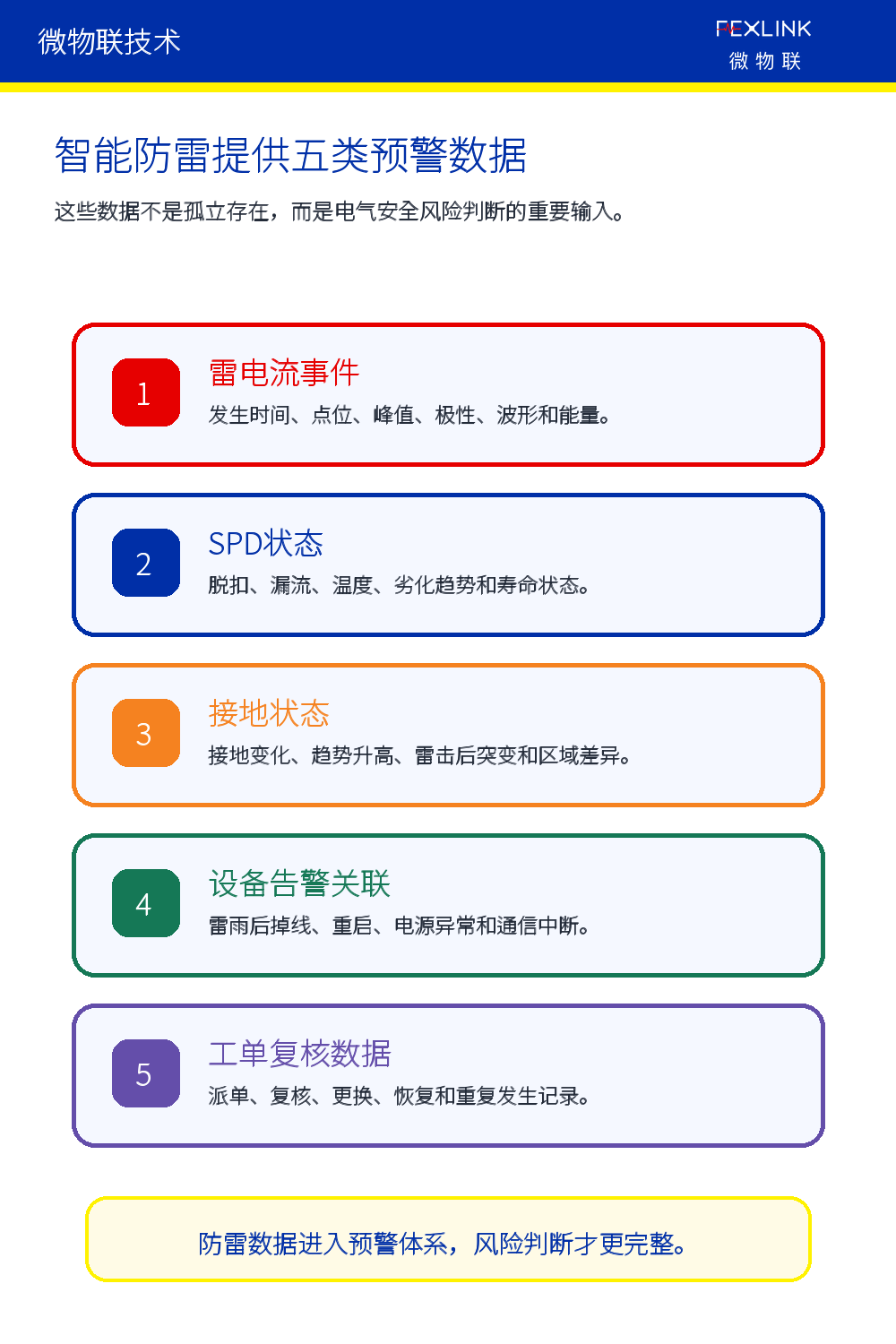
Intelligent lightning protection can provide five types of important data for early warning of electrical safety. The first category is lightning current event data, including occurrence time, point, peak value, polarity, rise time, duration, energy and multiple impact records. It can answer what kind of external shocks the system has experienced.
The second category is SPD status data, including tripping, leakage current changes, temperature changes, deterioration trends, life status and number of actions. It can answer whether the protective device is still reliable. The third category is grounding status data, including grounding resistance changes, rising trends, sudden changes after lightning strikes, unstable connections, and regional differences. It can answer whether the bleed path is still reliable.
The fourth category is data related to surges and equipment alarms, such as equipment disconnection after thunderstorms, communication alarms, power supply abnormalities, equipment restarts and control system failures. The fifth category is work order and review data, including whether the order is dispatched, reviewed, replaced, restored, and repeated. Together they answer whether risks are actually being addressed.
3. Why should these data enter the electrical safety early warning system?
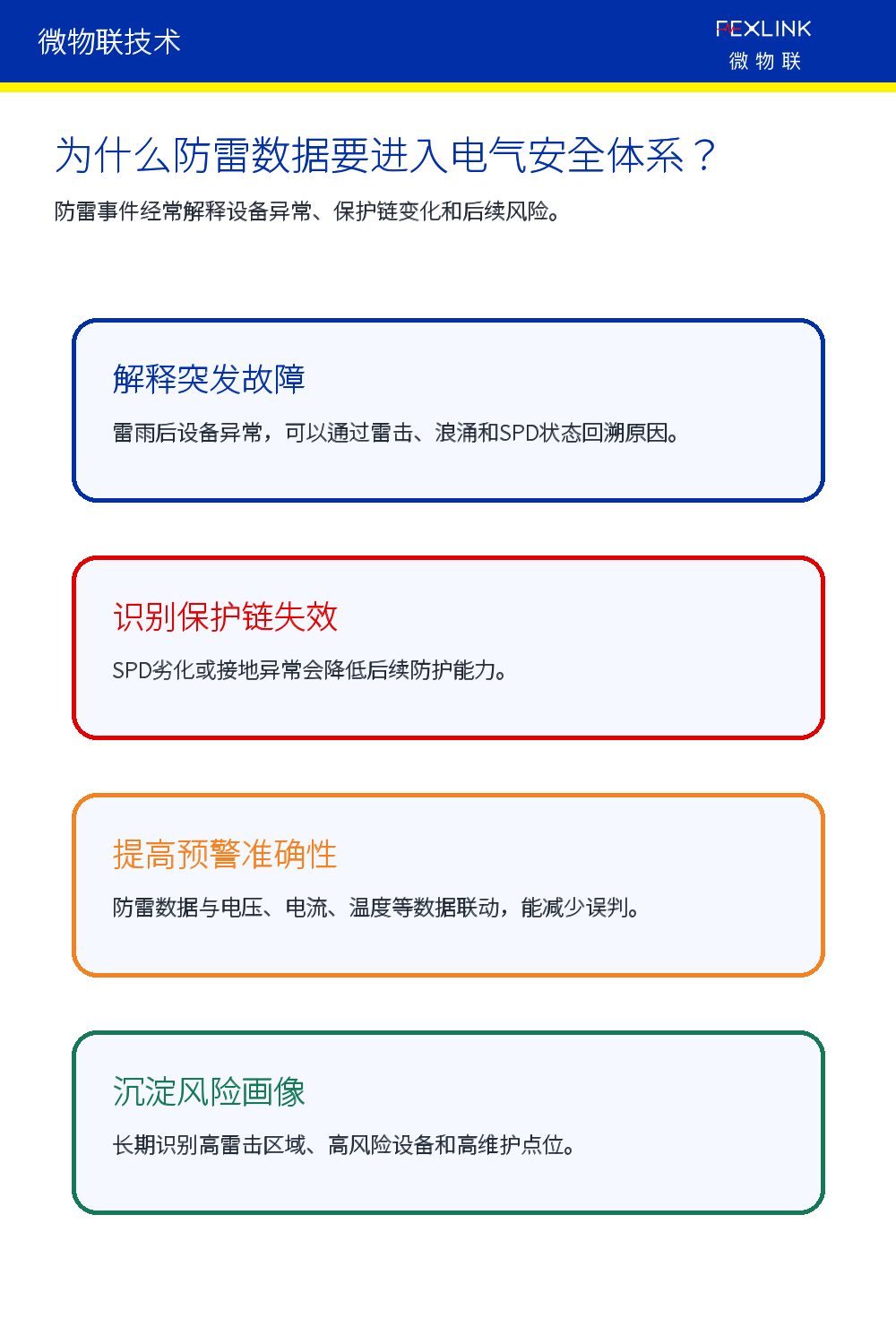
Lightning strikes and surges can trigger other electrical hazards. After surge impact, the equipment insulation may decline; after SPD degradation, the protection capability decreases; after grounding abnormality, fault current and lightning current discharge paths become worse; after communication abnormality, the platform may lose the ability to sense the on-site status.
Lightning protection data can also explain many sudden equipment failures. If a piece of equipment becomes abnormal after a thunderstorm, lightning protection data can help determine whether a lightning strike or surge impact occurs, whether the SPD operates, whether the grounding is abnormal, and whether there is a time correlation between equipment alarms and lightning strikes.
More importantly, lightning protection data can improve early warning accuracy. If you look at device alarms alone, you may not know the cause of the anomaly; if you superimpose lightning current, SPD, grounding, voltage, current, temperature and other data, you can more accurately identify the risk chain and reduce false alarms and false negatives.
4. How should the electrical safety early warning system adopt intelligent lightning protection?
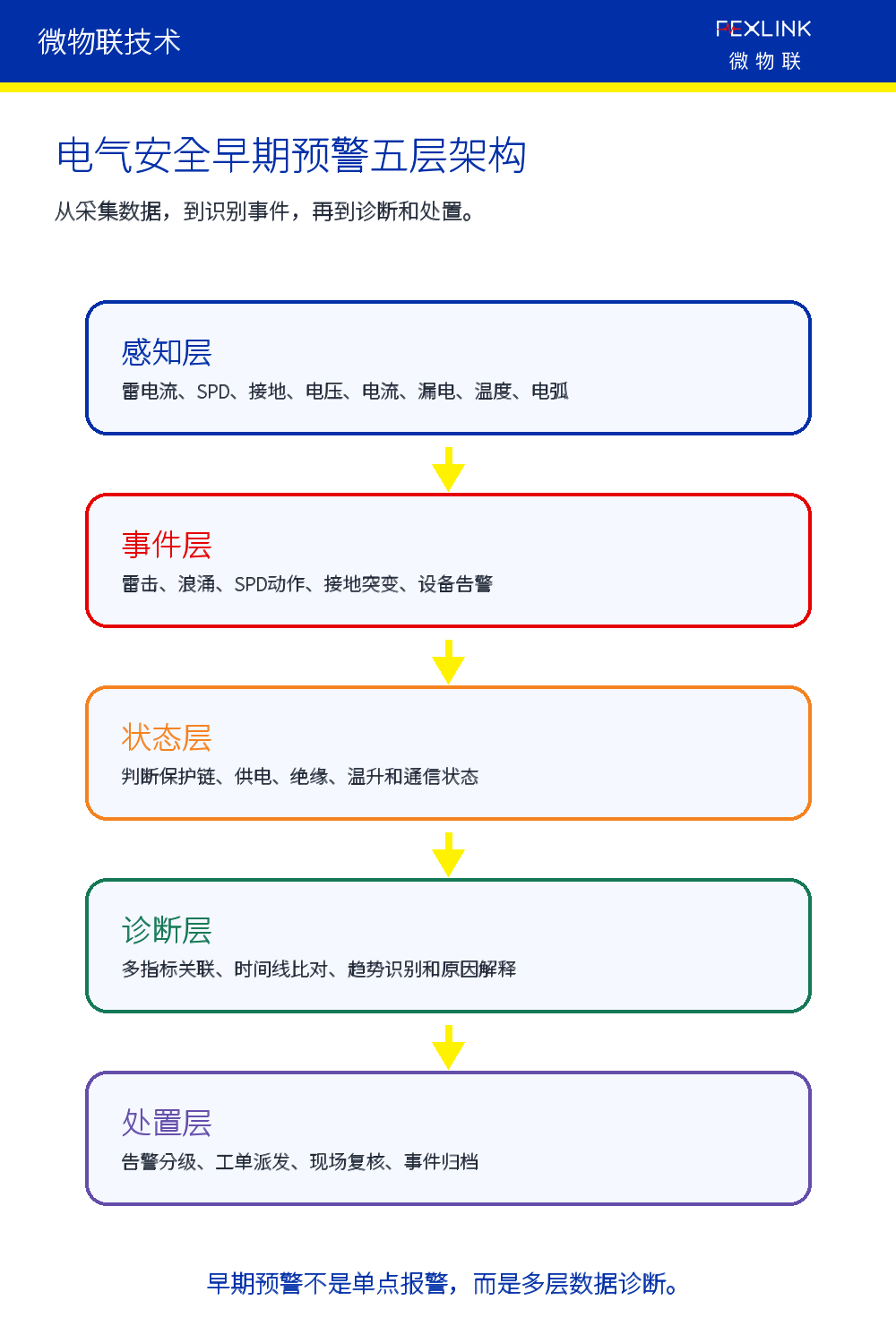
The electrical safety early warning system can incorporate intelligent lightning protection into a five-layer architecture: perception layer, event layer, status layer, diagnosis layer and disposal layer.
The sensing layer collects lightning current, SPD status, grounding status, voltage, current, leakage, temperature, arc, harmonics and equipment online status. The event layer identifies lightning strike events, surge events, SPD action events, grounding mutation events and equipment alarm events.
The status layer determines whether the SPD is degraded, whether the grounding is stable, whether the power supply fluctuates, whether leakage increases, whether the temperature is abnormal, and whether the arc risk increases. The diagnostic layer performs multi-index correlation, timeline comparison, risk level judgment, cause explanation and trend identification. The disposal layer ultimately forms alarm classification, work order dispatch, on-site review, recovery confirmation and incident archiving.
5. Multi-source data fusion is the real early warning
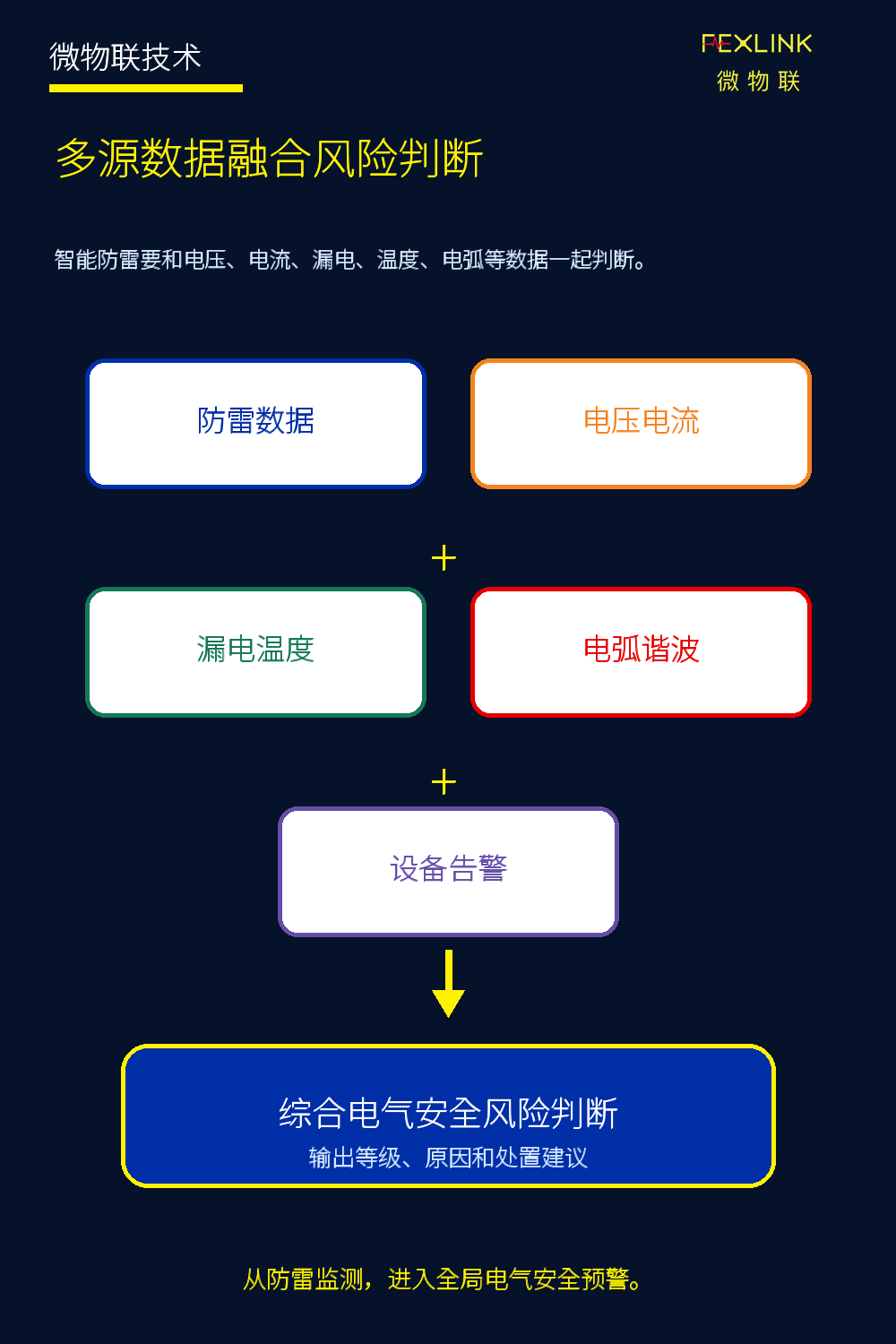
After intelligent lightning protection enters the electrical safety early warning system, the platform no longer only looks at "whether a certain lightning protection equipment is normal", but analyzes lightning protection data and voltage, current, leakage, temperature, arc, harmonics and equipment alarms in the same risk chain.
For example, after a lightning current event, the SPD leakage current increases, and at the same time the grounding state changes suddenly, and an offline alarm occurs in a certain communication equipment. At this time, the platform should not regard the four phenomena as four isolated alarms, but should identify them as changes in the protection chain and equipment status caused by an external impact.
This multi-source data fusion is the key to moving from “seeing anomalies” to “explaining anomalies”.
6. Which scenarios most require this kind of integration?
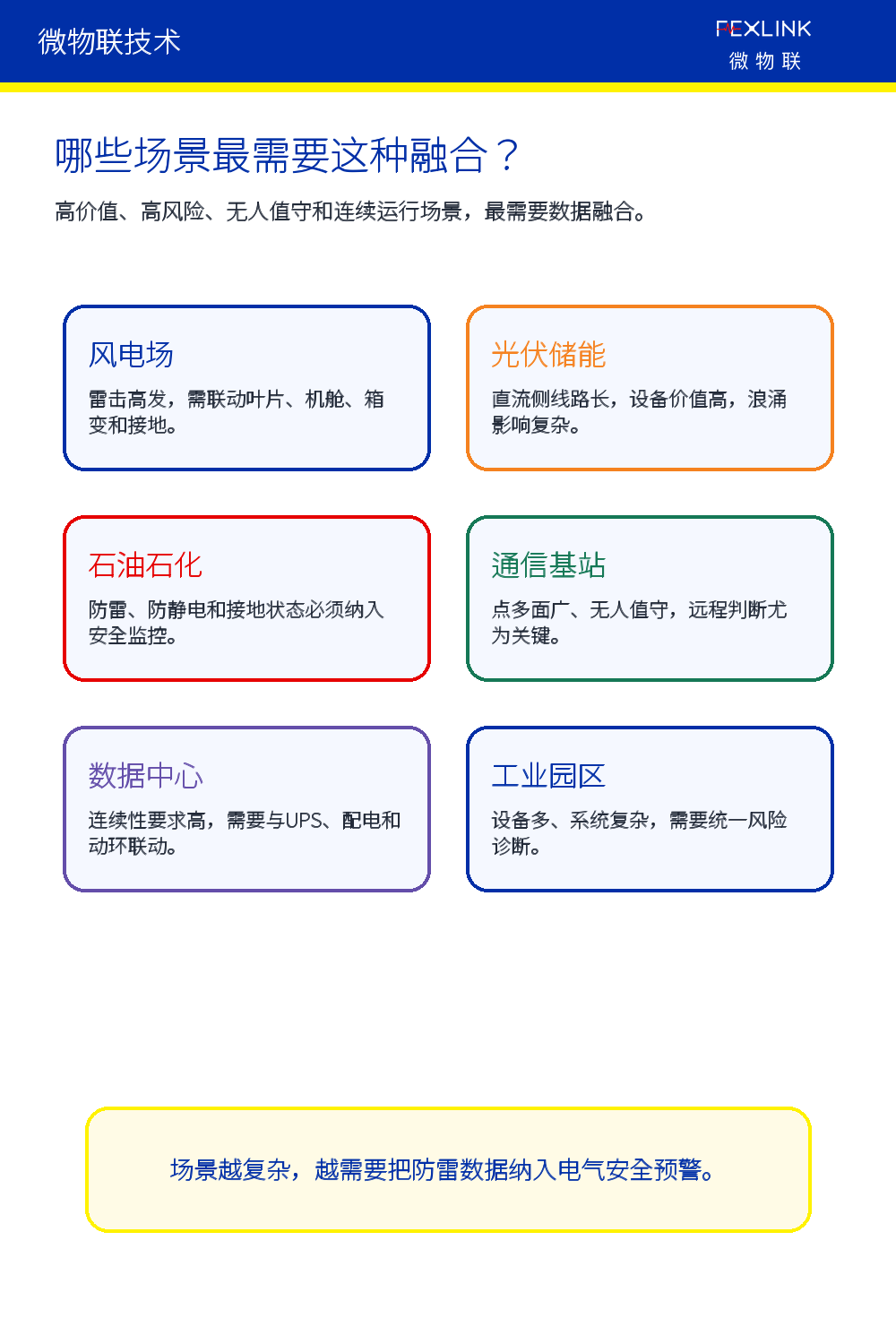
Wind farms are a typical scenario. Wind turbines are prone to lightning strikes, and lightning protection data should be linked to the blades, nacelle, tower, box-type transformer, grounding and communication systems. Photovoltaic and energy storage power stations also require similar capabilities because the DC side lines are long, the inverters and energy storage equipment are of high value, and surge events may affect PCS, BMS, communication and monitoring systems.
In petroleum, petrochemical and hazardous chemical scenarios, lightning protection, anti-static, grounding and electrical safety are closely related. Risk review after thunderstorms must have an evidence chain. Communication base stations are multi-faceted and unattended. After a lightning strike, the status of power, communication, grounding and SPD needs to be judged remotely.
Data centers and industrial parks have high requirements for continuous operation. Lightning strikes and surge events must be linked to UPS, power distribution cabinets, weak current systems, and monitoring systems to truly serve electrical safety management.
7. How does FEXLINK understand this matter?
FEXLINK believes that intelligent lightning protection is not an isolated "online lightning protection equipment", but an important risk perception module in the electrical safety early warning system.
What FEXLINK focuses on is not a single device status, but a complete data link from electrical signal capture, data feature extraction, multi-dimensional risk diagnosis, alarm classification, work order closed loop to long-term risk portrait.
When intelligent lightning protection data enters the electrical safety early warning system, the platform no longer only answers whether the lightning protection equipment is normal, but further answers: Is the electrical system being affected by external shocks? Is the chain of protection still valid? Are risks accumulating? Does it need to be disposed of in advance?
Conclusion: The next step for intelligent lightning protection is to enter the electrical safety risk base
The value of intelligent lightning protection is not only to make the lightning protection system visible, but also to allow lightning strikes, surges, SPD, grounding and equipment alarms to enter a unified electrical safety risk judgment system. The lightning protection system is not an island, lightning strikes are not isolated events, SPD degradation is not an isolated state, and grounding abnormalities are not isolated indicators.
Only by combining these data with voltage, current, leakage, temperature, arc, harmonics, equipment alarms and work order handling can an electrical safety early warning system that is truly oriented to on-site operations be formed.
FEXLINK technology will continue to share content related to intelligent lightning protection, early warning of electrical safety, digital power distribution, energy supervision and industrial Internet of Things.
FEXLINK/FEXLINK uses data to reconstruct energy efficiency and electrical safety.
Where there is electricity, there is FEXLINK.