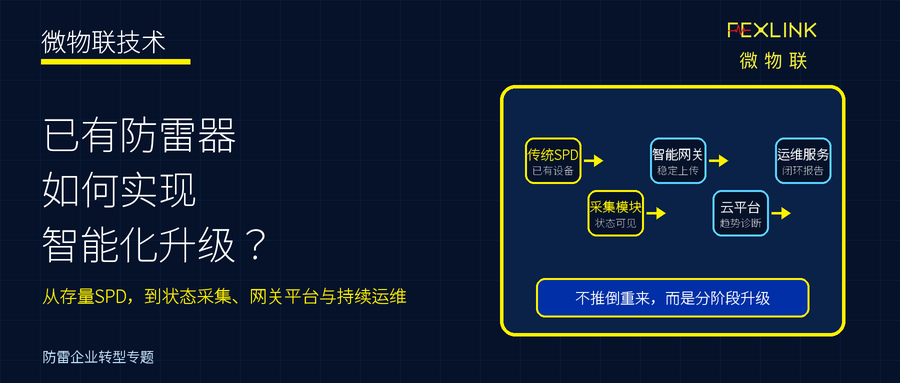
Cover image of public account: How to upgrade existing lightning protection devices intelligently?
Abstract: Many lightning protection projects have installed SPDs, lightning protection boxes, lightning protection cabinets and grounding systems, and have also passed testing or acceptance. However, in long-term operation, it is often still invisible whether the lightning arrester has deteriorated, whether it has tripped, whether the leakage current has increased, whether the temperature has been abnormal, whether the grounding status has changed, whether a lightning strike or surge event has occurred. The intelligent upgrade of existing lightning protection devices is not to tear down and rebuild, but to add status collection, edge gateway, platform diagnosis and operation and maintenance closed-loop capabilities to the original lightning protection system, so that the traditional lightning protection system has the ability to continuously produce status data.
Many customer sites do not have lightning protection systems. There are SPDs in the power distribution cabinets, signal lightning protection devices in the weak current boxes, lightning protection boxes in the computer rooms, and lightning protection, downlink and grounding systems in the building. The project has also undergone lightning protection testing.
But the problem is that after the system is put into operation, many key states are still invisible: whether the SPD has tripped, whether the SPD has deteriorated, whether the leakage current has increased, whether the temperature has been abnormal, whether the grounding has changed, whether there has been a lightning strike or surge, and whether anyone has dealt with the abnormality.
Therefore, intelligent transformation does not negate the original lightning protection system, but supplements the visibility of the original system during the operation stage. The traditional lightning protection system solves the problem of "whether there is protection", while the intelligent upgrade solves the problem of "whether the protection is still effective".
1. What are the upgrade targets for existing lightning protection systems?
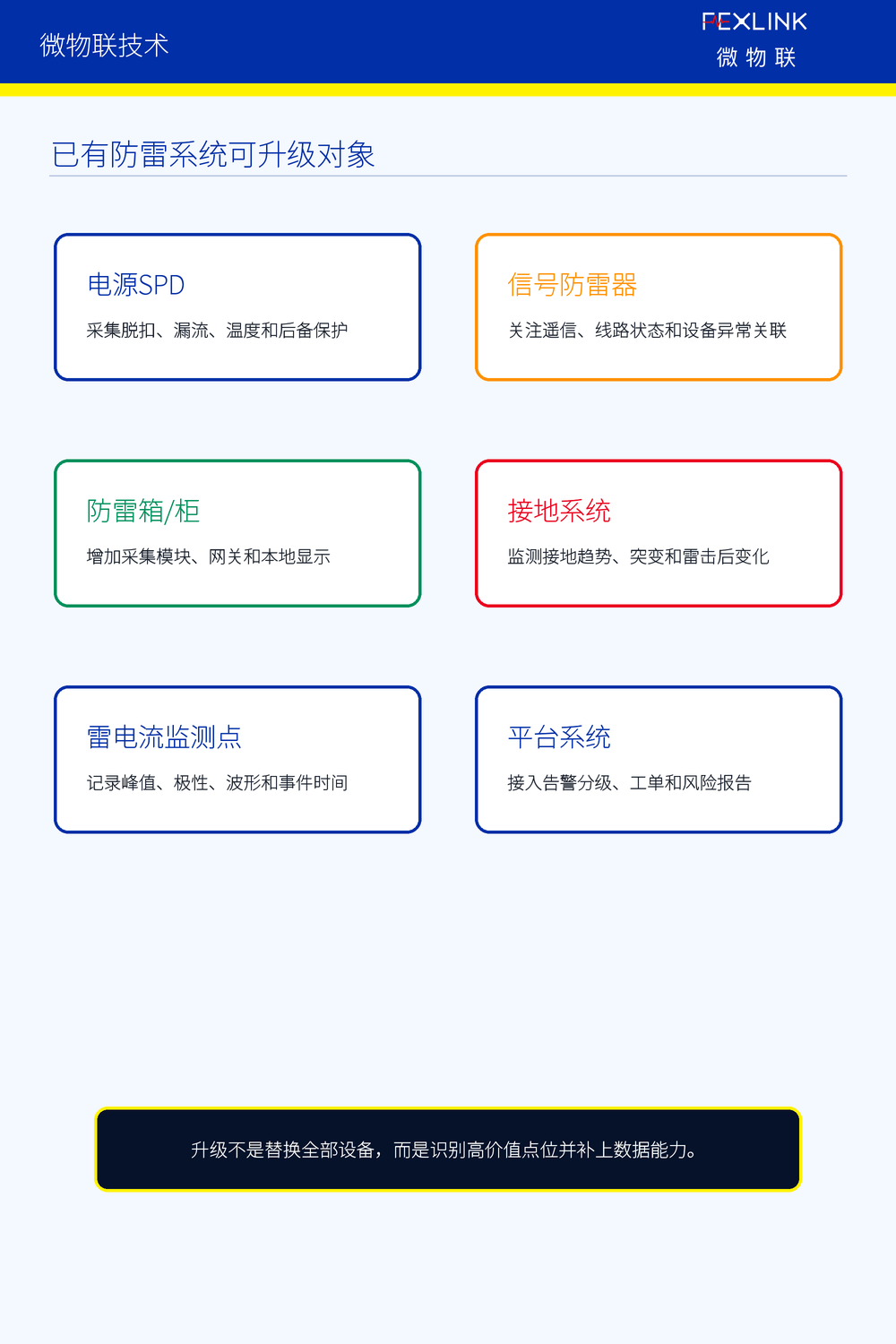
The first category is power SPD. Typical points include primary power distribution cabinet SPD, secondary power distribution cabinet SPD, terminal distribution box SPD, UPS front and back stage SPD, photovoltaic inverter AC side SPD and energy storage PCS side SPD. Upgradeable data includes trip status, leakage current, temperature, backup protection status, number of lightning strikes and life trends.
The second category is signal and communication lightning protection devices. Common objects include RS485 lightning protectors, network lightning protectors, video lightning protectors, instrument signal lightning protectors, antenna feeder lightning protectors and control line lightning protectors. Such points are usually small and scattered, and may not all be suitable for deep intelligence. Therefore, it is more suitable to select key equipment entrances and high-value loops for priority transformation.
The third category is lightning protection boxes and lightning protection cabinets. Many traditional lightning protection boxes already have SPD modules, backup protection, indicator lights, remote signaling terminals and grounding terminals inside, which are high-value entrances to the intelligent transformation of existing products. Remote signaling collection, leakage flow collection, temperature collection, door status, ambient temperature and humidity, communication gateway, local display and platform upload capabilities can be added.
The fourth category is the grounding system. Grounding is not a static value in a test report, but an operating state that is affected by corrosion, construction disturbance, soil moisture, loose connections and lightning strikes. Involving building grounding, power distribution system grounding, lightning protection grounding, communication grounding, equipment protection grounding, tank area anti-static grounding, photovoltaic and wind farm station grounding, etc.
The fifth category is lightning current monitoring points. Not every project must add lightning current monitoring, but high-rise buildings, computer rooms, wind farms, photovoltaic power stations, communication base stations, railway signaling systems, petroleum and petrochemical tank farms and important electrical equipment entrances can all set lightning current monitoring points according to risk levels.
2. Intelligent upgrade cannot only adopt “remote signaling”
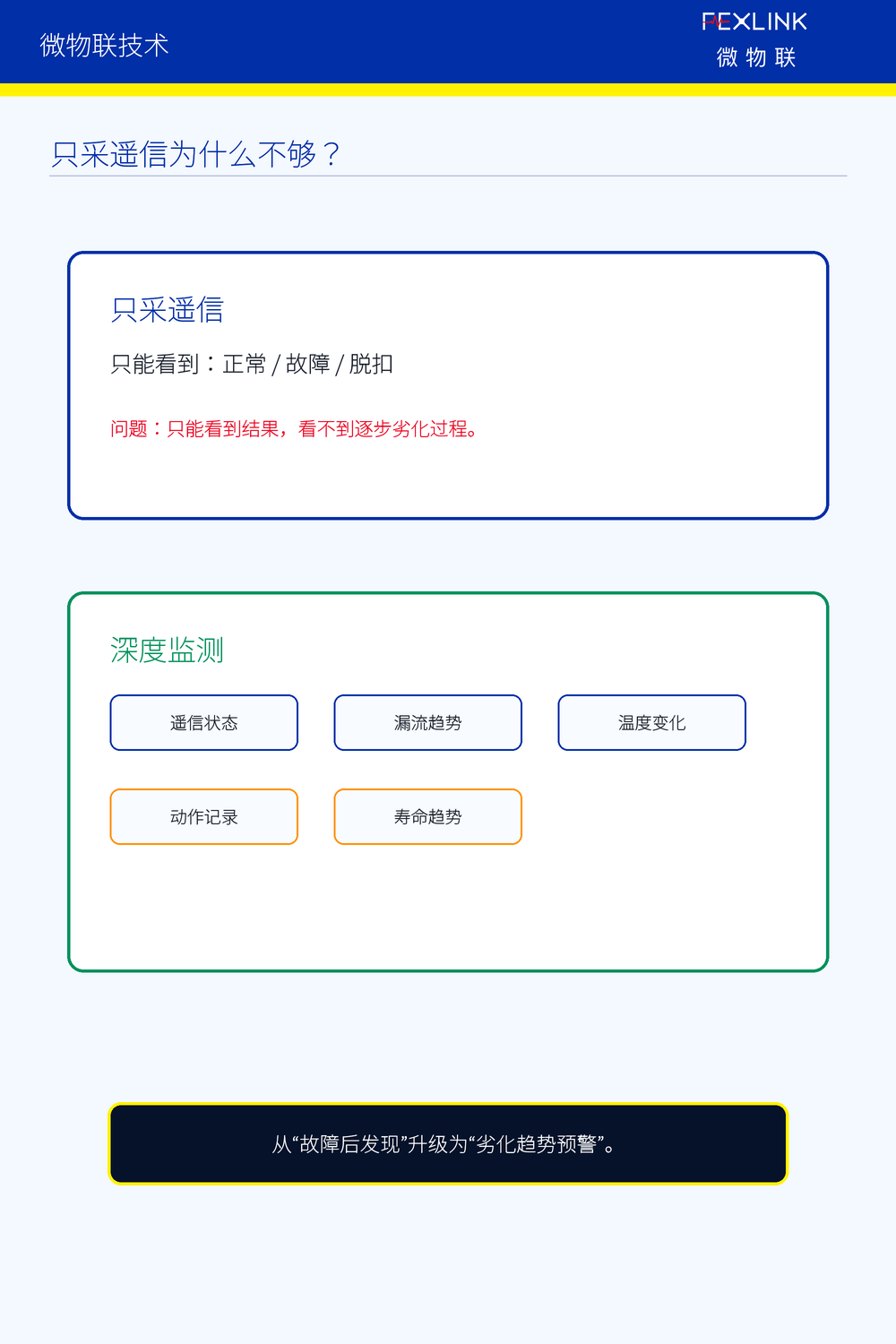
The first step in the transformation of many existing projects is to connect SPD remote signaling to the acquisition module. This action is valuable because it allows the platform to remotely know whether the lightning arrester has tripped or failed. However, if only remote information is used, the system can still only see the "result" and it is difficult to see the "process".
Traditional SPD remote signaling usually can only output normal or fault. It cannot tell the user whether the leakage flow is gradually increasing, whether the temperature is abnormal, whether it is deteriorating after lightning strikes, whether multiple short-term shocks are accumulated, whether the life trend is declining.
Leakage flow and temperature are closer to the SPD degradation process. SPD degradation usually does not occur in an instant. Increased leakage flow, increased temperature, and increased number of impacts can often allow the system to see risk trends before tripping.
The grounded state cannot be absent either. If the SPD is normal but the ground path is abnormal, the protection effect may still be affected. Therefore, it is best to view the SPD status in conjunction with the grounding status to form a complete risk chain of "SPD status + grounding status + lightning current event + equipment alarm".
Lightning current events can explain many field failures. After the equipment is damaged, if there is no event data, all we can say is "it may have been a lightning strike." If the system records lightning strike time, peak value, polarity, waveform and event point, it can help determine whether equipment abnormalities are related to lightning strikes or surges.
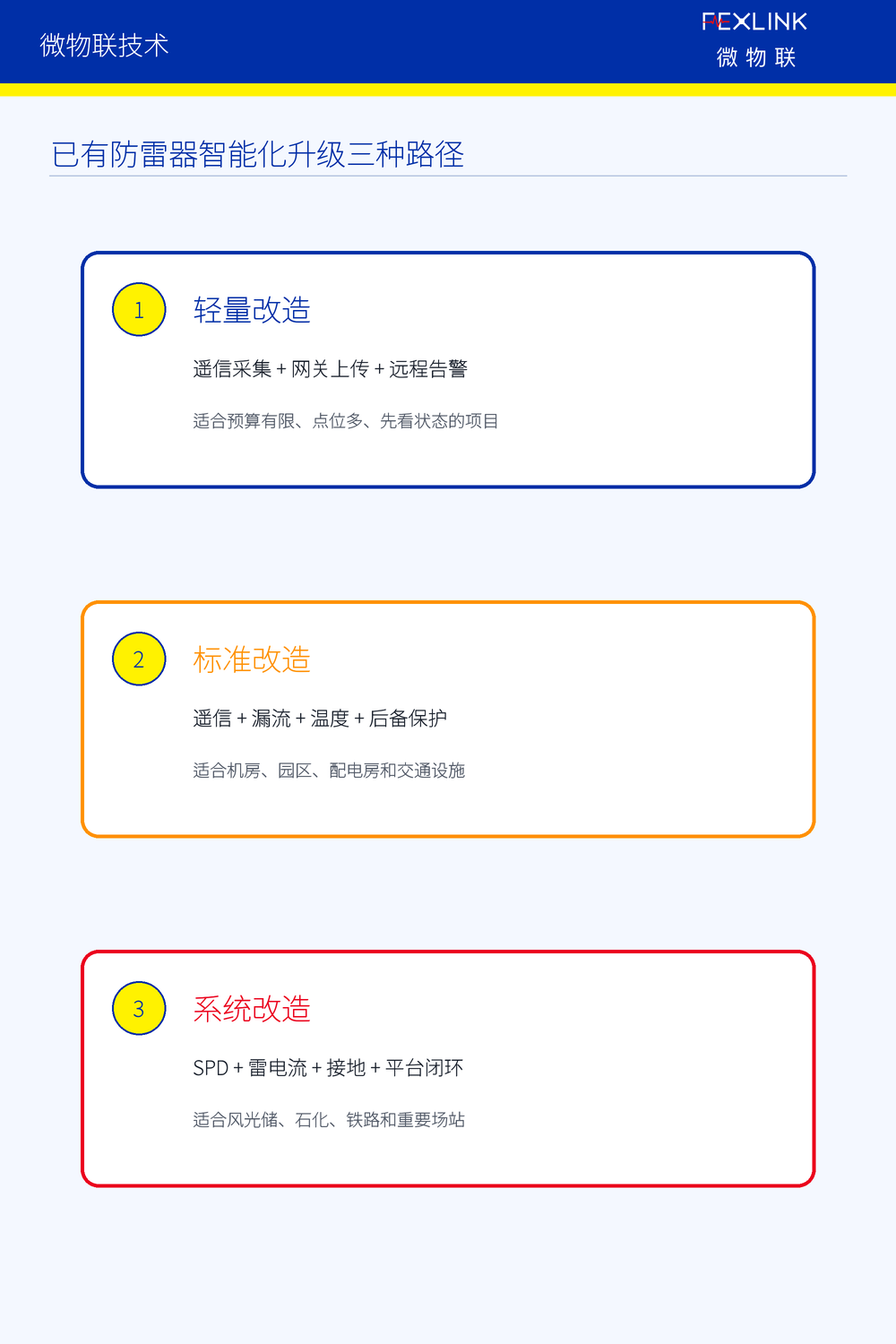
3. Three paths for intelligent upgrade of existing lightning protection devices
The first path is lightweight transformation, starting with remote messaging and online status. This is suitable for projects with limited budget, many points, existing SPD with remote signaling terminals, and the customer first wants to check the status remotely. The transformation content includes remote signal collection module, communication gateway, equipment online status, platform alarm and simple work order record. The advantages are low cost, fast construction, and suitable for large-volume inventory projects; the limitation is that only tripping or faults can be seen, making it difficult to judge the deterioration trend.
The second path is a standard modification that adds leakage flow, temperature and backup protection monitoring. This is suitable for scenarios such as power distribution rooms, data centers, computer rooms, parks, transportation facilities, communication base stations, and new energy stations. The transformation includes SPD remote signaling, leakage monitoring, temperature monitoring, backup protection status, box environment status, intelligent gateway and platform alarm classification. Its value is upgraded from "post-fault discovery" to "deterioration trend early warning".
The third path is to modify the system and add lightning current, grounding and platform closed loops. This is suitable for wind farms, photovoltaic energy storage, petroleum and petrochemicals, railways, highways, large industrial parks and important computer rooms. The transformation includes SPD status monitoring, lightning current monitoring, ground resistance online monitoring, multi-point data aggregation, edge gateway, cloud platform analysis, work order closed loop and risk reporting. Its value is to upgrade from a single smart device to a complete smart lightning protection system.
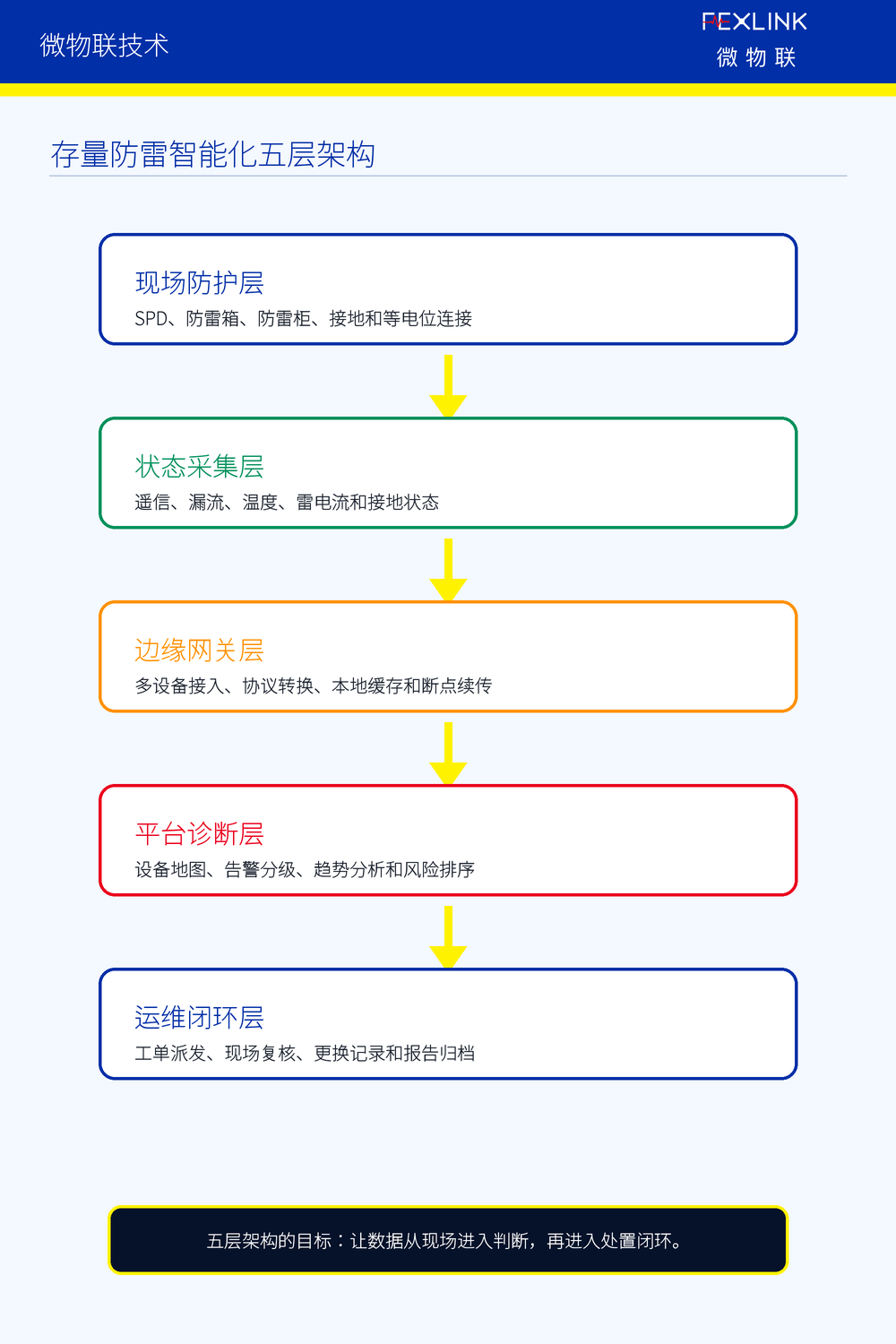
4. How should the renovation plan be designed?
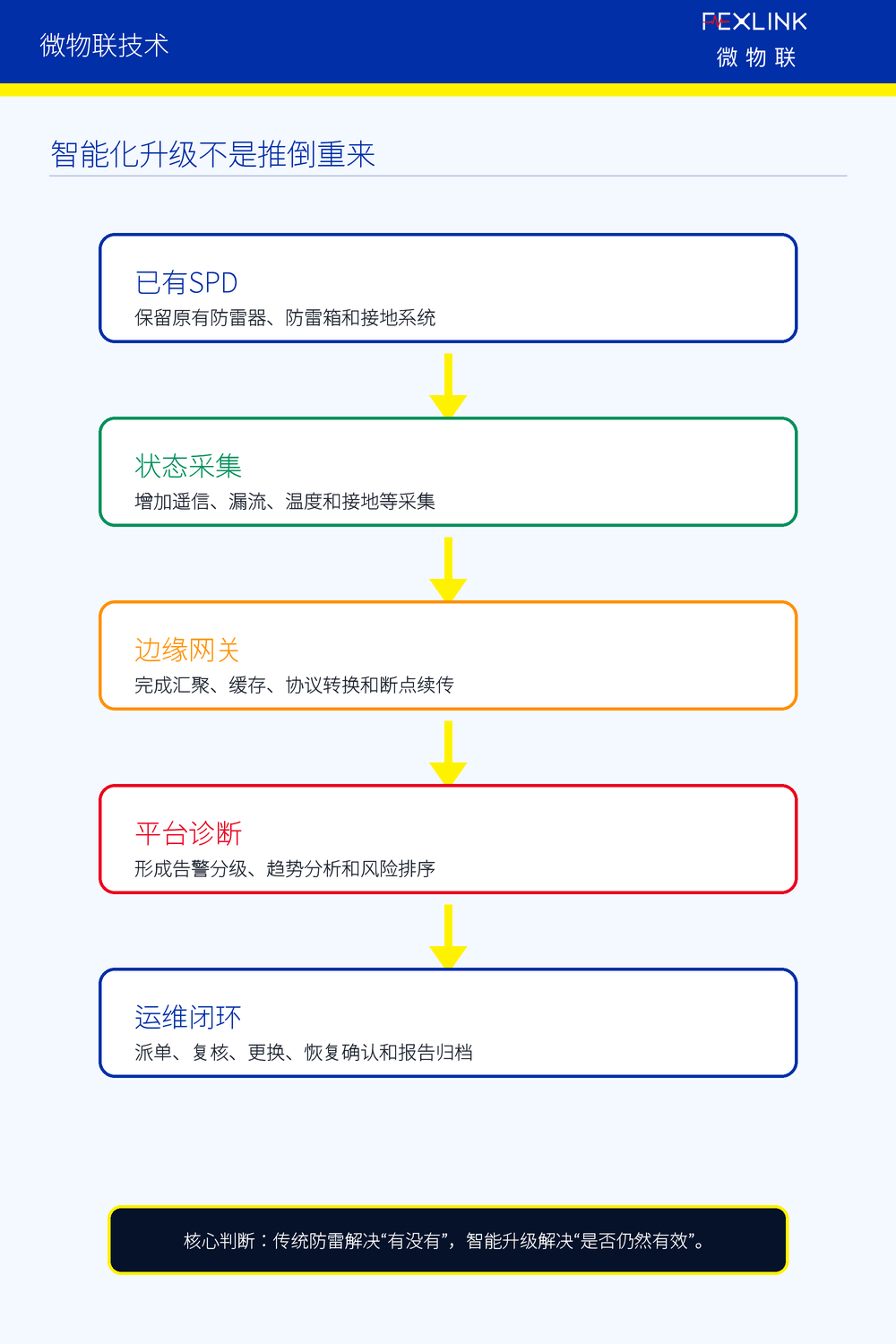
The first layer is the on-site protective layer. The original system includes SPD, lightning protection box, lightning protection cabinet, down conductor, grounding system and equipotential bonding. Renovation is not about tearing down and rebuilding, but adding monitoring capabilities based on the original system.
The second layer is the status collection layer. Add or connect remote signal collection, leakage current sensing, temperature sensing, lightning strike counting, lightning current sensing, ground resistance monitoring and box environment monitoring, turning originally invisible states into data.
The third layer is the edge gateway layer. The gateway is responsible for multi-device access, protocol conversion, local caching, breakpoint resumption, remote configuration, local alarms and data cleaning. Many existing projects are scattered and have complex communication conditions. The gateway capability determines whether data can be uploaded stably.
The fourth layer is the platform diagnostic layer. The platform cannot just display equipment online, normal, and faulty, but should have equipment maps, status boards, alarm classification, trend analysis, event files, life assessment, and risk ranking.
The fifth layer is the operation and maintenance closed-loop layer. After an alarm is issued, someone must confirm it, review it, have a replacement record, have a recovery confirmation, and have a report filed. Only by forming a closed loop can intelligent transformation truly transform from "seeing data" to "managing risks."
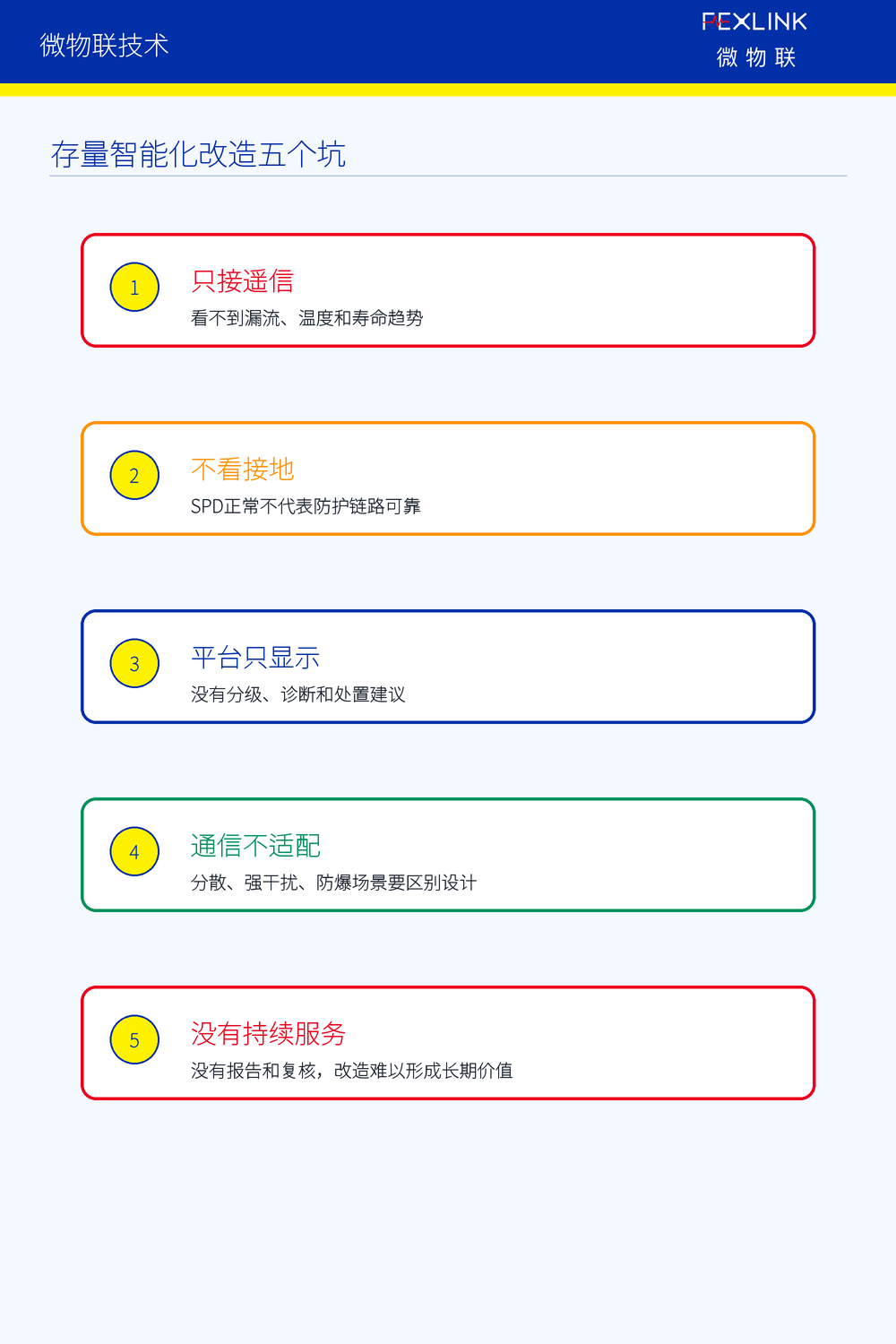
5. What pitfalls are most likely to be encountered by lightning protection companies when they implement intelligent transformation of existing products?
The first misunderstanding is to only connect the remote communication to the platform. Remote signaling is very important, but if only remote signaling is adopted, the system is still very shallow, the degradation process cannot be seen, and it is difficult to form predictive maintenance.
The second misunderstanding is to only pay attention to SPD and not to grounding. Intelligent lightning protection cannot only look at lightning arresters. The protection link at least includes lightning strikes or surge events, SPD status, grounding status, equipment alarms, and operation and maintenance handling.
The third misunderstanding is that the platform only displays and does not diagnose. If the platform only shows that the equipment is online, normal, and faulty, without trends, classifications, explanations of causes, and suggestions for disposal, customers will soon feel that the value is limited.
The fourth misunderstanding is that the communication method is not suitable for the scene. The power distribution room is suitable for RS485 or Ethernet, the decentralized base station is suitable for 4G or 5G, the park can use gateway aggregation, the petroleum and petrochemical industry must consider explosion-proof and safety regulations, and the wind power and photovoltaic industry must consider distance, interference and breakpoint resumption.
The fifth misunderstanding is that there is no follow-up service design. Intelligent transformation is not the end of construction. Without monthly reports, inspection recommendations, post-thunderstorm review, SPD life assessment and grounding trend analysis, it is still difficult to turn it into a long-term service.
6. How does FEXLINK understand the intelligent upgrade of existing lightning protection devices?
MicroIoT believes that the intelligent upgrade of existing lightning protection devices does not simply add communication to traditional lightning protection devices, but allows the originally silent lightning protection system to continue to produce status data.
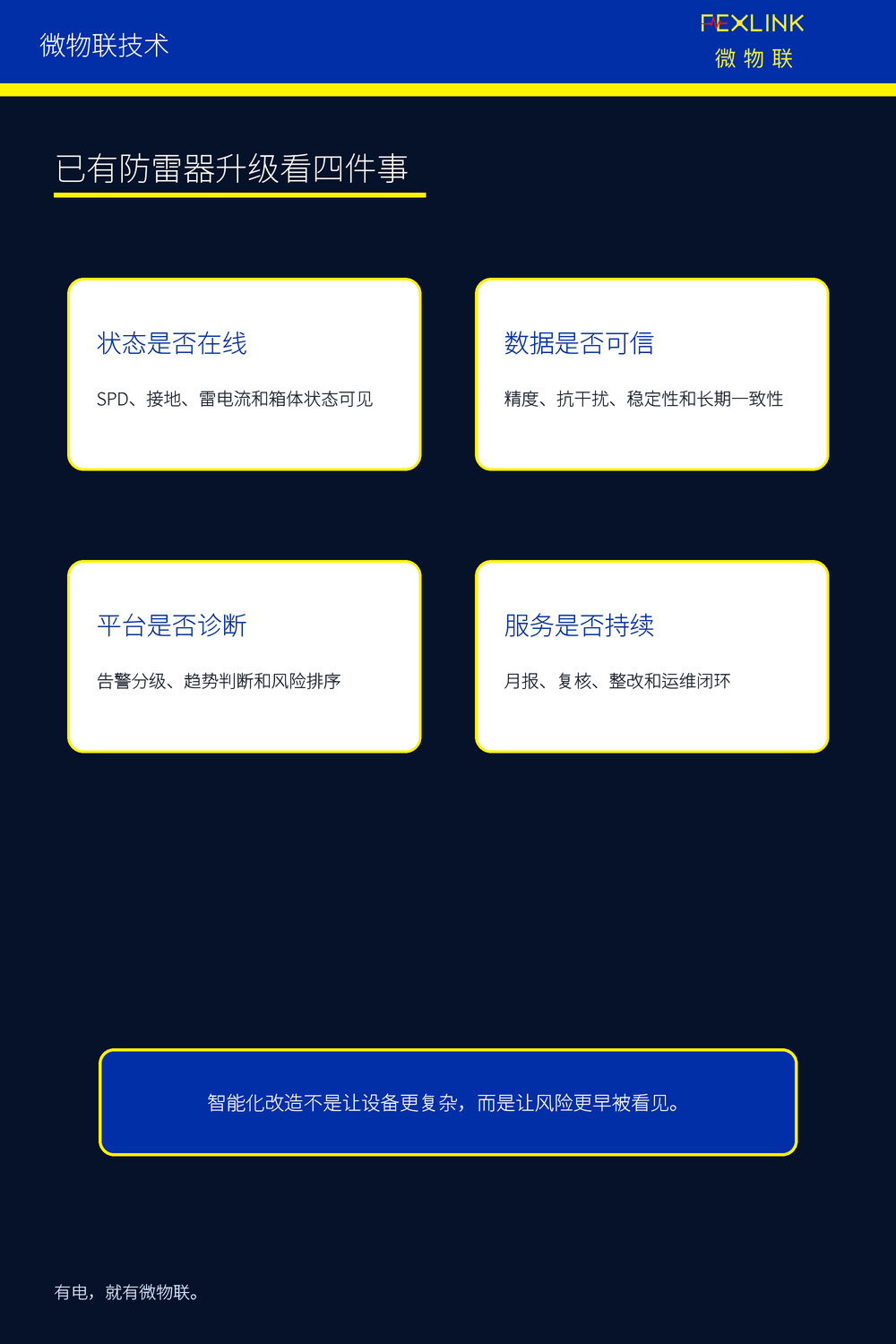
What FEXLINK focuses on is not whether a single device is connected to the Internet, but whether the SPD status can be judged, whether the leakage current and temperature can be trended, whether the grounding status can be continuously monitored, whether lightning current events can be traced, whether alarms can be classified, whether work orders can be closed-loop, and whether the data can become the basis for long-term safety management of customers.
It can be summarized as three transformations: from invisible status to online status; from replacement after failure to early warning of deterioration; from one-time engineering to continuous data services.
Conclusion: The existing lightning protection system is an important entrance to the transformation of intelligent lightning protection
The intelligent upgrade of existing lightning arresters is not to make traditional equipment "look more advanced", but to answer key questions in long-term operation: whether the lightning arrester is still effective, whether the grounding path is reliable, whether lightning strikes or surges occur, whether abnormalities are discovered in time, and whether disposal forms a closed loop.
For lightning protection companies, the intelligent transformation of existing lightning protection systems is a very realistic entrance to transformation. It does not require all projects to be reinvented, but it allows companies to move from disposable equipment sales to platformization, dataization and continuous service.
The real value of intelligent lightning protection is not to provide more equipment, but to change the lightning protection system from "installed" to "knowable, judgeable, manageable and serviceable".
FEXLINK technology will continue to share content related to intelligent lightning protection, early warning of electrical safety, digital power distribution, energy supervision and industrial Internet of Things.
FEXLINK/FEXLINK uses data to reconstruct energy efficiency and electrical safety.
Where there is electricity, there is FEXLINK.