Abstract: Lightning arresters are the most common and most misunderstood equipment in lightning protection systems. Many engineering projects are equipped with power SPD, signal SPD, communication SPD or DC SPD during the construction phase. If the status is normal during acceptance, the protection is considered to have been completed. However, in long-term operation, SPD will experience surge impact, lightning strike energy, power frequency voltage, leakage current changes, temperature rise, environmental aging and multiple actions. It is difficult to judge whether the SPD has deteriorated, needs to be replaced, and whether there is a hidden risk of failure by just manually checking the indicator window. The value of SPD online monitoring is to incorporate tripping, leakage current, temperature, number of lightning strikes, life trends and alarm closed loop into the intelligent lightning protection system, making the protection status visible for a long time.
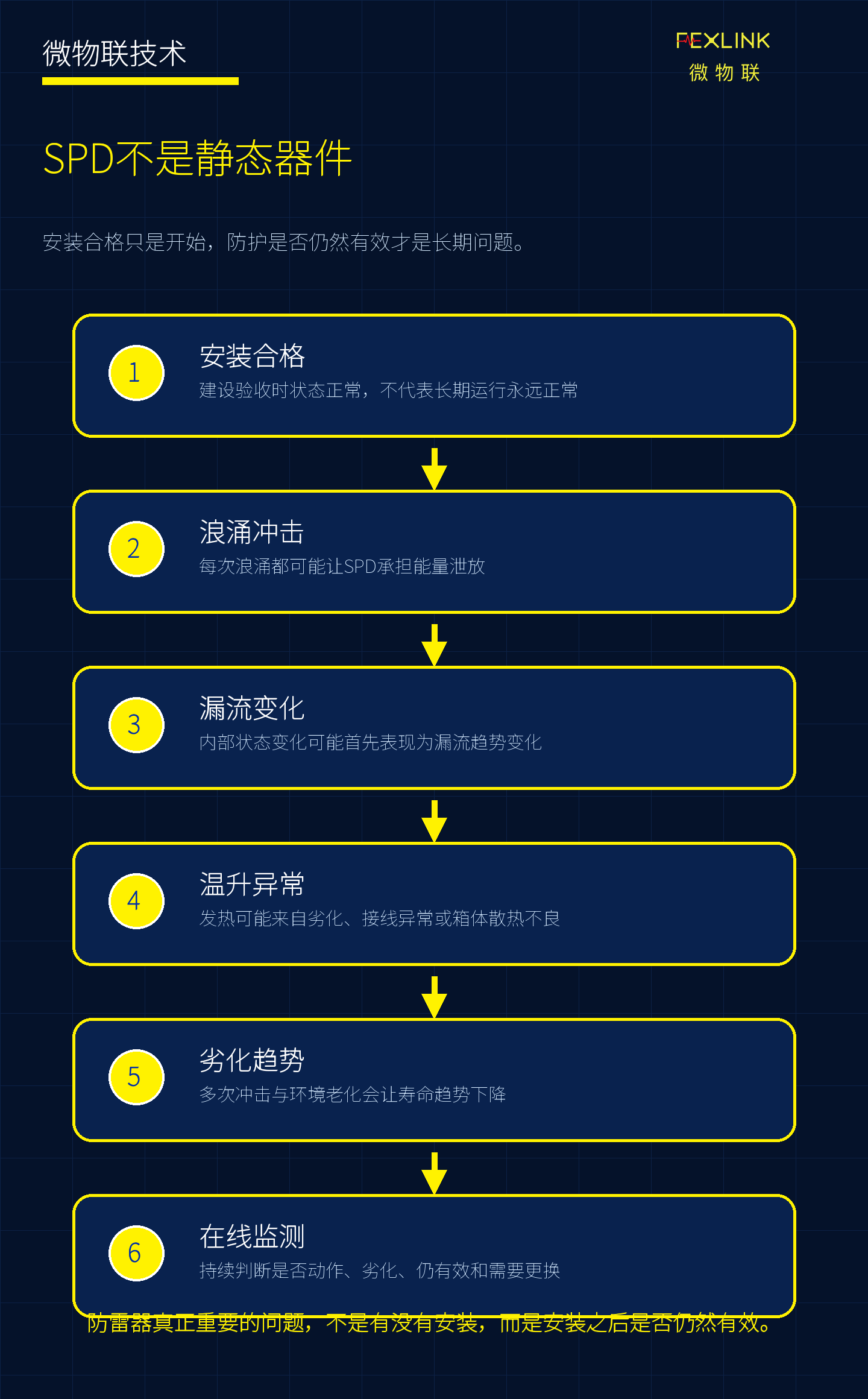
Many people understand lightning protectors and think that "there is a module installed in the power distribution cabinet", "it shows normal during acceptance" and "there is no problem if there is a green indicator window". But SPD is not a static device that will be effective forever after being installed. It may undergo state changes during every surge impact, every lightning strike energy release, and every long-term power frequency operation.
The really important issue with lightning protectors is not whether they are installed, but whether they are still effective after installation. If the lightning protection system only stays in the installation list and inspection photos, it will be difficult to detect operational problems such as SPD degradation, tripping, temperature rise, leakage rise, and life trend decline in a timely manner.
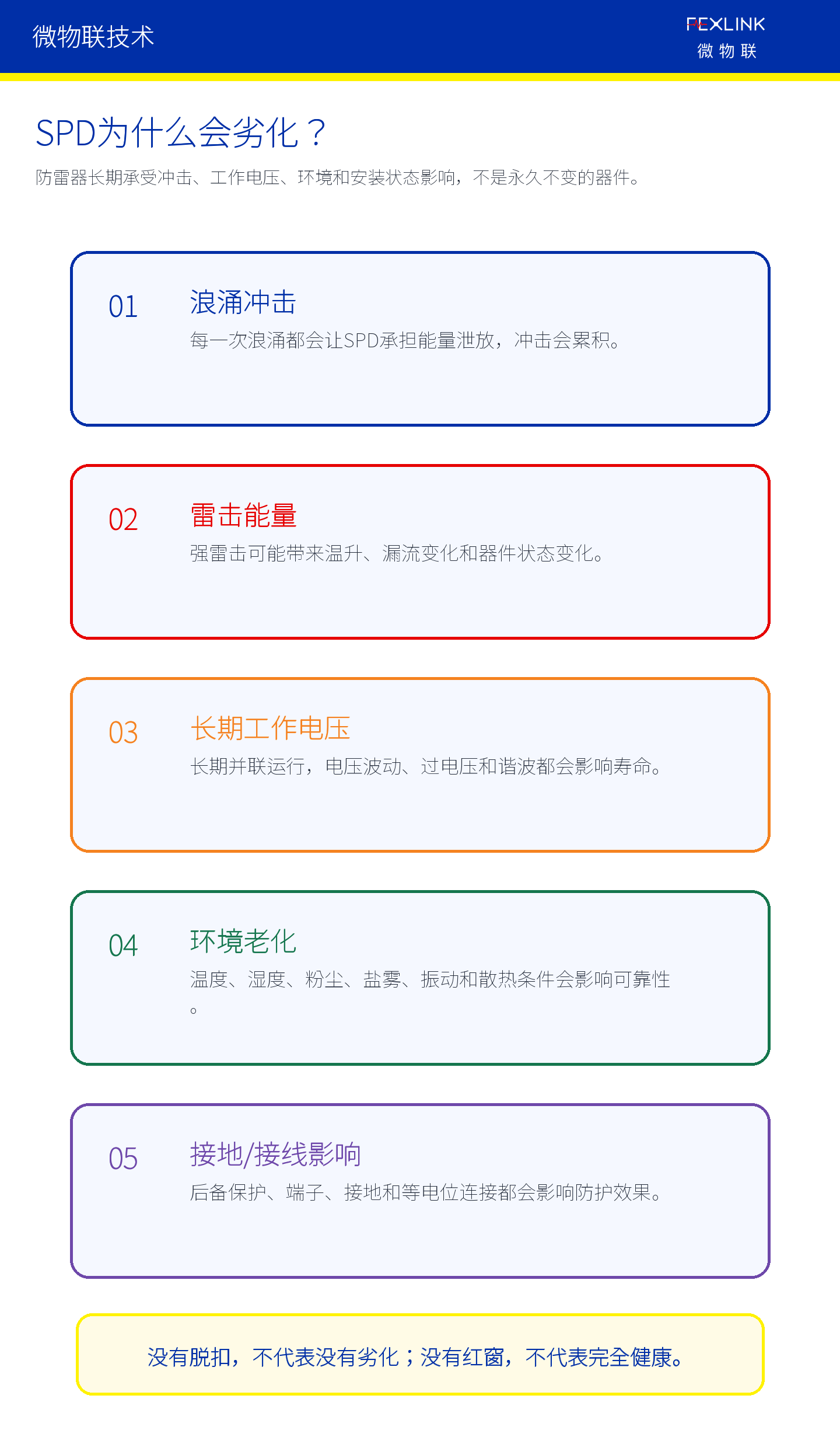
1. Why does SPD deteriorate?
First, surge impacts accumulate damage. Each surge impact causes the SPD to release energy. If there are many impacts and high energy, the SPD may enter a degraded state even if it does not trip immediately.
Second, lightning strike impact may accelerate aging. Lightning strike energy is stronger, which may cause SPD temperature rise, leakage current changes, voltage-sensitive device degradation, gap device status changes, and even affect backup protection.
Third, the long-term effect of power frequency voltage. SPDs are connected in parallel in the system for a long time, and long-term working voltage, overvoltage, harmonics, voltage fluctuations, etc. may affect its operating status.
Fourth, environmental factors can affect lifespan. Temperature, humidity, dust, salt spray, vibration, poor heat dissipation of the box, etc. will affect the life and operational reliability of the SPD device. Fifth, backup protection and wiring status will also affect the protection effect. SPD does not work in isolation. Backup protection, wiring terminals, ground connections, installation methods, cable lengths, and equipotential connections will all affect whether it can function correctly.
2. What are the blind spots in traditional SPD inspections?
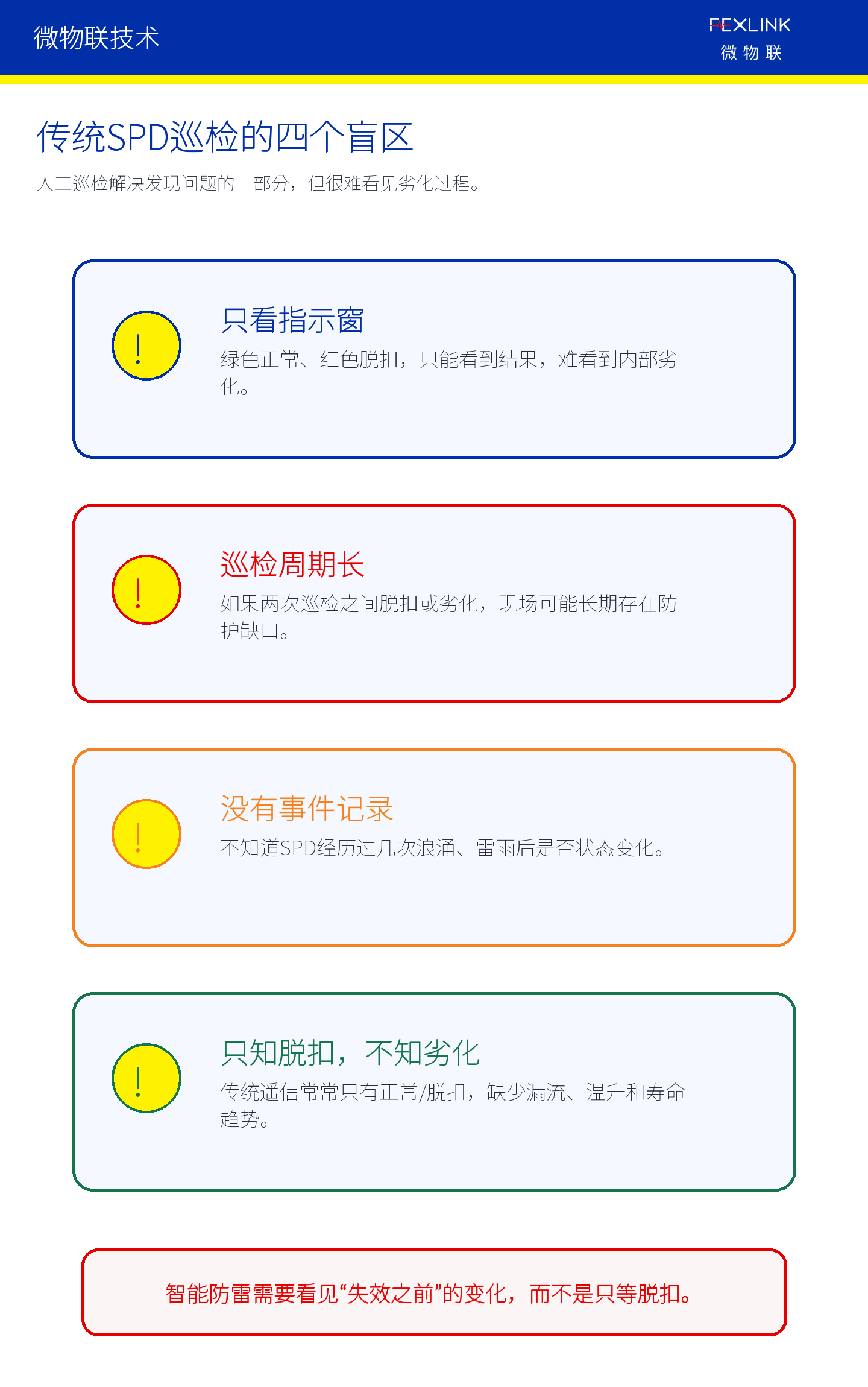
The first blind spot is to only look at the indicator window and not know about the internal deterioration. Many on-site inspections mainly look at green normal and red tripped. But the fact that SPD does not turn red does not mean that it has not experienced impact, nor does it mean that it has not deteriorated. Leakage flow, temperature, frequency of operation, or life trends may have changed before failure is apparent.
The second blind spot is the long manual inspection cycle. Many projects are inspected once a month, a quarter or even a year. If the SPD trips or deteriorates between inspections, the site may be in a protection gap for a long time.
The third blind spot is that there are no records of lightning strikes or surge events. Whether the SPD has acted, experienced several surges, or whether its status changed after a thunderstorm, it is difficult to answer without event data.
The fourth blind spot is that we only know the tripping but not the degradation trend. Traditional remote signaling can usually only tell the platform whether it is normal or tripped, but smart lightning protection needs to further know whether the leakage flow is increasing, whether the temperature is abnormal, whether the number of lightning strikes is increasing, whether the life trend is declining, and whether it needs to be replaced in advance.
3. What exactly does SPD online monitoring monitor?
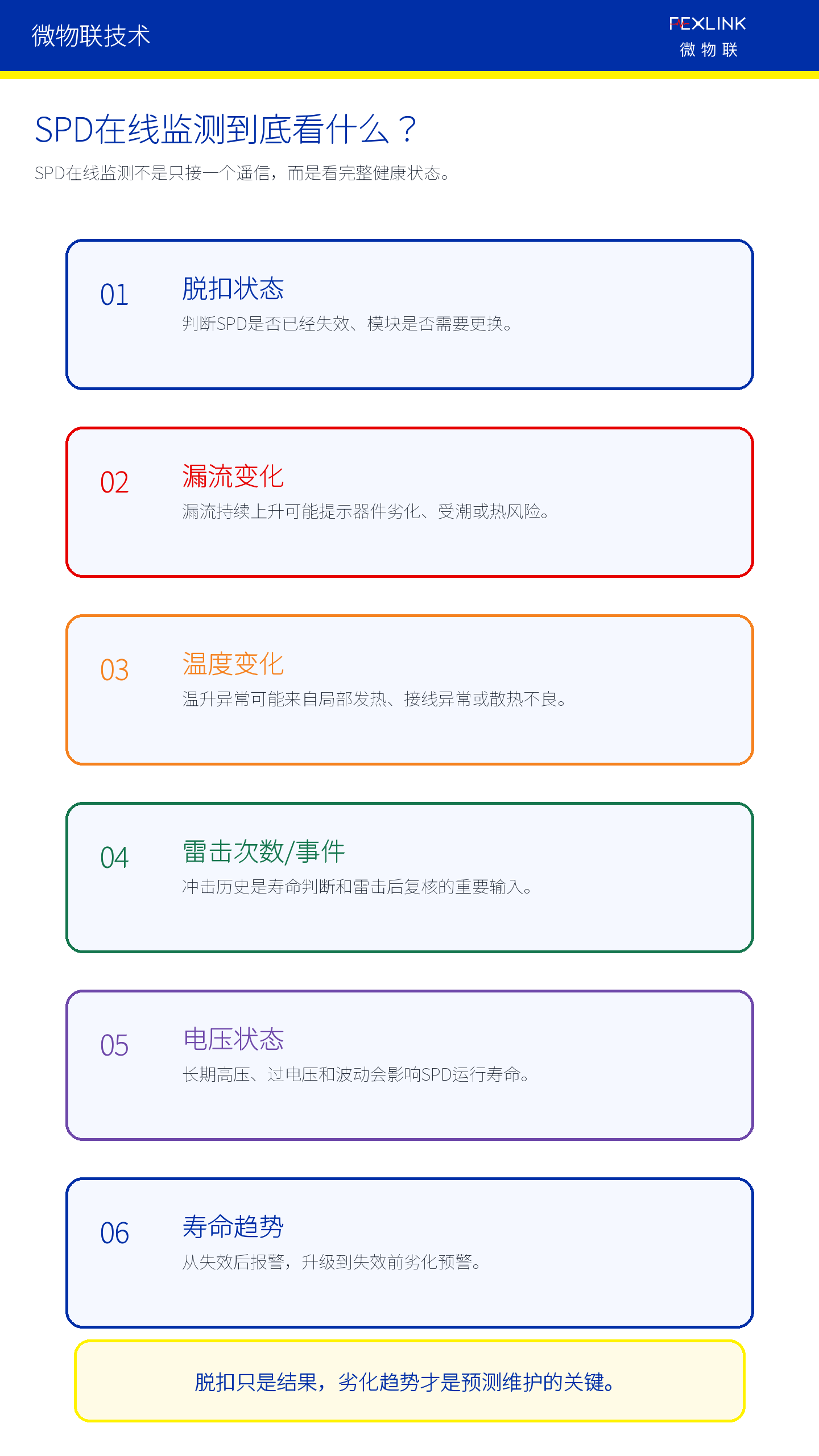
SPD online monitoring must first check the tripping state, which is the most basic state. It can determine whether the SPD has failed, whether the SPD module needs to be replaced, and whether the remote signaling status is abnormal. But tripping is just the result, not the whole story.
Leakage current change is one of the important indicators to judge the internal state of SPD. If the leakage current continues to increase, it may indicate device degradation, moisture exposure, increased risk of thermal runaway, or changes in insulation status. Temperature changes are also critical. SPD temperature rise may reflect local heating, wiring abnormalities, device degradation, poor cabinet heat dissipation, or potential thermal risks.
The number of lightning strikes and surge events is not a simple count, but an important input for life span judgment. If it can be associated with lightning current, equipment alarms and grounding status, the value will be even higher. The voltage state cannot be ignored. SPD operates in the actual voltage environment. Overvoltage, voltage fluctuation and long-term high-voltage operation may affect the life of SPD.
Furthermore, SPD online monitoring should form life trend and degradation judgment. The truly valuable monitoring is not to wait for alarm after failure, but to see the deterioration trend before failure and arrange review or replacement in advance.
4. How should SPD online monitoring be designed?
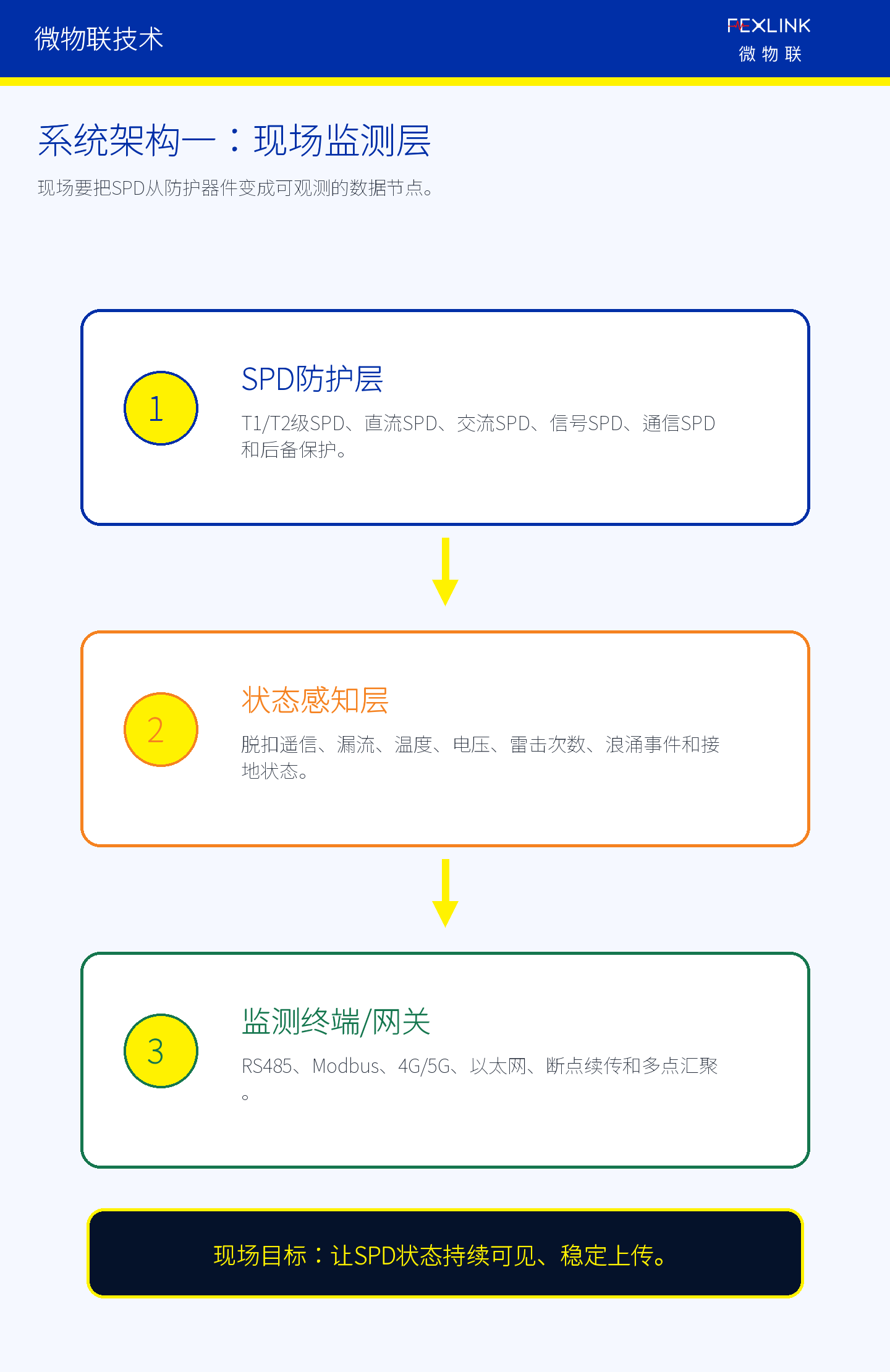
The first layer is the on-site protection layer, including T1 level SPD, T2 level SPD, DC SPD, AC SPD, signal SPD, communication SPD, backup protection, grounding and equipotential bonding. This layer solves the problem of whether there is basic protection.
The second layer is the status awareness layer, including trip remote signaling, leakage current, temperature, voltage, number of lightning strikes, surge events, backup protection and grounding status. This layer solves the problem of whether the protection status is visible.
The third layer is the edge collection and communication layer, including RS485, Modbus, 4G/5G, Ethernet, edge gateway, breakpoint resume transmission and multi-point aggregation. If SPD status monitoring is to cover power distribution rooms, computer rooms, base stations, wind and solar storage stations and transportation infrastructure, it is very important to stabilize communication and data integrity.
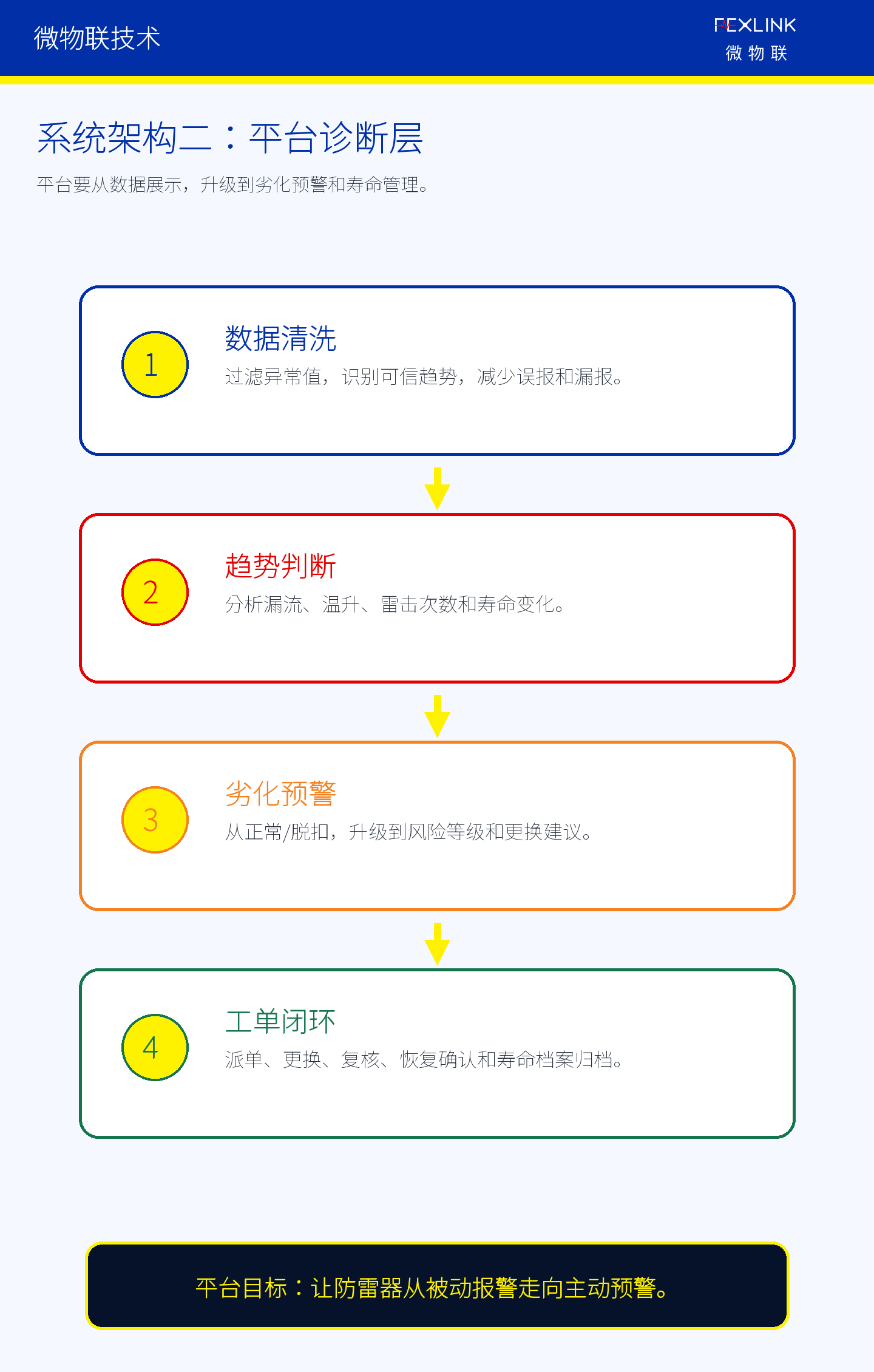
The fourth layer is the edge computing layer, including data cleaning, anomaly filtering, leakage trend analysis, temperature rise trend analysis, post-lightning status judgment, preliminary judgment of life trend and local alarm linkage. The fifth layer is the closed loop of platform diagnosis and operation and maintenance, including SPD status map, alarm classification, deterioration trend, life estimation, remote review, work order dispatch, replacement record, recovery confirmation and event files.
5. How is the SPD status linked to lightning current, grounding, and equipment alarms?
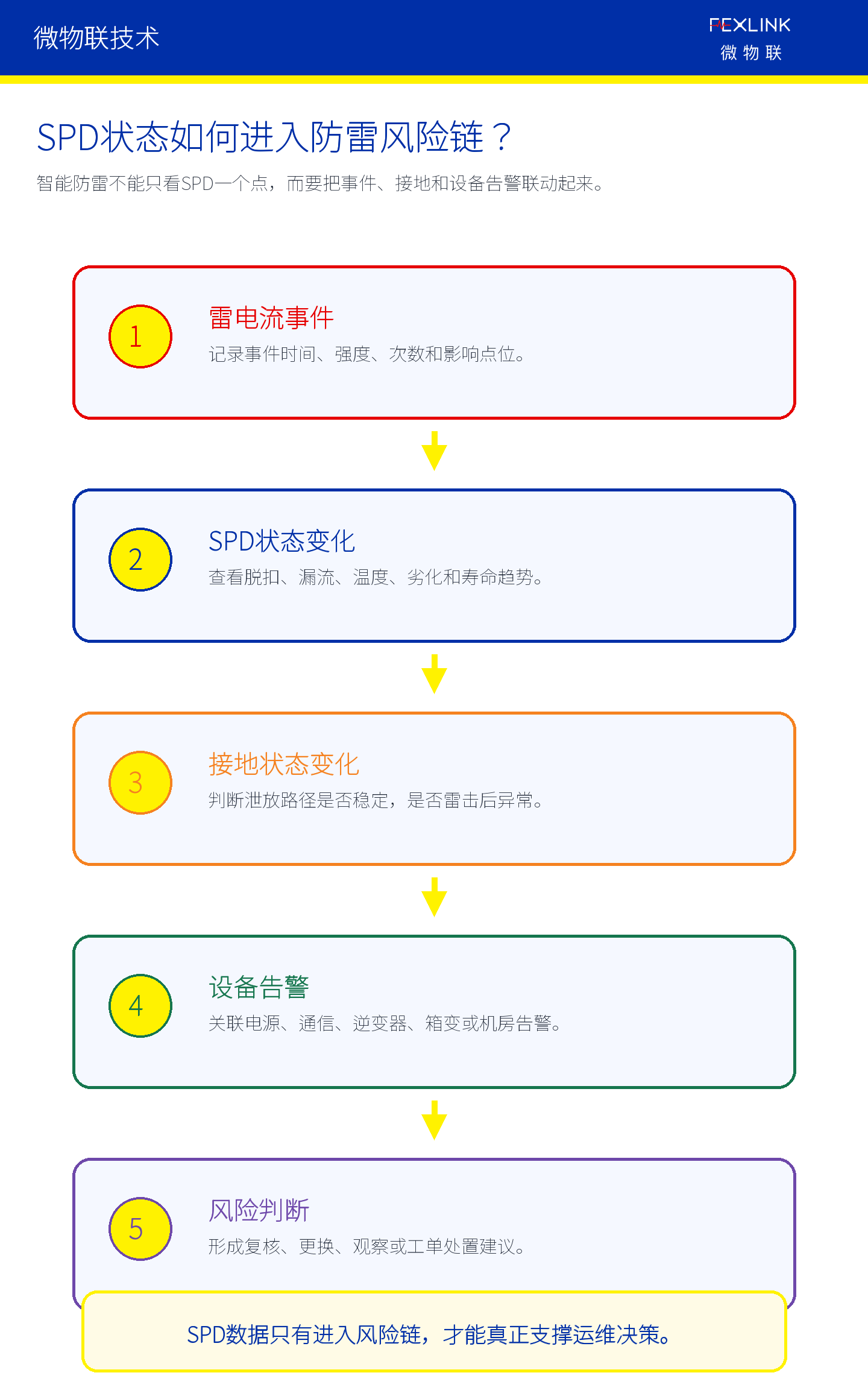
The intelligent lightning protection system cannot only look at one point of SPD. What is more valuable is to put the SPD status into the complete risk chain: lightning current events, SPD action or degradation, grounding status changes, equipment alarms and operation and maintenance review.
For example, if the SPD leakage current increases after a lightning strike, it may indicate that the SPD enters a state of deterioration after sustaining the impact, and requires focused review. The SPD temperature is abnormal and the grounding status fluctuates at the same time, which may indicate an abnormality in the on-site protection circuit or grounding discharge path. If the SPD trips and is accompanied by an alarm on key equipment, it is necessary to determine whether the protection has failed and arrange replacement and equipment review. If multiple small impacts lead to a downward trend in SPD life, it is appropriate to enter predictive maintenance instead of waiting until a trip occurs.
6. Which scenarios require SPD online monitoring most?
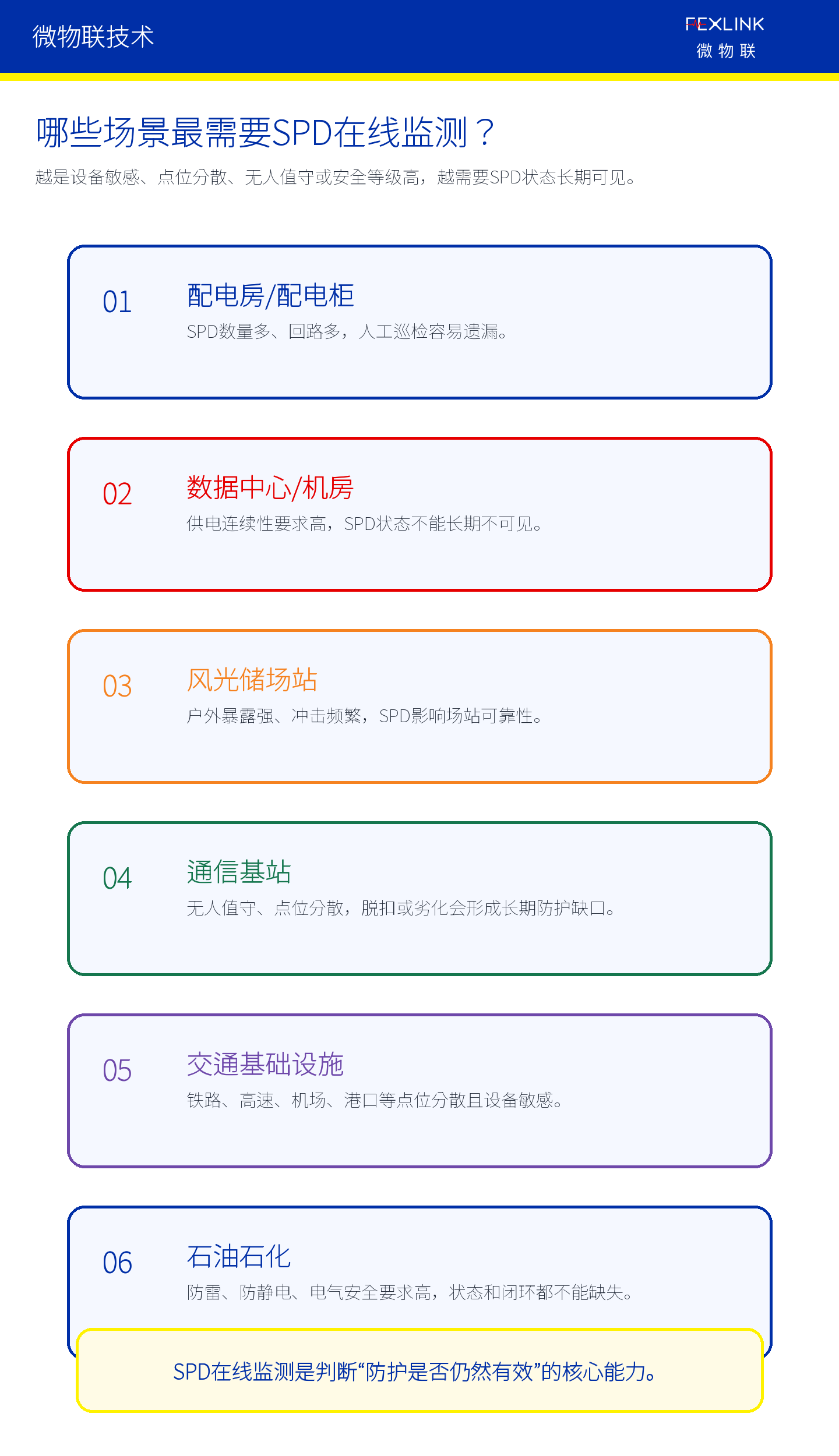
Power distribution rooms and power distribution cabinets require SPD online monitoring. Because there are many SPDs and many circuits, manual inspections are easy to miss. Data center and computer room equipment are sensitive and have high requirements for power supply continuity, so the SPD status cannot be invisible for a long time.
Wind power, photovoltaic and energy storage sites are subject to strong outdoor exposure and frequent impacts, and their SPD status will directly affect site reliability. The communication base station is unattended and the points are scattered. If SPD tripping or deterioration cannot be detected remotely, it will form a long-term protection gap.
Key infrastructure such as railways, highways, airports, and ports are dispersed, have sensitive equipment, and have high operation and maintenance costs, and require platform-based management. Petroleum, petrochemical and hazardous chemical sites have high requirements for lightning protection, anti-static and electrical safety. SPD status, grounding status and alarm closed loop cannot be invisible for a long time.
7. How does FEXLINK understand SPD online monitoring?
FEXLINK believes that SPD online monitoring is not about connecting a normal/fault remote signaling platform to a platform, but about transforming SPD from a passive protection device into an intelligent protection node that can continuously produce status data.
SPD online monitoring needs to complete three transformations: from tripping alarms to deterioration trends; from single point status to lightning protection links; from manual inspection to life prediction and closed-loop operation and maintenance. The value of FEXLINK is not only to show whether the SPD has tripped, but to put leakage current, temperature, number of lightning strikes, SPD life trend, lightning current events, grounding status and equipment alarms in the same risk chain, turning the lightning arrester from a device into a data node.
Conclusion: SPD installation is just the beginning, only when the status is visible is intelligent lightning protection
SPD is one of the most critical protective equipment in the intelligent lightning protection system, but it is not effective forever after it is installed. Installation is only the beginning of protection. Visible status, judgeable trends, traceable anomalies, and closed-loop processing are the real problems that digital lightning protection needs to solve.
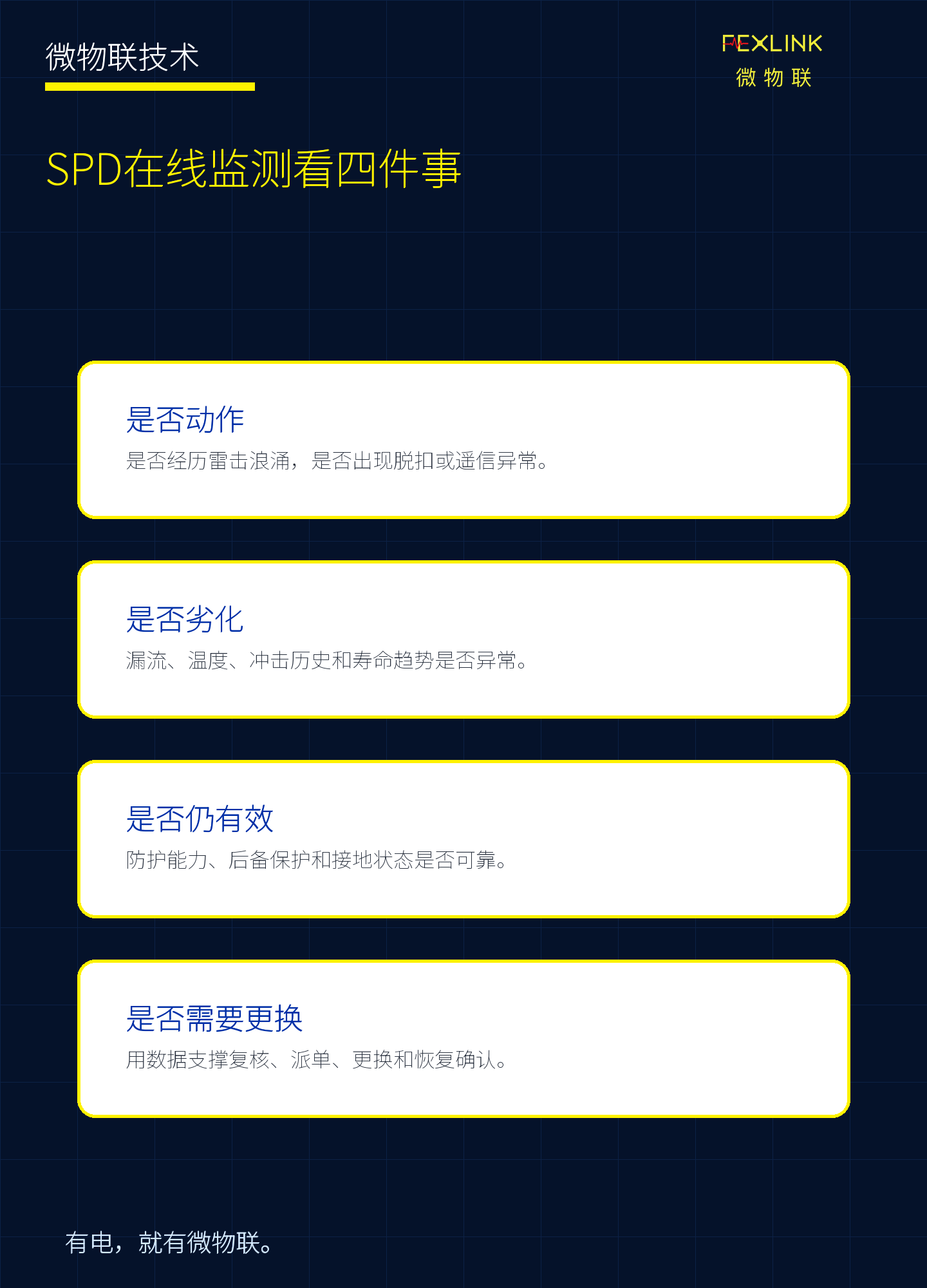
The truly valuable SPD online monitoring is not to move the red and green status to the platform, but to continuously answer four questions: whether the SPD is operating, whether it has deteriorated, whether it is still effective, and whether it needs to be replaced.
FEXLINK technology will continue to share content related to intelligent lightning protection, early warning of electrical safety, digital power distribution, energy supervision and industrial Internet of Things.
FEXLINK/FEXLINK uses data to reconstruct energy efficiency and electrical safety.
Where there is electricity, there is FEXLINK.