Abstract: Wind farms are typical high lightning exposure scenarios. The wind turbine blades are high, the tower metal structure is long, the nacelle equipment is complex, and the box-type transformer and booster station are responsible for power conversion and grid connection tasks. The impact of lightning strikes or surges may be transmitted along the blade lightning protection channel, tower, grounding system, power supply system, communication link, and box-type transformer/boost station equipment. The value of smart lightning protection in wind farms is not to simply display the number of lightning strikes, but to record lightning current events, determine SPD status, track grounding changes, correlate equipment alarms, and form a closed loop of predictive maintenance and work orders.
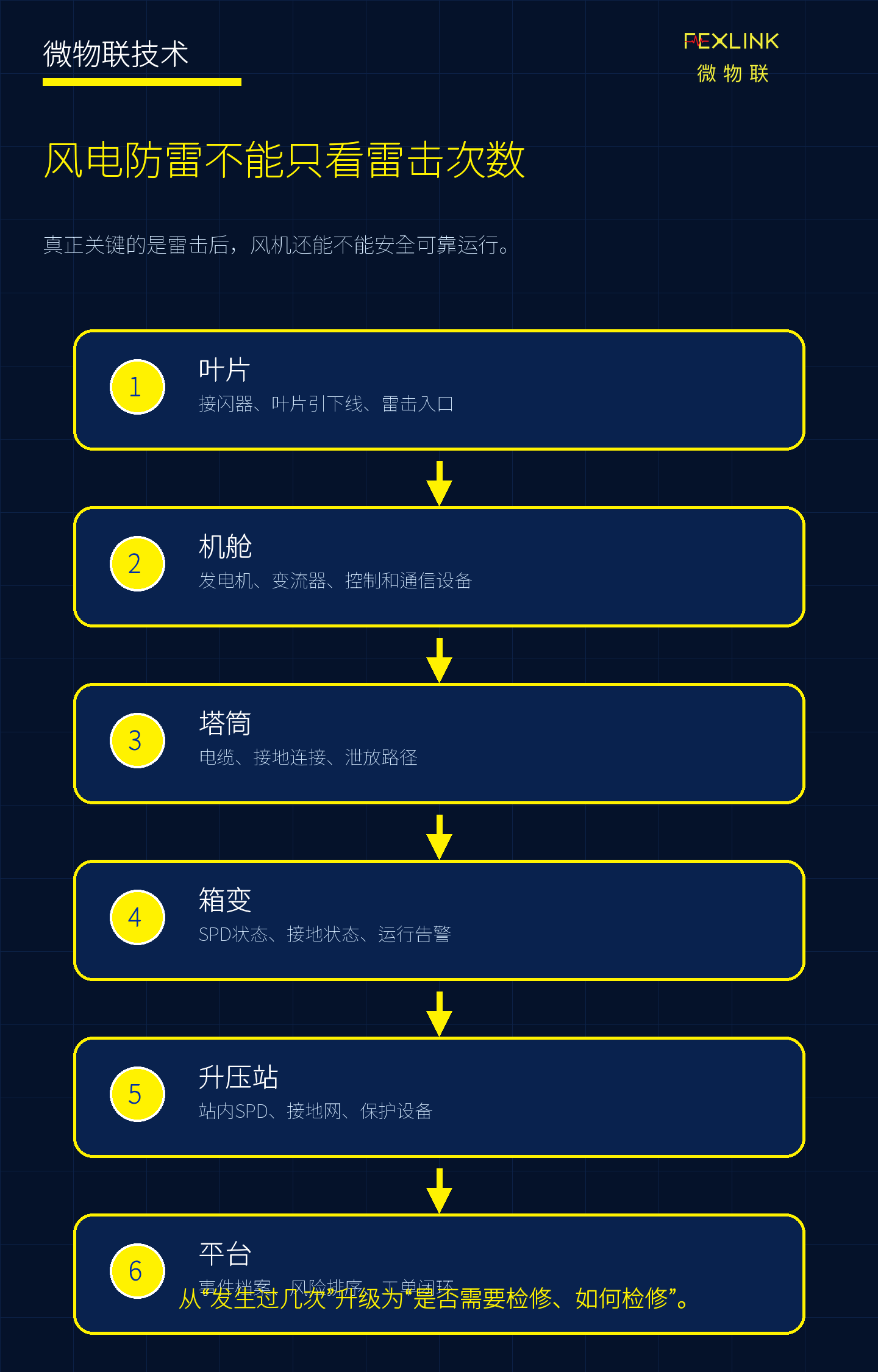
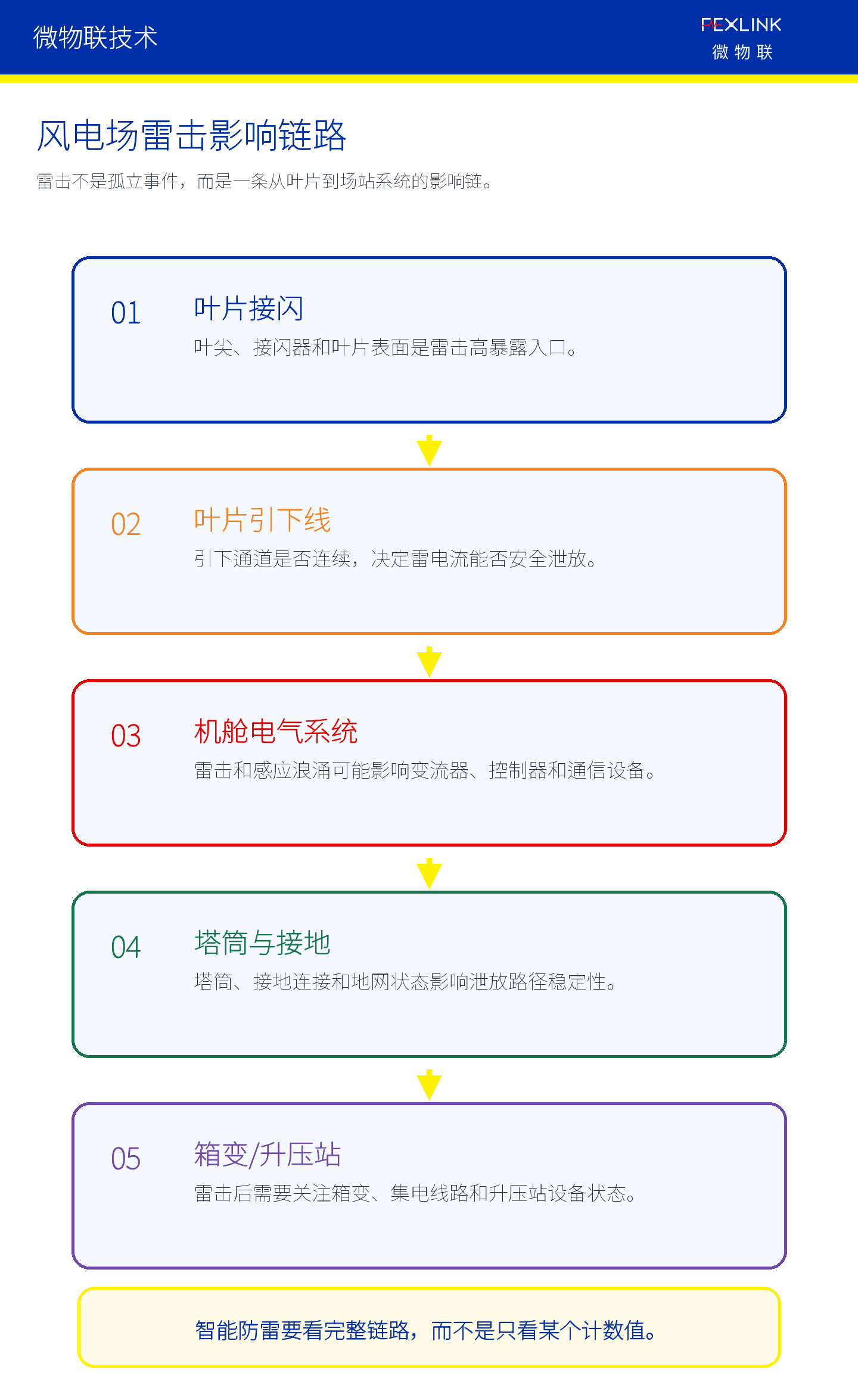
Wind turbines are naturally highly exposed objects to lightning strikes. The blades rotate at high altitude. There are generators, converters, control systems and communication equipment in the engine room. There are cables and ground connections in the tower. There are power distribution and control cabinets at the bottom of the tower. There are also box-type transformers, collector lines and booster stations in the field area. A lightning strike may not be a single point event, but a comprehensive impact chain from the blade to the tower, from the tower to the grounding grid, and from the electrical system to the communication system.
Therefore, the key to wind power lightning protection is not whether a lightning strike occurs, but whether the wind turbine can still operate safely and reliably after the lightning strike. It is difficult to support operation and maintenance decisions by only knowing "how many times it has been struck by lightning". Wind farms need to know which unit the lightning strike occurred, how strong it was, which paths were affected, whether the equipment status has changed, and whether maintenance is needed.
1. Why are wind farms a high-value scenario for intelligent lightning protection?
First, the height of the fan is high and the blades are strongly exposed. Wind turbines are usually located in open areas with high blade heights and large lightning exposure areas, making them highly exposed to lightning strikes. Lightning strikes may occur at the blade tip, blade surface, air-termination or downconductor channels, and may also affect the cabin electrical and communication systems by inducing surges.
Second, lightning strikes affect chain length. Wind turbine lightning protection is not a problem of a single air-termination, but a protection chain composed of blade air-termination, blade down conductor, hub/cabin, tower, grounding system, box-type transformer, booster station and communication system. Abnormal status of any one of these links may affect the lightning current discharge path.
Third, the equipment is of high value and downtime is costly. Wind turbine blades, nacelle equipment, converters, box-type transformers and booster station equipment have high value and high maintenance costs. Offshore wind power, mountain wind power, and remote wind farms have limited maintenance windows, and an unplanned outage may cause significant power generation losses.
Fourth, the points are scattered and manual inspection is difficult. Wind farms often have a large number of units and are widely distributed. It is difficult for manual inspection to quickly determine the status of each wind turbine after a thunderstorm. If there is no online monitoring, which units need to be inspected after a lightning strike can often only rely on experience.
2. What are the operational blind spots of traditional wind power lightning protection?
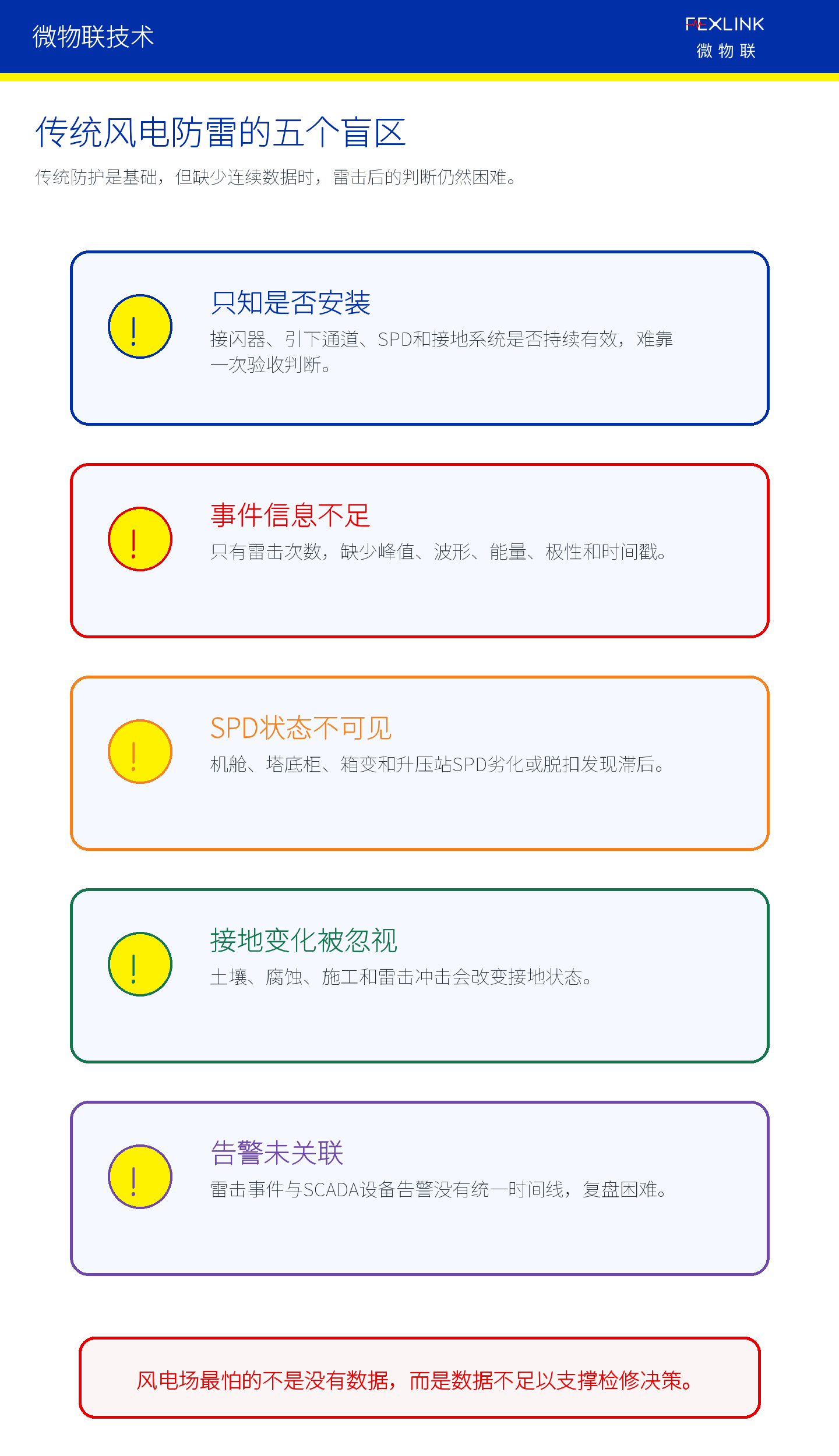
Traditional lightning protection is not without value. Wind turbines are usually designed with air terminals, blade down conductors, tower relief channels, grounding systems and SPDs. However, after being put into operation, it is difficult to judge whether these protective links will continue to be effective only by regular inspections.
The first blind spot is that we only know whether it is installed, but not whether it will continue to be effective. The air-termination system, downdraft channel, tower connection, box-type SPD and grounding system may age, loosen, corrode or deteriorate during long-term operation. However, if these conditions are not online, it will be difficult to continue to see them.
The second blind spot is the lack of information about lightning strikes. Many wind farms can know that a certain unit may be struck by lightning, but they do not necessarily know the lightning strike time, lightning current peak value, polarity, waveform characteristics, energy level, multiple impact conditions, and whether it affects SPD, grounding or equipment alarms.
The third blind spot is that the SPD status is not visible. Different levels of SPD may be configured in the wind turbine tower base cabinet, engine room cabinet, box-type transformer and booster station. Without online monitoring, SPD tripping, deterioration, abnormal leakage, abnormal temperature rise and abnormal backup protection are not easy to detect in time.
The fourth blind spot is that changes in grounding status are ignored. The wind turbine grounding system is affected by soil moisture, corrosion, construction disturbance, loose connections and aging of the ground grid. After a lightning strike, whether the grounding status changes is very important for subsequent risk judgment.
The fifth blind spot is that there is no correlation between lightning strike events and wind turbine equipment alarms. The wind turbine SCADA system may record inverter, temperature, vibration, communication, yaw, pitch and other alarms. If lightning event data is not associated with equipment alarms, it will be difficult to determine whether an anomaly is related to a lightning surge afterwards.
3. What objects should the wind farm intelligent lightning protection system monitor?
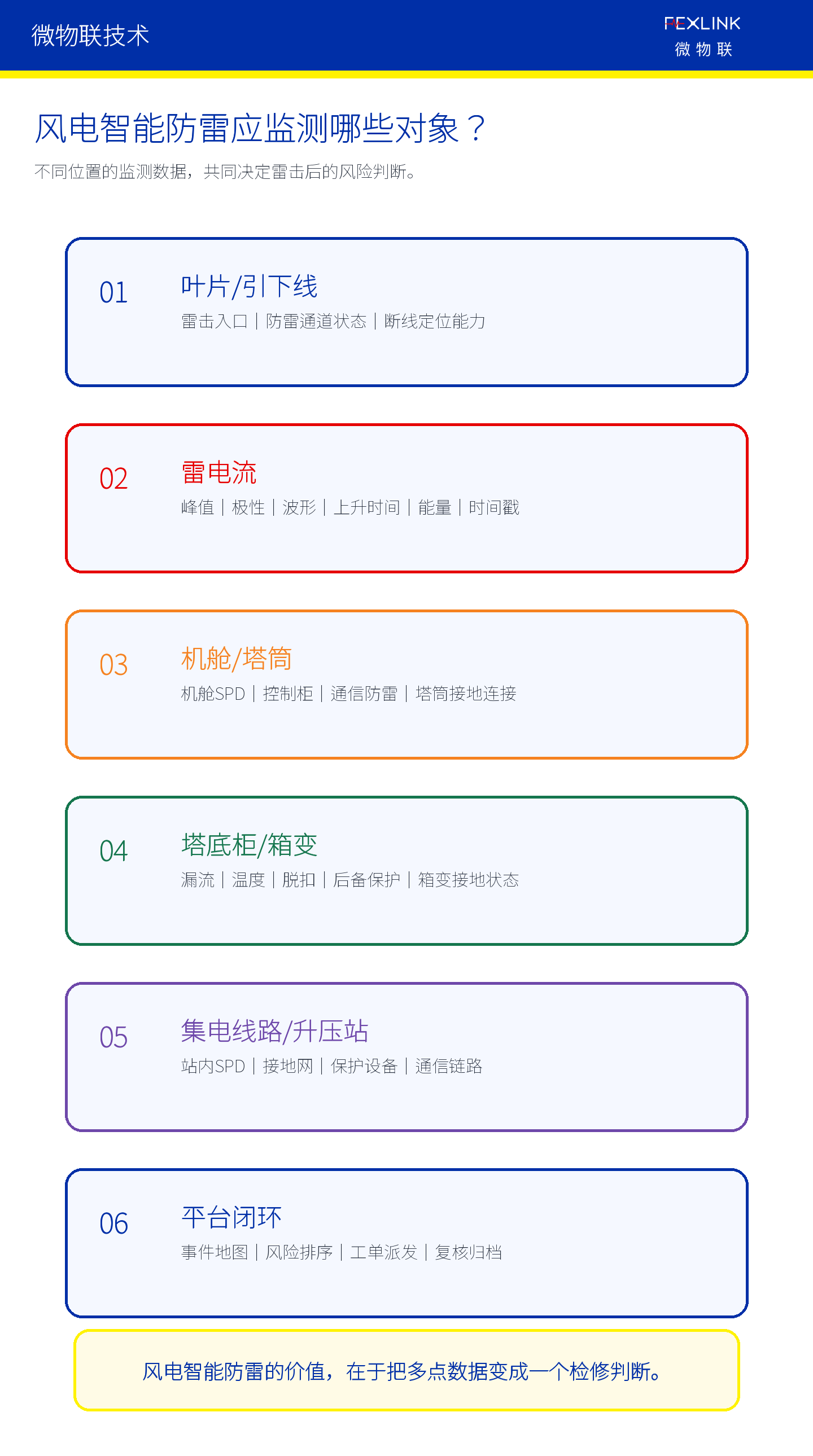
The first type of objects are blades and lightning/downconducting channels. Here you need to pay attention to the lightning event time, lightning intensity, lightning current peak, number of lightning strikes, blade lightning protection channel status, and in necessary scenarios, pay attention to blade down-conductor breakage and breakpoint location. The location of blade down-conductor breakage is a subdivided capability, but it is of high value in wind power intelligent lightning protection systems.
The second type of object is lightning current. Merely recording the number of times is not enough. Wind farms need to pay more attention to peak current, polarity, waveform, rise time, duration, charge amount, unit energy and event timestamp. Only when the event data is credible enough can subsequent maintenance judgments be based on it.
The third type of object is the engine room and tower electrical system, including the engine room SPD status, control cabinet SPD status, communication lightning protection status, cable and ground connection status in the tower, and equipment alarm correlation.
The fourth category of objects is tower base cabinets and box transformers, including power supply SPD status, leakage current, temperature, tripping, backup protection, status changes after lightning strikes/surges, and box transformer grounding status. The fifth category of objects is the collector line and booster station, including the SPD status in the station, the status of the grounding network, communication links, post-lightning protection equipment alarms, and the operating status of the booster station equipment. The sixth category of objects is the station platform and operation and maintenance closed loop, including multi-unit lightning strike event maps, ranking of units with high lightning strike incidence, SPD degradation trends, grounding anomaly trends, work order dispatch, maintenance and repair, event archiving and risk reports.
4. How to design the intelligent lightning protection system for wind farms?
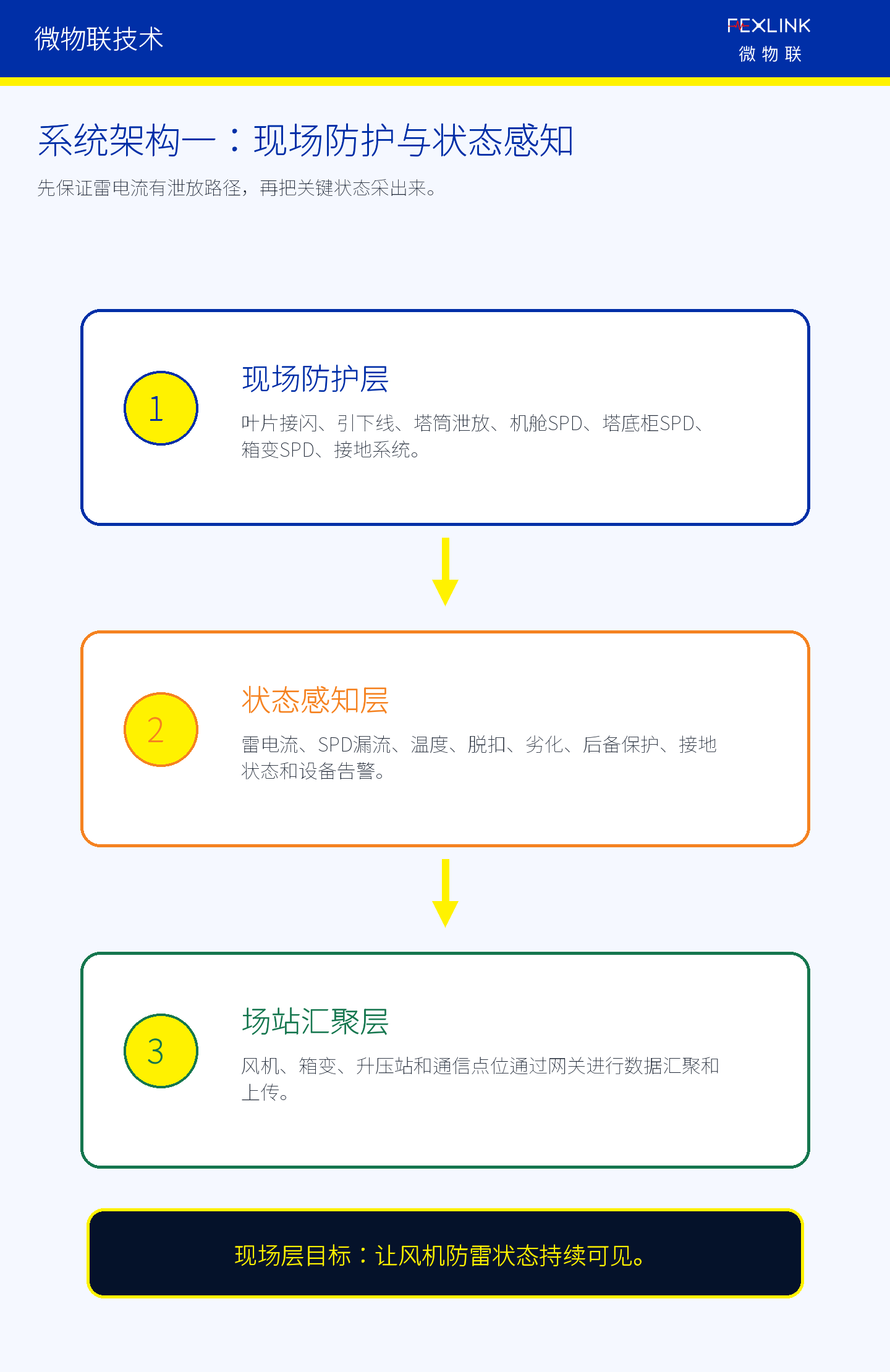
The first layer is the on-site protection layer, including blade lightning system, blade lightning protection downconductor, tower discharge channel, engine room SPD, tower base cabinet SPD, box transformer SPD, booster station SPD, grounding and equipotential connection. This layer solves the problem of whether the lightning current has a correct discharge path.
The second layer is the status awareness layer, including lightning current monitoring, SPD leakage current, SPD temperature, SPD tripping, SPD degradation, backup protection status, grounding resistance or grounding status, and equipment alarm collection. This layer solves the problem of whether the state is continuously visible. Products such as FS, FSS, FSP, FL, FR, and FG in the FEXLINK product system correspond to key capabilities such as SPD monitoring, intelligent SPD, transient current, ground resistance, and gateway aggregation.
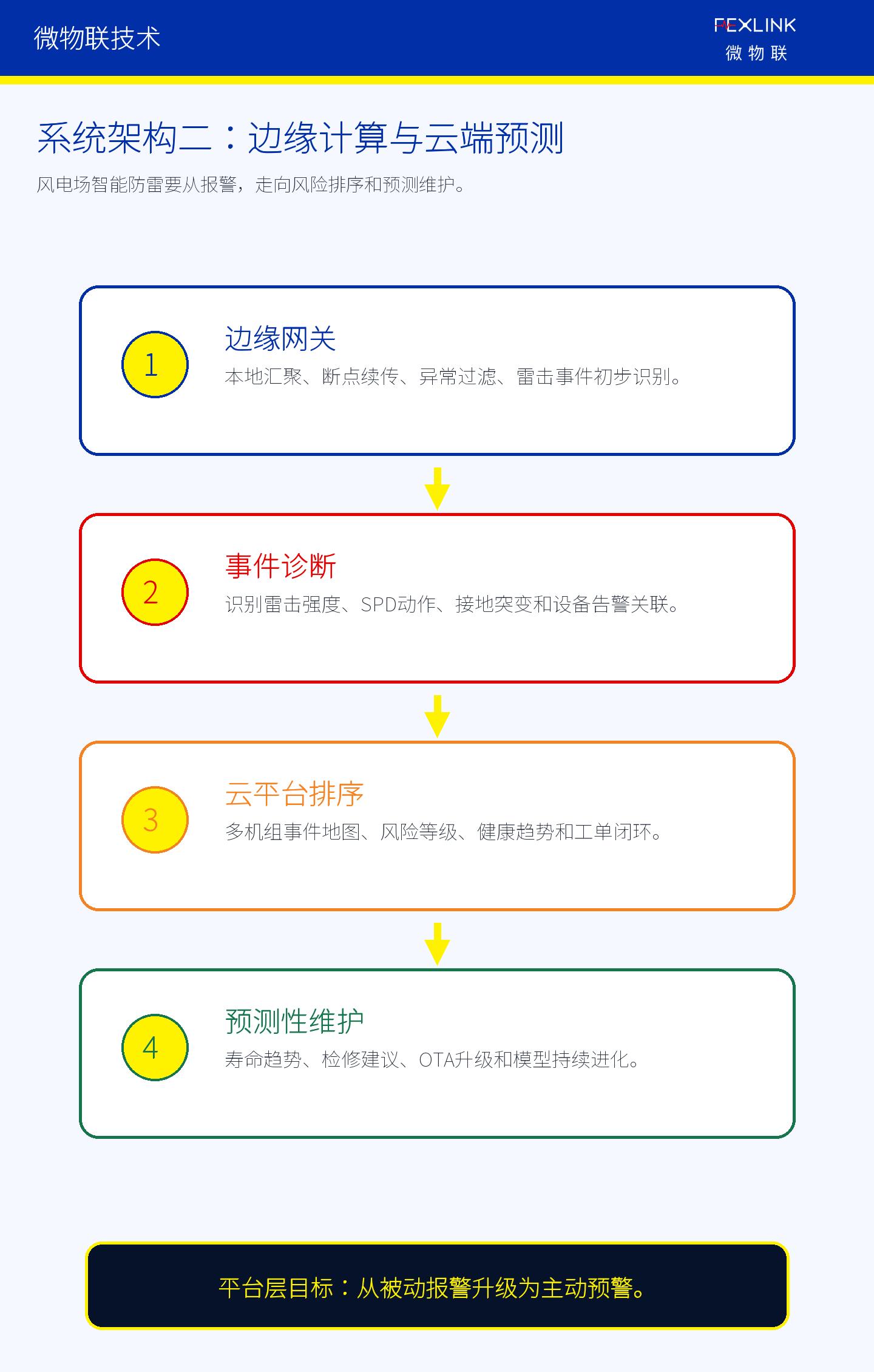
The third layer is the edge computing layer. Wind farms cannot just upload data to the cloud and then make judgments. Some judgments should be completed on the edge side, such as preliminary identification of lightning current events, abnormal data filtering, SPD degradation trend judgment, grounding mutation identification, communication breakpoint resumption and local alarm linkage.
The fourth layer is the cloud platform diagnostic layer. What the platform needs to do is not only display data, but also form judgments: which wind turbine suffered a lightning strike, what level the lightning strike intensity is, whether the SPD operates or deteriorates, whether the grounding status is abnormal, whether shutdown inspection is required, whether special blade inspection is required, whether the lightning arrester needs to be replaced, and whether the grounding needs to be retested.
The fifth layer is predictive maintenance and algorithm upgrades. The advanced value of intelligent lightning protection in wind farms is from alarm to prediction. The combination of multiple small impacts, rising SPD leakage current, abnormal temperature rise, and worsening grounding tendency may mean that the lightning protection health of a certain unit or box-type transformer is declining.
5. What is the key value of intelligent lightning protection in wind farms?
First, lightning strikes can be traced. Intelligent lightning protection does not only know "it was struck by lightning", but also knows which wind turbine, when, how strong it is, whether it has been impacted multiple times, whether it affects SPD, whether it affects grounding, and whether it is associated with equipment alarms.
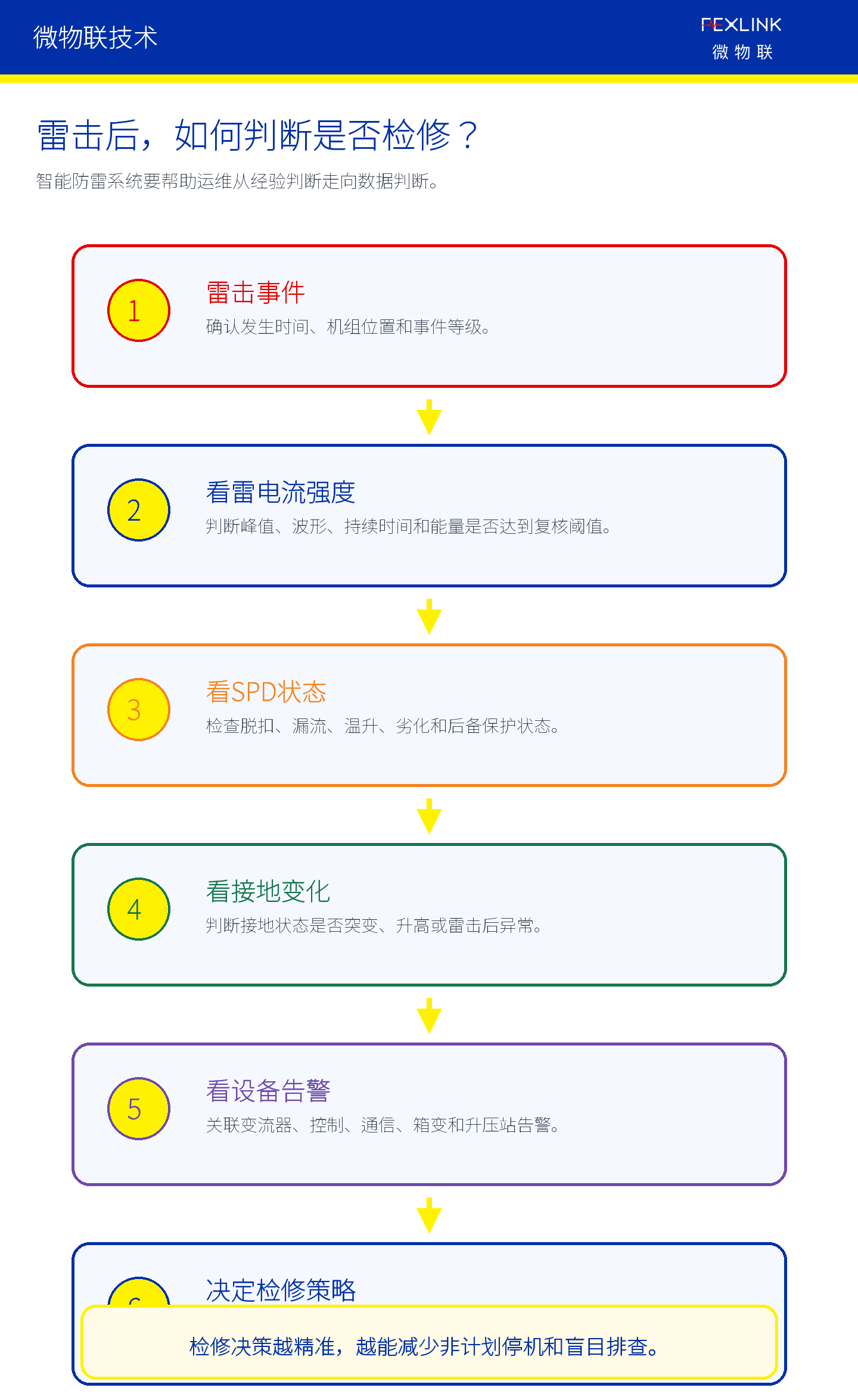
Second, maintenance decisions are more accurate. After a lightning strike, not all units are shut down immediately for inspection, nor are they completely ignored. The system should help determine which units must be reviewed first, which units need blade inspection, which units only need to observe trends, which SPDs need to be replaced, and which grounding systems need to be retested.
Third, reduce unplanned downtime. Through the joint judgment of lightning strike events, SPD status, grounding changes and equipment alarms, blind troubleshooting and subsequent fault expansion can be reduced.
Fourth, extend the life of protective equipment. By judging the SPD leakage, temperature, impact history and life trend, you can avoid replacing it when it is broken or replacing it in advance unnecessarily.
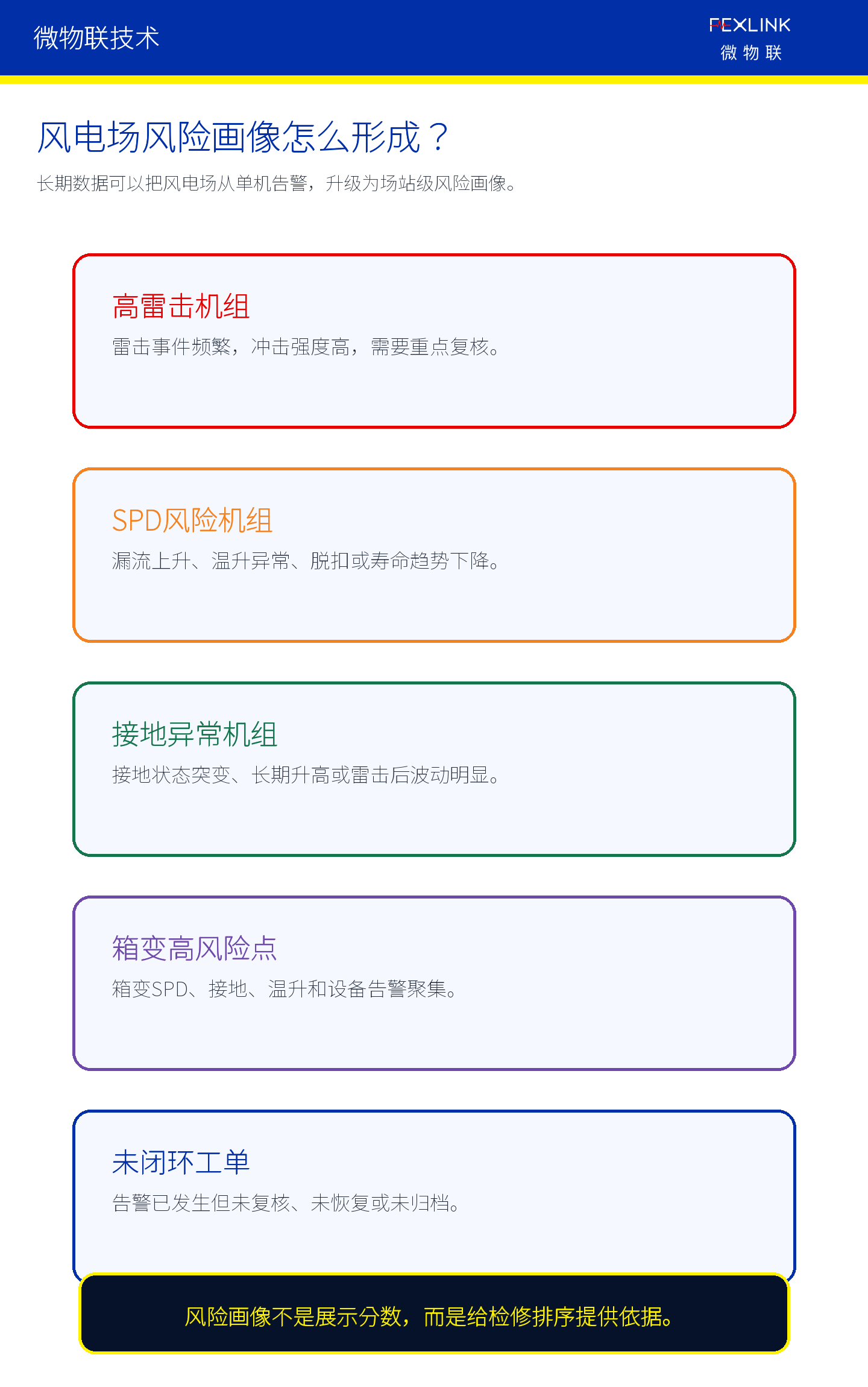
Fifth, form a healthy portrait of lightning protection at the site level. Wind farms can form units with high lightning strike risk, units with SPD risk, units with abnormal grounding, high-risk points of box-type transformers, key risks of booster stations and unclosed-loop work orders, providing a basis for maintenance sequencing.
6. How does FEXLINK understand intelligent lightning protection in wind farms?
FEXLINK believes that smart lightning protection for wind farms is not about adding a lightning strike counter to the wind turbine, nor is it simply connecting SPD to the platform, but about making the lightning current, SPD, grounding, electrical equipment and operation and maintenance of the wind farm form a risk identification system for sustainable production data.
Intelligent lightning protection for wind power needs to complete three transformations: from lightning strike counting to lightning current event diagnosis; from stand-alone protection to station-level risk portraits; from post-failure maintenance to predictive maintenance and algorithm evolution. The value of FEXLINK lies in producing risk evidence through data such as lightning current, SPD leakage current, temperature, grounding status, etc., completing local aggregation, breakpoint resuming and preliminary judgment through edge gateways, completing multi-unit risk ranking, intelligent alarm and closed-loop operation and maintenance through the cloud platform, and through model iteration, allowing the lightning protection system to move from passive alarm to active early warning.
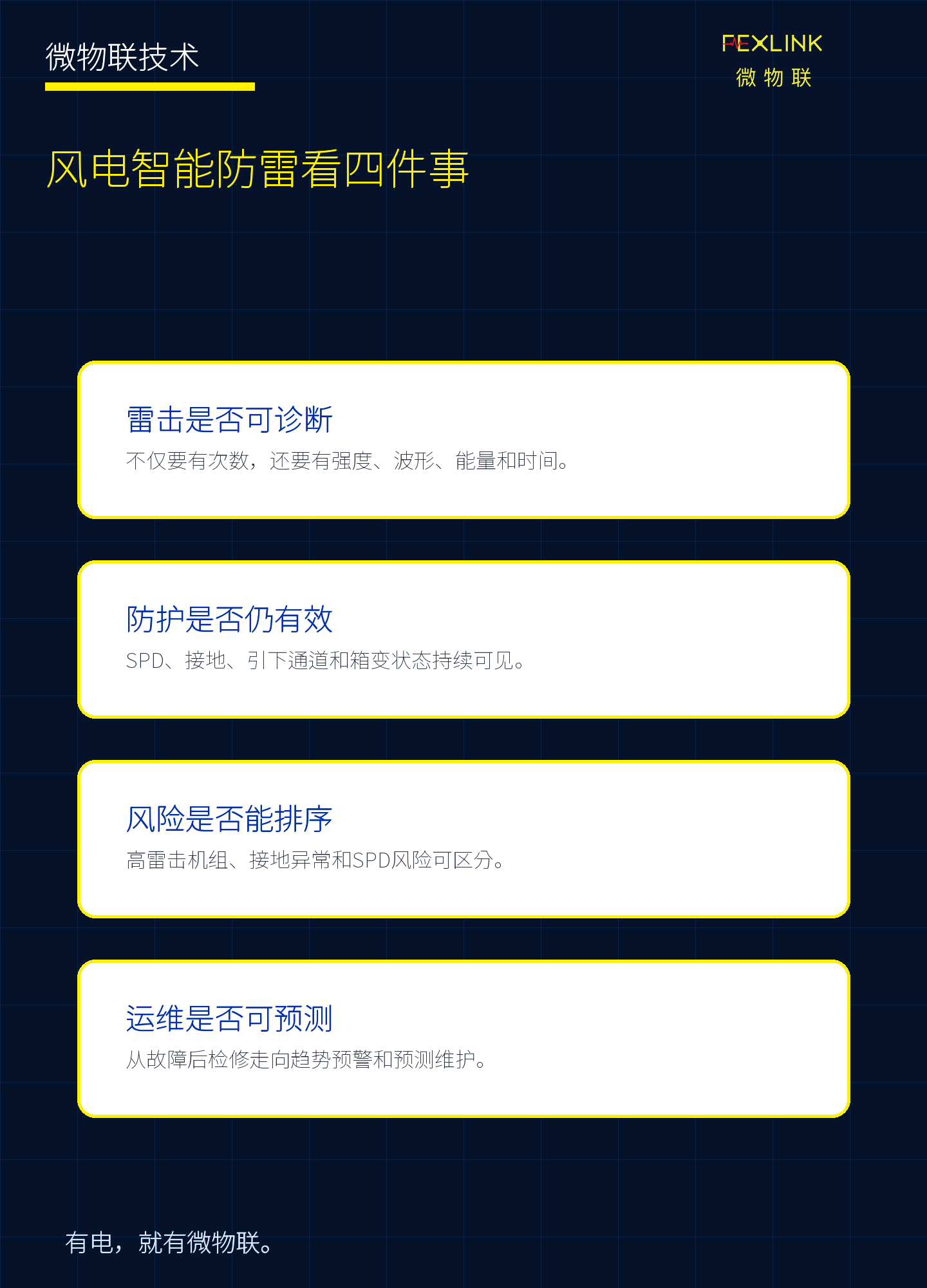
Conclusion: Wind power lightning protection upgrade is moving from experience operation and maintenance to data operation and maintenance.
The essence of wind farm lightning protection upgrade is not to install more equipment, but to turn the lightning protection status of wind turbines, box-type transformers, booster stations and grounding systems into data for sustainable analysis. For wind farms with high value, high exposure, and high maintenance costs, the significance of intelligent lightning protection systems is to make lightning strike events traceable, to allow protection status to be judged, to make maintenance decisions more accurate, and to allow station operation and maintenance to move from experience-driven to data-driven.
The truly valuable wind power intelligent lightning protection does not display the number of lightning strikes, but organizes lightning current, SPD, grounding, equipment alarms and operation and maintenance disposal into a complete risk evidence chain.
FEXLINK technology will continue to share content related to intelligent lightning protection, early warning of electrical safety, digital power distribution, energy supervision and industrial Internet of Things.
FEXLINK/FEXLINK uses data to reconstruct energy efficiency and electrical safety.
Where there is electricity, there is FEXLINK.